Simple Booth vs Touchpix: Which Photo Booth Software Fits Your Business in 2026?

Choosing between Simple Booth and Touchpix for your photo booth business often comes down to five questions:
- Do you need an integrated hardware-and-software system, or a cross-platform app that runs on equipment you already own?
- Is your focus on traditional photo booths and branded marketing activations, or do you need 360-degree spinning booth support?
- Do you value a turnkey experience with minimal setup, or format versatility across capture modes?
- Are you primarily running iPad-based booths, or do you need to deploy on Android, Windows, and Linux devices too?
- Is lead capture and first-party data collection a priority, or are you focused on delivering the widest range of photo and video formats?
In short, here’s what we recommend:
Touchpix is the cross-platform workhorse for event professionals who need one subscription to cover every booth format.
With native support for iOS, Android, macOS, Windows, Linux, and Raspberry Pi, six capture modes, and the industry’s dominant 360-degree booth integration, it gives operators the widest hardware and format flexibility in the category.
The Scanpix 2 offline sharing system handles media delivery without Wi-Fi, and the AI Photo Booth offers 80+ transformation styles with custom prompt support.
However, the platform only launched in 2020 and is still maturing. Operators report stability issues during live events, slow image and video rendering, and a recent major cloud outage. The entry-level PhotoPass plan at $439.90/year (starting at $39.99/week) limits you to 2 active events with photos only.
Simple Booth pairs proprietary HALO ring-light hardware with an iPad app and cloud dashboard, built on over a decade of development since 2012.
Its precision-machined aluminum chassis with 112 LEDs producing up to 2,100 lumens delivers consistent studio-grade lighting that standalone ring lights and plastic enclosures can’t match.
Where Touchpix emphasizes format breadth, Simple Booth emphasizes depth in branded experiences and data capture, with opt-in rates as high as 87 to 89% and tools like the Layout Designer, wired and wireless DSLR camera support, and a Virtual Booth for hardware-free activations.
HALO runs on iPad, and pricing starts at just $14.99/week for the Lite tier, making it one of the most accessible professional photo booth apps on the market.
Both platforms serve professional event operators, but they’re built around different philosophies: Touchpix maximizes format and platform coverage, while Simple Booth maximizes photo quality and marketing value per session.
Simple Booth vs Touchpix at a glance
| Touchpix | Simple Booth | |
|---|---|---|
| Core Philosophy | All-in-one cross-platform booth software | Integrated hardware + software system |
| Platform Support | iOS, Android, macOS, Windows, Linux, Raspberry Pi | iPad only |
| 360° Booth Support | Native Bluetooth trigger integration | Not available |
| Capture Modes | 6 (Photo, AI, Boomerang, Video, GIF, Slomo) | 6 (Photo, Photo Strip, Custom Layout, GIF, Rebound, Video) |
| DSLR/Mirrorless Support | Canon, Nikon, Sony (wired) | Canon, wired + wireless (Core plan and above) |
| Proprietary Hardware | None (hardware-agnostic) | HALO ring-light kits (machined aluminum) |
| Offline Sharing | Scanpix 2 (QR code, no internet) | Offline upload queue (delivers when connected) |
| AI Effects | 80+ styles, custom prompts, offline face replacement | AI Effects (Nano Banana), custom prompts, guest input variables |
| Lead Capture | Advanced Surveys (MultiPass Pro+) | Built-in data capture with 87%+ opt-in rate (Pro+) |
| Starting Price | $439.90/year (PhotoPass, 2 events) | $290/year (Lite, 1 device, ads included) |
| Best For | 360 booth operators, multi-platform deployments | iPad-based rental companies, unattended/drop-off events, brand marketers |
The core difference: Platform breadth vs integrated quality
The split between these platforms reflects two different answers to the same question: what does a photo booth operator need most?
Touchpix answers with versatility. Built by Martin Modderkolk, a Dutch photo booth rental operator who created the software to control his own hardware, the platform grew to cover every common booth format in a single subscription.
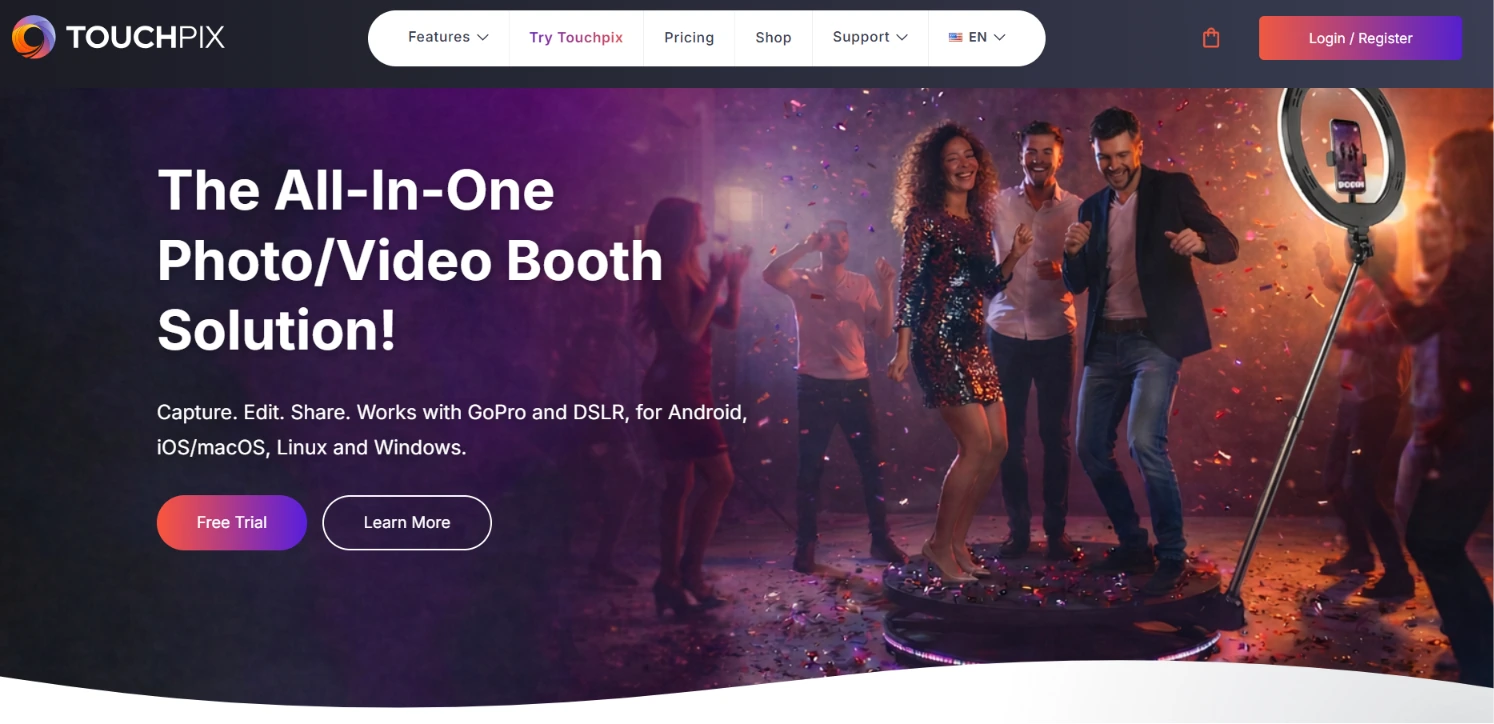
One license handles 360-degree spinning booths, traditional DSLR setups, mirror booths, open-air iPad stations, and AI-transformed experiences across six operating systems.
The logic is simple: operators shouldn’t need separate software for each booth type, and they shouldn’t be forced to buy specific hardware to run it.
Simple Booth answers with integration. In development since 2012, it was co-founded by Mark Hennings, a wedding videographer who taught himself app development, and Jeremy Cox, an Austin-based DJ who built the first HALO hardware prototype.
The company designs hardware, software, and cloud services as a single system. The HALO chassis is engineered from a single billet of anodized aluminum with a patented ring-light system, and the iPad app is built specifically to take advantage of it.
The logic: controlling the full stack produces a more polished, reliable experience than assembling components from different vendors. That maturity shows in the numbers: over 30,000 customers, 40 million moments captured, and a 4.7-star App Store rating.
Touchpix launched in 2020 and grew quickly on the strength of its 360-booth focus, but hasn’t had as much time to build that same depth of platform stability. This philosophical difference (and the experience gap between a platform with 14 years of development and one with 6) shapes every downstream decision from pricing structure to feature priorities to who each platform serves best.
Touchpix dominates 360-degree and multi-format booths
Touchpix built its reputation on 360-degree spinning video booths, and it remains the self-described “leading 360 photo booth app” in the category.
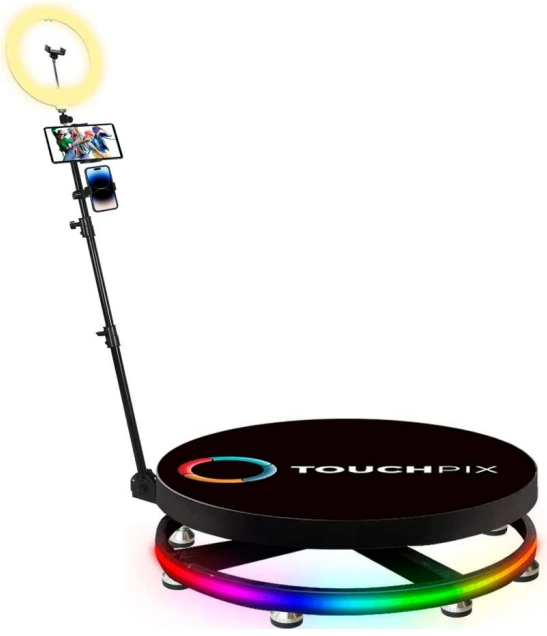 *Source: [Manuals.plus](https://manuals.plus/touchpix/360-photo-booth-automatic-slow-motion-video-manual)*
 Its Bluetooth integration triggers the spinning platform automatically, and its wired GoPro support (models 7 to 14) gives operators a reliable connection to the cameras most commonly mounted on spinning arms.
For operators whose business depends on 360 booths, Touchpix is the default choice.
The platform’s format range extends well beyond 360. Six capture modes (still photos, AI photos, boomerangs, video, animated GIFs, and slow-motion video) run from the same app, so an operator can offer a 360 booth at a corporate gala on Friday and a traditional photo booth at a wedding on Saturday without switching software.
The Mirror Booth module adds another format entirely, with interactive touchscreen workflows for upscale events.
Cross-platform support amplifies this versatility. Running on iOS, Android, macOS, Windows, Linux, and Raspberry Pi with unlimited devices per account means operators can deploy whatever hardware fits the event.
An iPad for a roaming photographer, a Windows PC for a mirror booth, a Mac for a DSLR station, all under one subscription.
This breadth does come with complexity. The interface serves many formats and platforms, which means more settings to configure and navigation that can confuse new users.
Practitioners report a steeper learning curve for operators who want to use the full feature set, and the complexity can make unattended operation less reliable since guests may struggle without an attendant.
The weekly Masterclass webinar series and 17 tutorial videos help bridge that gap, though the guest-facing experience remains less streamlined.
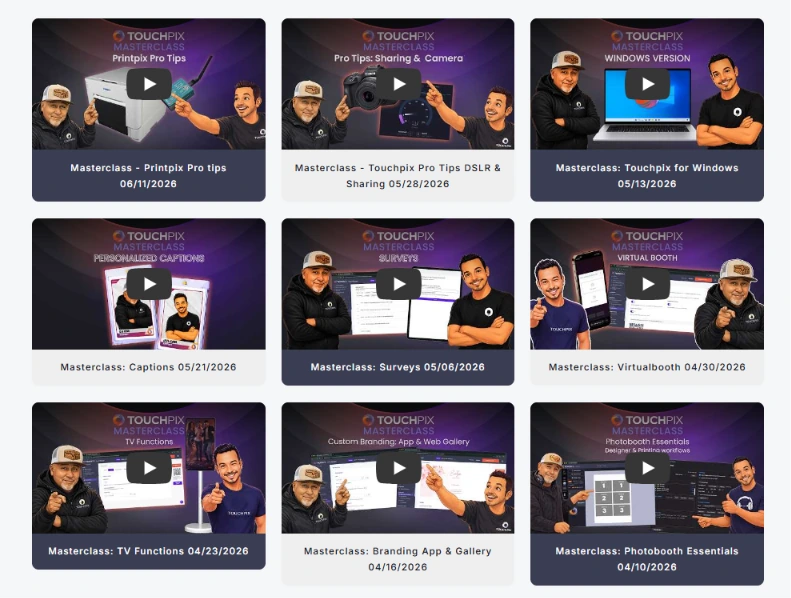
Source: Touchpix
Simple Booth excels at branded experiences
Simple Booth doesn’t try to cover every booth format. Instead, it goes deep on making iPad-based photo experiences look and perform at a level typically associated with more expensive setups.
The HALO hardware is the clearest expression of this approach. Its 112 high-end LEDs producing up to 2,100 lumens with a refined diffuser deliver flattering, even illumination for groups standing 6 to 8 feet from the camera.
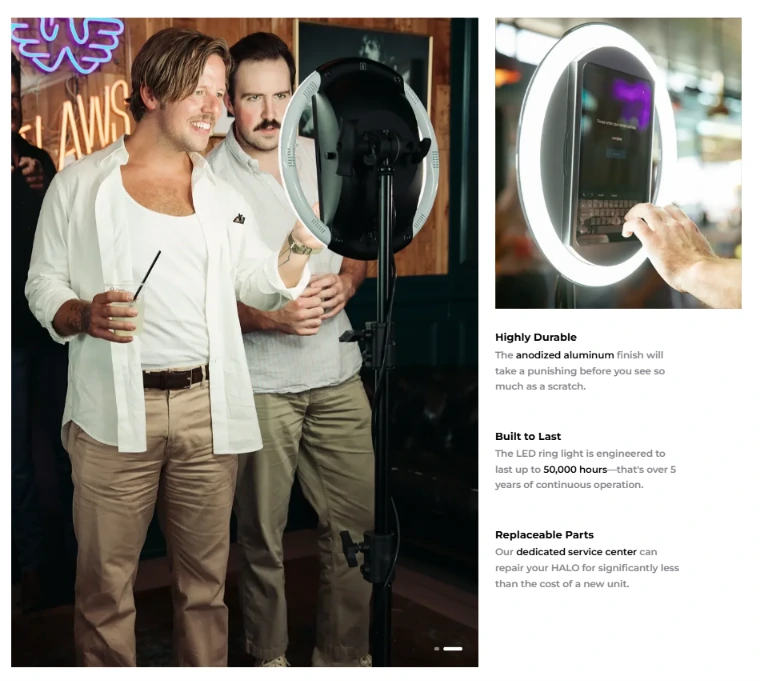
Source: Simple Booth
The LEDs are rated for up to 50,000 hours of operation, and the machined aluminum body resists the scratches and dents that plastic enclosures accumulate over months of transport.
Setup takes under one minute with a tool-less faceplate and a concealed USB-C cable that keeps the iPad charged throughout the event.
The software layer extends the iPad’s native camera beyond what you’d expect. DSLR-quality background blur and bokeh, Glam skin smoothing, and AI background replacement without a green screen all process on-device.
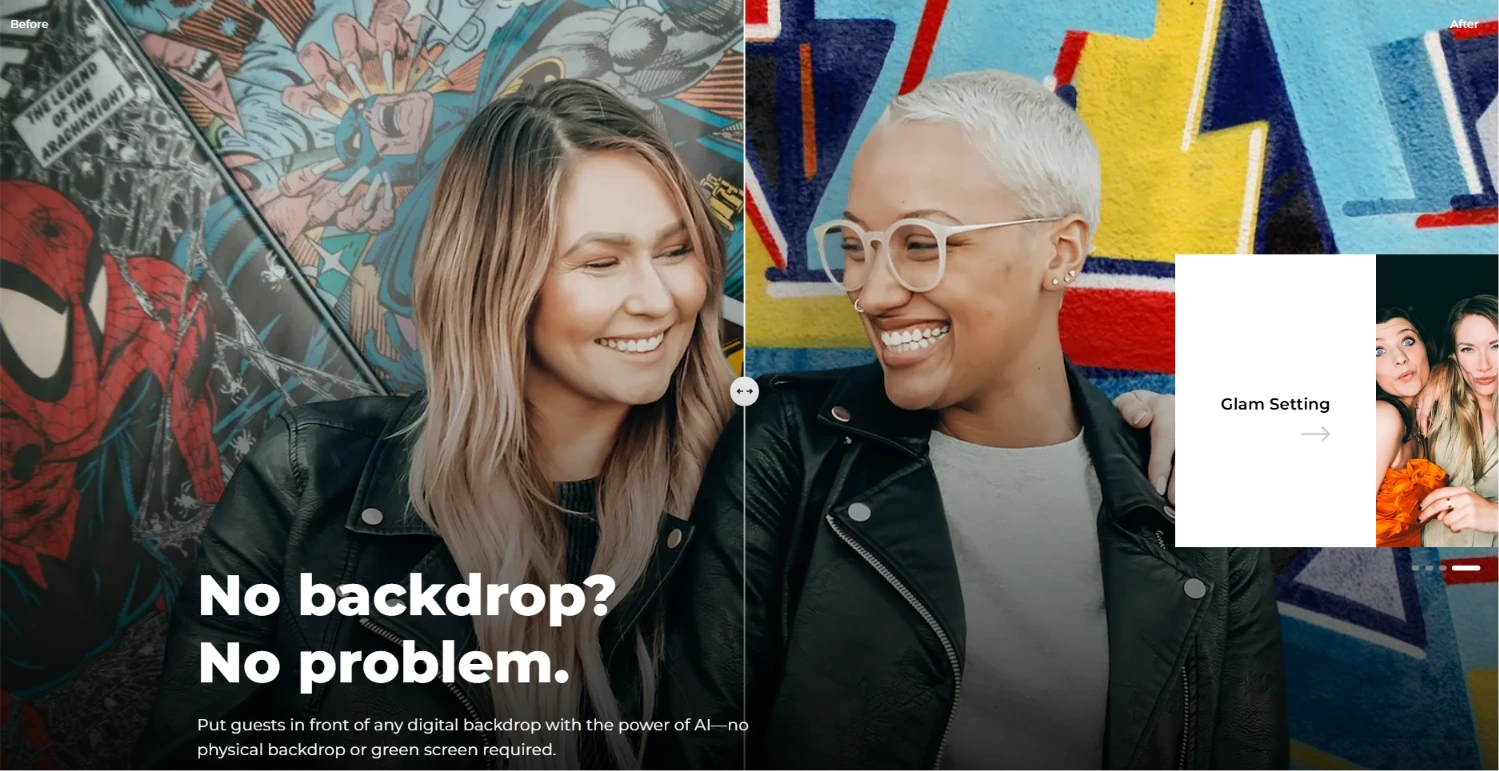
Source: Simple Booth
DSLR and mirrorless camera integration supports both wired USB and wireless Wi-Fi connections, a differentiator most competitors don’t offer. Image previews appear up to 12x faster thanks to optimized rendering, so guests see their photos instantly rather than waiting.
HALO 5.0 introduced the Layout Designer, a full in-app design tool with layers, fonts, gradients, QR code embedding, and multi-layout support that eliminates the need for external graphic design software. Simple Booth positions it as “the most powerful design tool in the photo booth industry”.
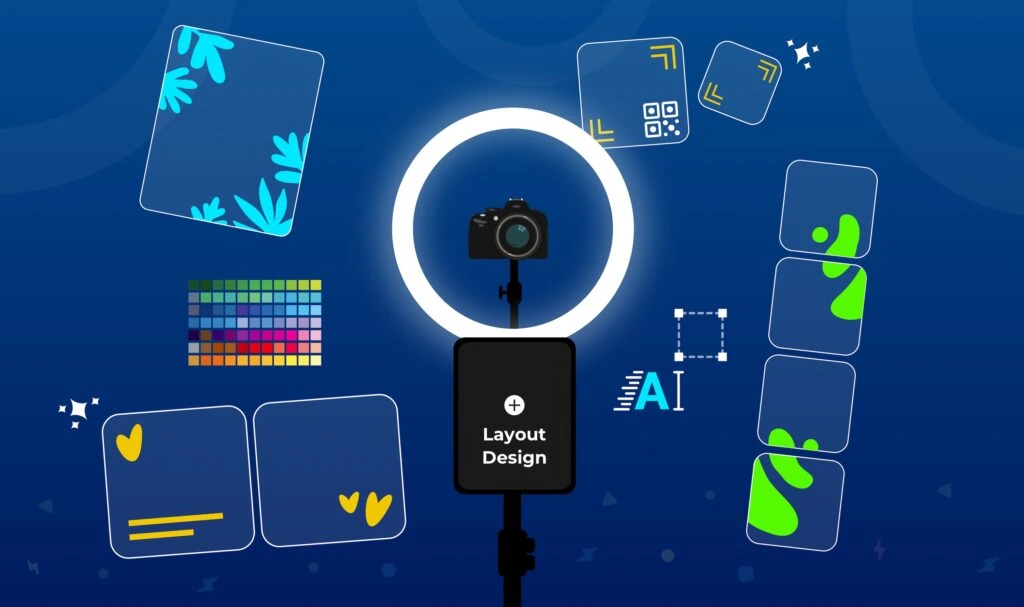
Source: Simple Booth
Simple Booth’s features work together without friction. Filters, Glam, and background blur all work with video. Live Feed respects individual upload privacy settings. Every effect functions in offline mode and with DSLR integration.
Operators don’t have to navigate a complex set of rules to figure out which settings can be combined, a common frustration with competing platforms.
This design also makes Simple Booth ideal for unattended selfie stands and drop-off events, where rental companies leave equipment at a venue and return to pick it up later.
The guest-facing interface is intuitive enough that attendees don’t need an attendant, and the platform’s stability means it can run continuously without issues.
For growing rental companies, this translates into an operational advantage: training new staff is smooth since the platform is intuitive and easy to learn.
For brand marketers and experiential agencies, this depth matters. Custom-branded overlays, guest-editable text layers where participants type captions directly onto their photo, and per-frame AI prompt assignment for multi-frame layouts create outputs that look deliberate and on-brand rather than generic.
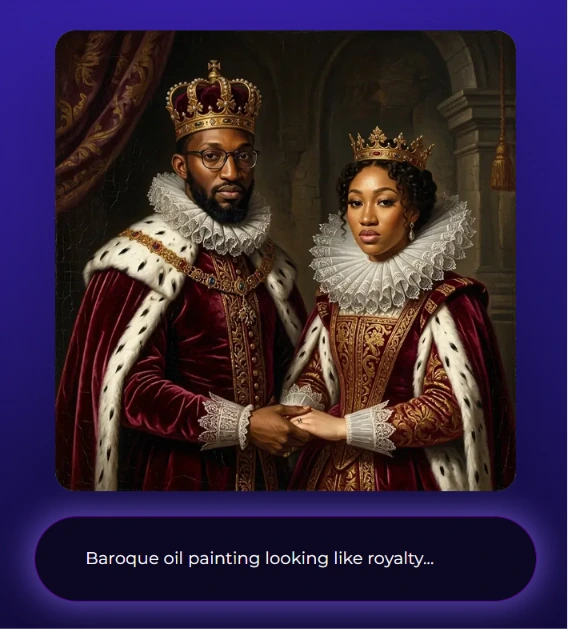
Source: Simple Booth
G7 Entertainment Marketing has used Simple Booth for 10+ years, generating 136,000+ fan interactions across their activations. (Simple Booth)
Offline capabilities and event reliability
Both platforms address the reality that event venues often have unreliable internet, but they take different approaches.
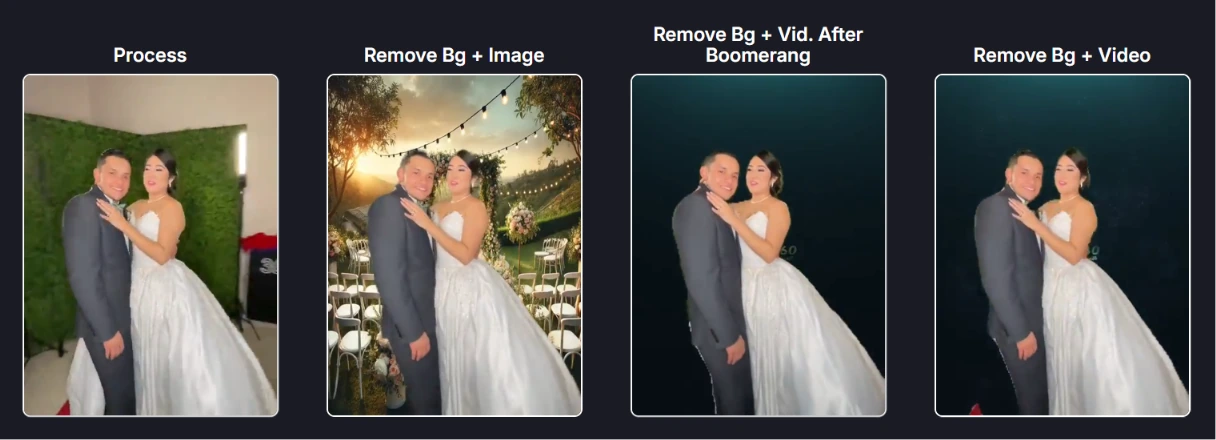
Touchpix’s Scanpix 2 is a fully offline QR-code sharing system that delivers media to guests without any internet connection, on both iOS and Android.
The guest scans the code and receives their photo or video locally. Beyond sharing, Touchpix runs AI Face Replacement and background removal entirely on-device, so these effects work at venues with zero connectivity. An offline queue holds cloud uploads and delivers them when the connection returns.
Source: Touchpix
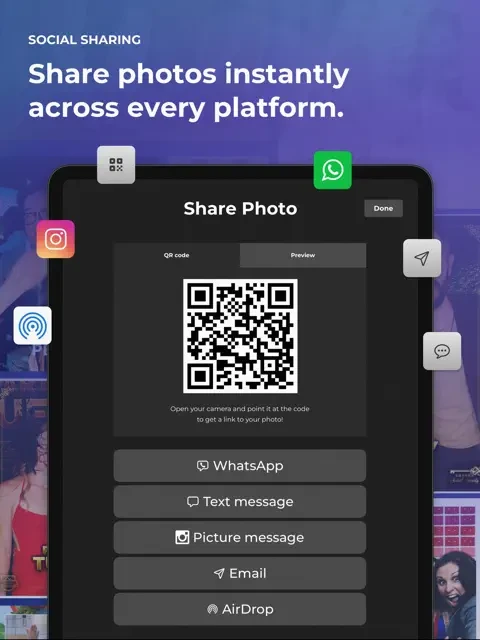
Simple Booth’s offline upload queue stores sessions when connectivity drops and delivers them automatically once Wi-Fi returns, prioritizing stability for unattended operations.
HALO 5.0 added WhatsApp delivery and AirDrop as alternatives to SMS and email, giving operators options when carrier coverage is poor.
Source: Simple Booth
On reliability, the platforms diverge more sharply. Touchpix experienced a significant cloud service outage, and App Store reviews report the app freezing mid-edit and force-closing during live events, with GoPro connections dropping after periods of inactivity. Captured images and videos can be slow to render, creating wait times for guests.
Simple Booth’s longer development history since 2012 gives it contingencies for handling the many things that go wrong at events.
Some App Store reviews note bugs after software updates, but the platform’s maturity and active support team help resolve issues quickly.
Both platforms respond to negative reviews with troubleshooting guidance, but for operators charging per-event, platform stability is a serious consideration, and Simple Booth’s decade-plus track record provides more confidence.
AI photo features compared
Both platforms have invested in AI-powered photo transformations, but their implementations differ.
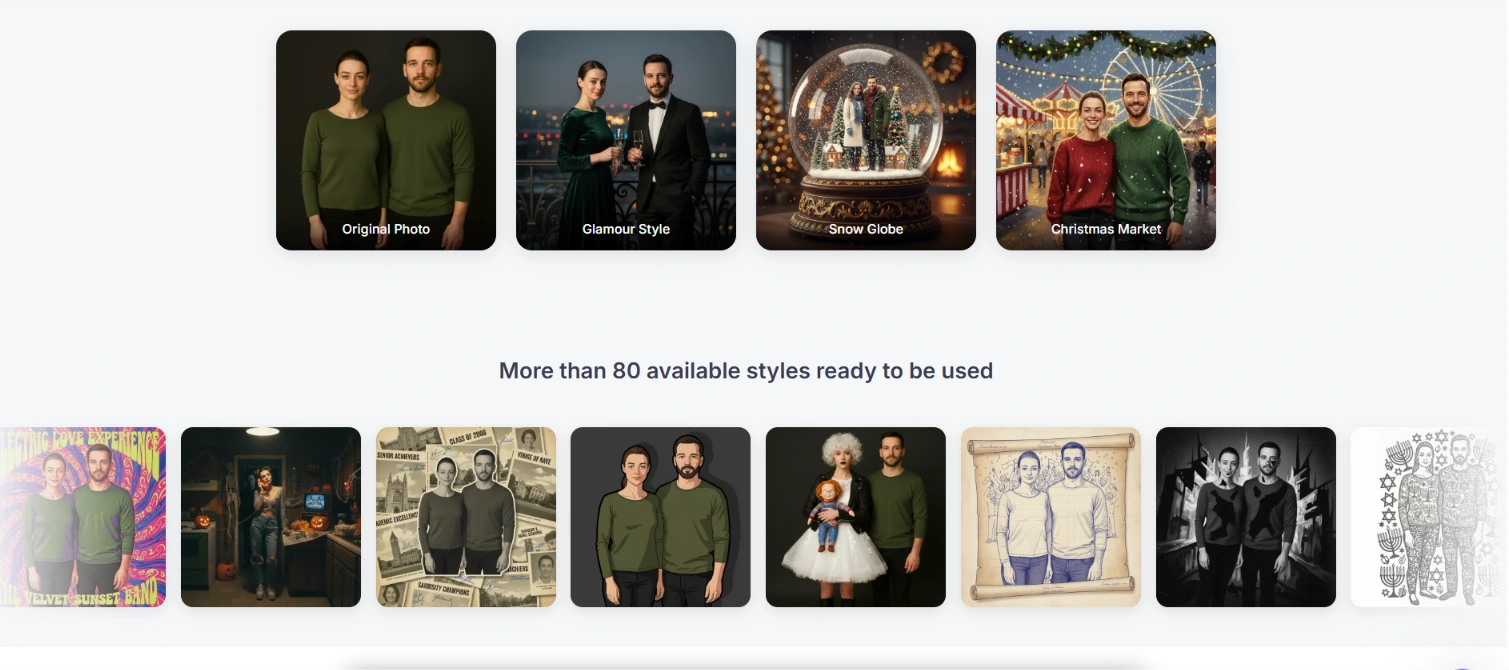
Touchpix offers 80+ ready-to-use AI styles spanning glamour portraits, seasonal environments, artistic illustrations, and branded avatars. Operators can write custom text prompts to create specific transformations for particular clients or themes.
Source: Touchpix
AI Photo is included on every pricing tier, including the entry-level PhotoPass.
Cloud AI transformations run through Google’s Gemini and consume credits, while face replacement and background removal run locally on-device without consuming credits or requiring internet.
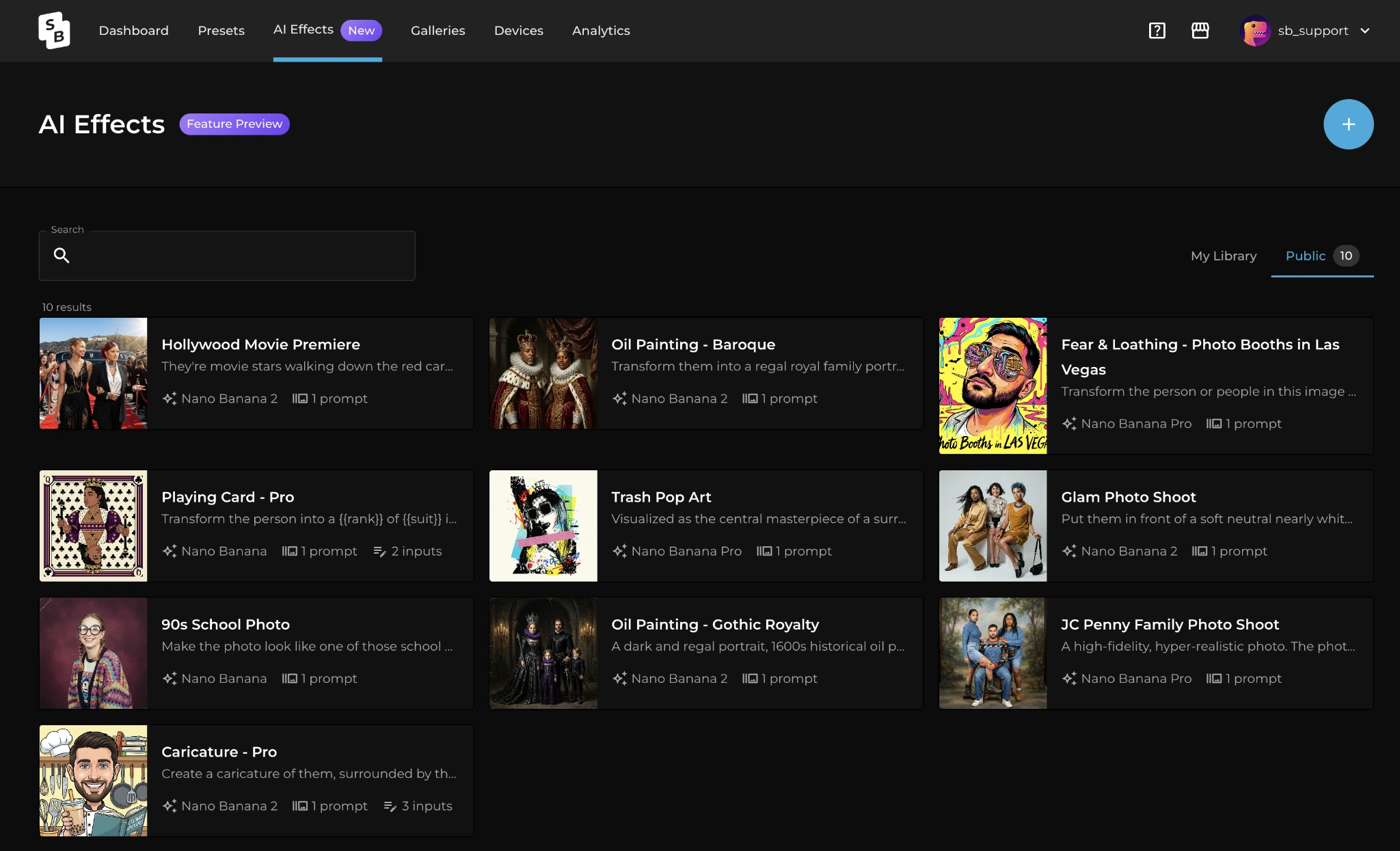
Simple Booth uses its Nano Banana AI models in three tiers (1, 2, and Pro) that balance speed, quality, and group size, consuming 1x, 2x, or 3x credits per generation respectively.
Source: Simple Booth
A distinct advantage is automatic identity preservation: the platform handles guest likeness at the system level without requiring operators to engineer prompts for it, removing a common failure mode at live events.
Simple Booth also supports per-frame multi-prompt storyboarding, where each frame in a multi-frame layout gets a unique AI prompt, enabling sequential narrative strips.
Guest Input variables (Pro/Select) let participants answer questions that feed directly into the AI prompt, producing personalized outputs.
On pricing, Touchpix AI credits cost $12 for 100 credits ($0.12 each) scaling down to $375 for 5,000 credits ($0.075 each).
Simple Booth AI credits cost $0.10 each, purchased in increments of 100 to 10,000, and do not expire.
Touchpix gives new accounts 15 free credits; Simple Booth gives new trials 25 free credits plus plan-based bonuses (50 to 200 credits) on new subscriptions.
Both platforms allow unlimited test generations at zero credit cost outside of live booth mode, so operators can iterate on prompts before events without financial risk.
Lead capture and marketing tools
This is where the platforms diverge most sharply.
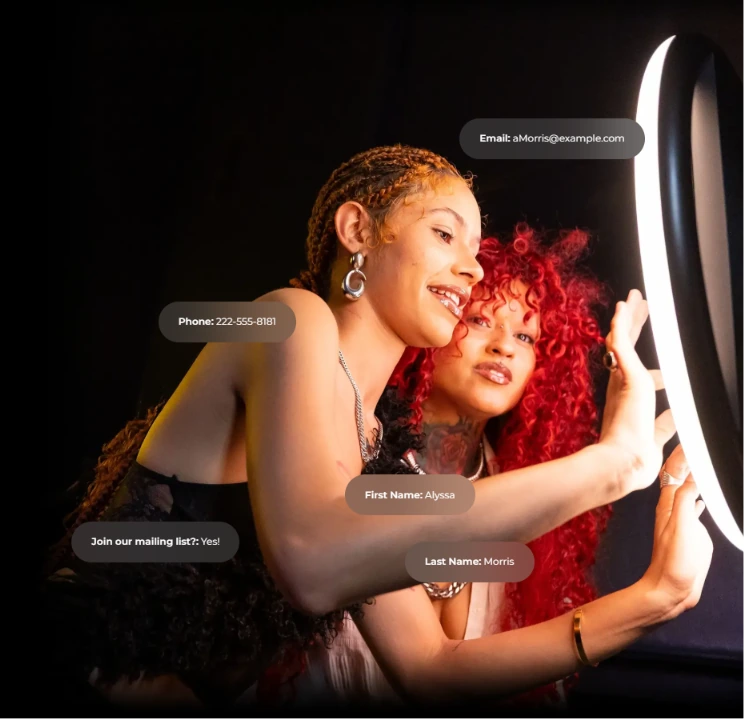
Simple Booth treats data capture as a core capability, not an add-on. The platform collects guest information (email, name, phone, postal code, date of birth) as a natural part of the photo-receiving flow, achieving opt-in rates as high as 87 to 89% per session.
Source: Simple Booth
The Select tier supports up to 10 custom fields including checkboxes and required legal terms. Data exports as CSV, syncs natively with MailChimp, and connects to custom CRMs via the Open API on Pro and above.
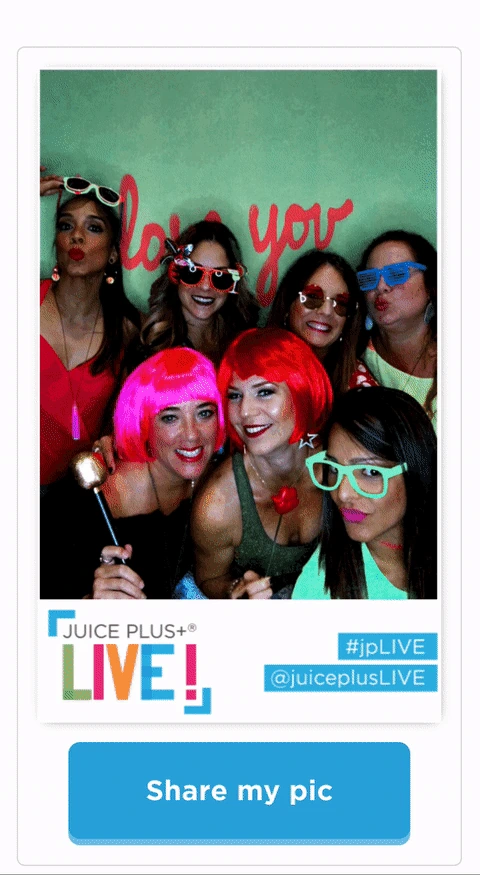
The marketing toolkit extends beyond data collection. Branded online galleries with custom hashtags, header images, and interstitial ads turn event photos into discoverable content.
Social sharing pre-populates hashtags on X/Twitter and automatically reformats layouts for Instagram compatibility.
Source: Simple Booth
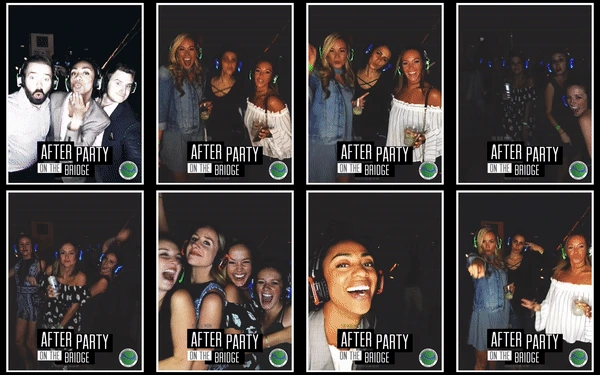
The Live Feed converts any gallery into a real-time slideshow for TVs or projectors.
Source: Simple Booth
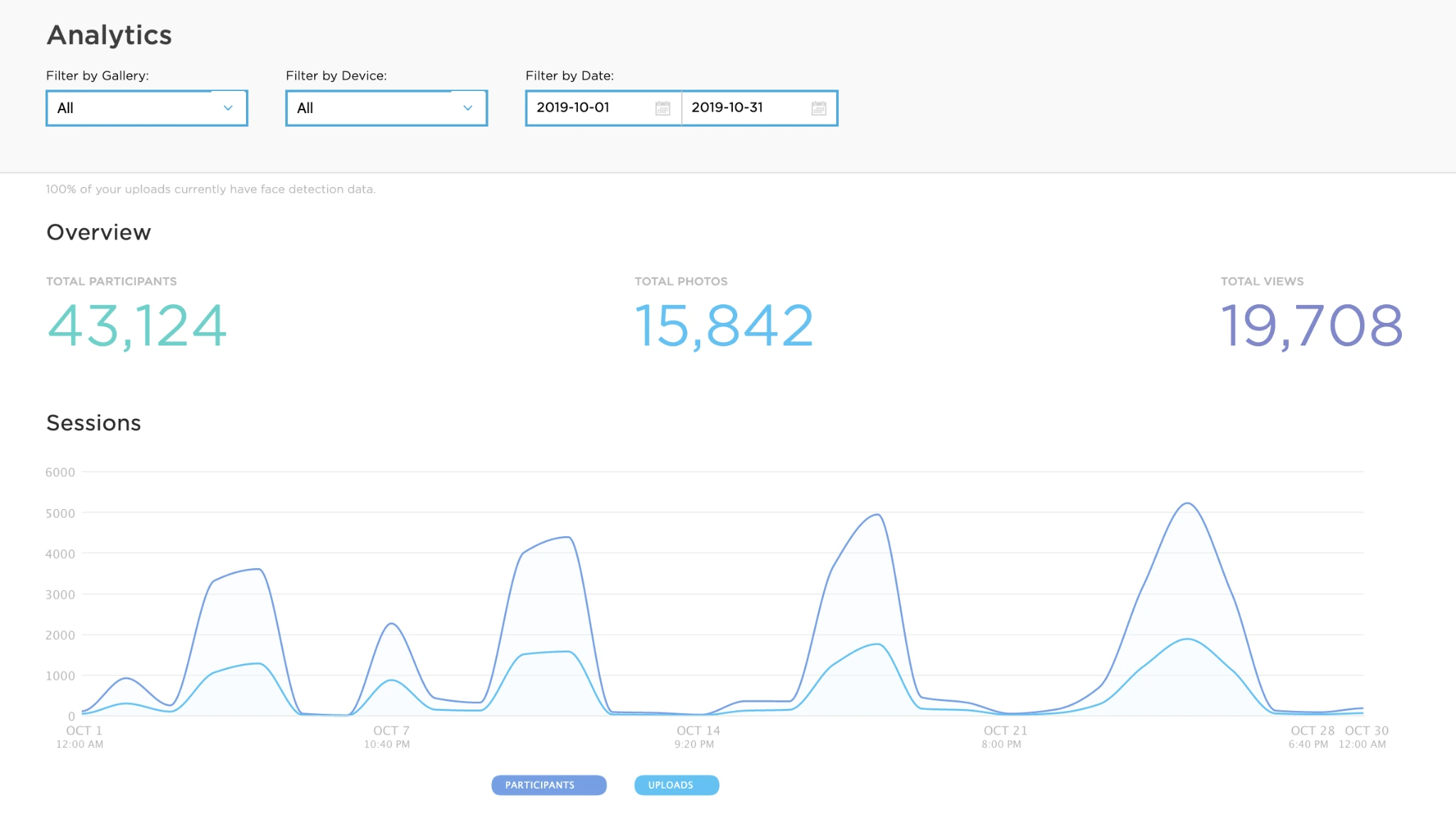
The Select tier adds demographic analytics via face detection, estimating age, gender breakdown, and average group size.
Source: Simple Booth
Arizona Opera grew its email list by 1,000 addresses in a few events using Simple Booth’s lead capture. (Simple Booth)
Touchpix offers Advanced Surveys on MultiPass Pro and above for guest data collection, but the feature is newer and less developed.
The platform provides strong media delivery options (SMS, email, WhatsApp, Facebook, Twitter, direct download, and AirPlay TV display) and supports fully customizable event galleries with planned custom domain support.
However, it lacks native CRM integrations, documented API access for lead data routing, and the analytics depth that Simple Booth provides.
For operators whose clients measure success by leads captured and social impressions generated, Simple Booth’s marketing infrastructure is more developed. For operators whose clients care primarily about the booth experience itself, Touchpix’s media delivery options are sufficient.
Pricing model comparison
The pricing structures reflect each platform’s design philosophy.
Touchpix prices by active event slots (simultaneous events), not per device. All plans include unlimited devices. Four tiers at yearly rates:
| Tier | Yearly Price | Active Events | Key Additions |
|---|---|---|---|
| PhotoPass | $439.90 | 2 | Photos, Photo AI, GIFs only |
| MultiPass | $879.99 | 4 | Adds Video, Slomo, Boomerang |
| MultiPass Pro | $1,407.99 | 8 | Adds Virtual Booth, Advanced Surveys |
| MultiPass Enterprise | $2,199.99 | 12 | Adds Mosaic, RAW cloud backups |
Yearly billing saves approximately 40% versus monthly. Weekly and half-yearly billing are also available. Additional features like Mosaic ($49.99/2 weeks) and Virtual Booth ($19.99/14 days) can be purchased as short-term extensions on lower tiers.
Simple Booth prices by device license. Each plan includes one license; additional devices cost extra. Five tiers at yearly rates:
| Tier | Yearly Price | Add-on License (Yearly) | Key Additions |
|---|---|---|---|
| Lite | $290 | $210 | Basic capture, ads included |
| Core | $490 | $360 | Ads removed, DSLR, video, background effects |
| Plus | $990 | $740 | Custom branding, analytics, guest-editable text |
| Pro | $1,490 | $1,110 | Lead capture, API, phone support, moderation |
| Select | $2,490 | $1,860 | Custom legal terms, demographic analytics |
Weekly billing starts at just $14.99/week for Lite, compared to Touchpix’s $39.99/week entry point. This makes Simple Booth one of the most accessible options for operators starting out or running a side hustle who want per-event pricing while building their clientele.
HALO hardware kits are sold separately, starting at approximately $2,090 for the Event Kit with iPad and Simple Care protection.
The pricing comparison shifts depending on fleet size. A solo operator running one booth finds Touchpix’s MultiPass ($879.99/year with 4 active events and video support) competitive with Simple Booth’s Core ($490/year for one device, or $850/year for two).
But a multi-booth operator running 5 devices hits a sharp cost difference: 5 Simple Booth Core licenses cost $490 + (4 × $360) = $1,930/year for software alone (plus hardware), while Touchpix’s MultiPass Pro at $1,407.99/year covers 8 simultaneous events on unlimited devices.
Both platforms offer trials: Touchpix provides a 14-day free trial with full feature access and no watermarks; Simple Booth offers a 7-day free trial.
Printing capabilities
Touchpix provides three dedicated printing paths: the Printpix hardware box ($340) that connects directly to the printer via USB with no computer required, and downloadable Windows and Mac print server applications for operators who prefer a software-based setup.
The Printpix box supports five connection topologies from direct wired to fully wireless, auto-detects strip versus full-frame templates for automatic paper selection, and works with over 3,000 compatible dye-sublimation printer models across Citizen, DNP, Fujifilm, HiTi, Mitsubishi, Sinfonia, Shinko, and Sony.
Simple Booth supports on-site printing but does not sell dedicated print hardware or print server software. The HALO app generates print-ready layouts through the Layout Designer, and operators typically connect via AirPrint-compatible printers or third-party print solutions.
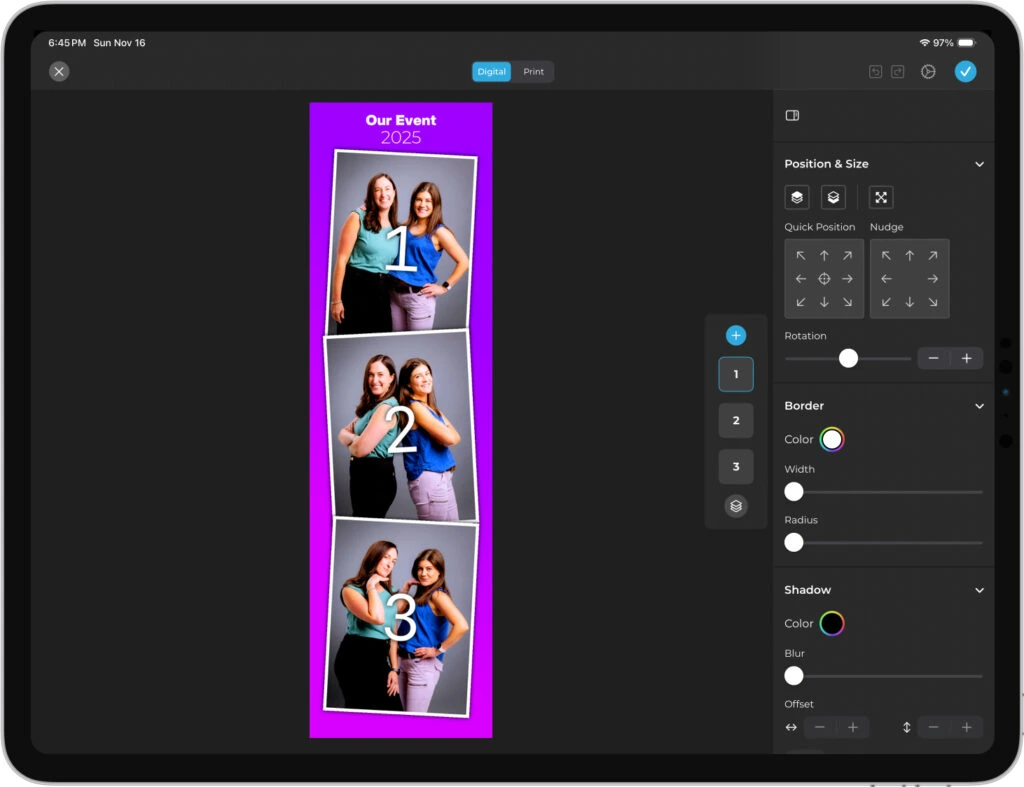
Source: Simple Booth
For operators who run dye-sublimation printers as a core part of their service, Touchpix’s printing ecosystem is more developed and better documented.
Support and onboarding
Touchpix offers 24/7 live chat support in English, Spanish, and Portuguese, with schedulable 1-on-1 Zoom sessions Monday through Thursday. The knowledge base covers GoPro troubleshooting, DSLR connections, printing, and event activation in detail.
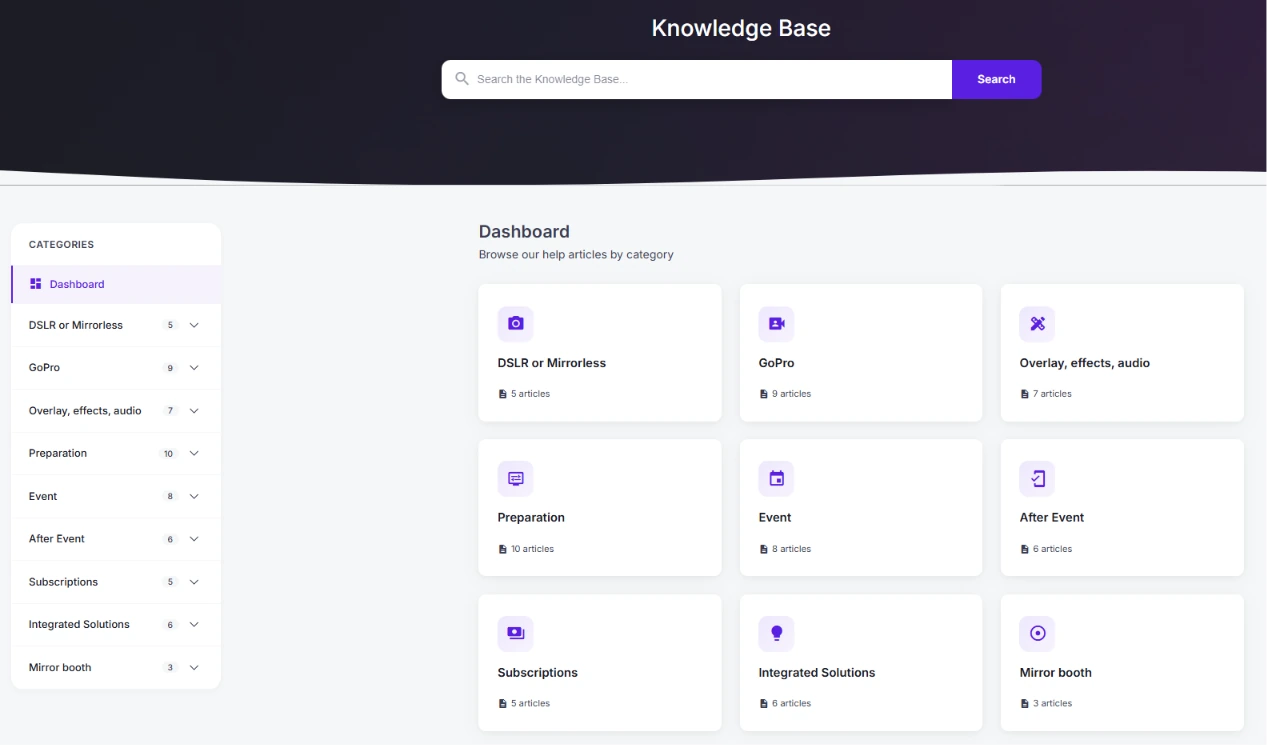
Source: Touchpix
The weekly Masterclass webinar series provides structured training on specific features, with all sessions available as recorded videos. That said, Touchpix support receives mixed reviews from users, with some operators reporting slow or unhelpful responses during live-event issues.
Simple Booth provides support from real humans 7 days a week, and most operators find they rarely need it because the app runs smoothly and intuitively.
Lite gets 7-day email/chat support; Pro adds phone support; Select includes a dedicated account manager during events. The Help Center contains 148+ articles across 10 collections, and the 5.0 Transition Guide includes a GitBook-based AI assistant for natural language documentation queries.
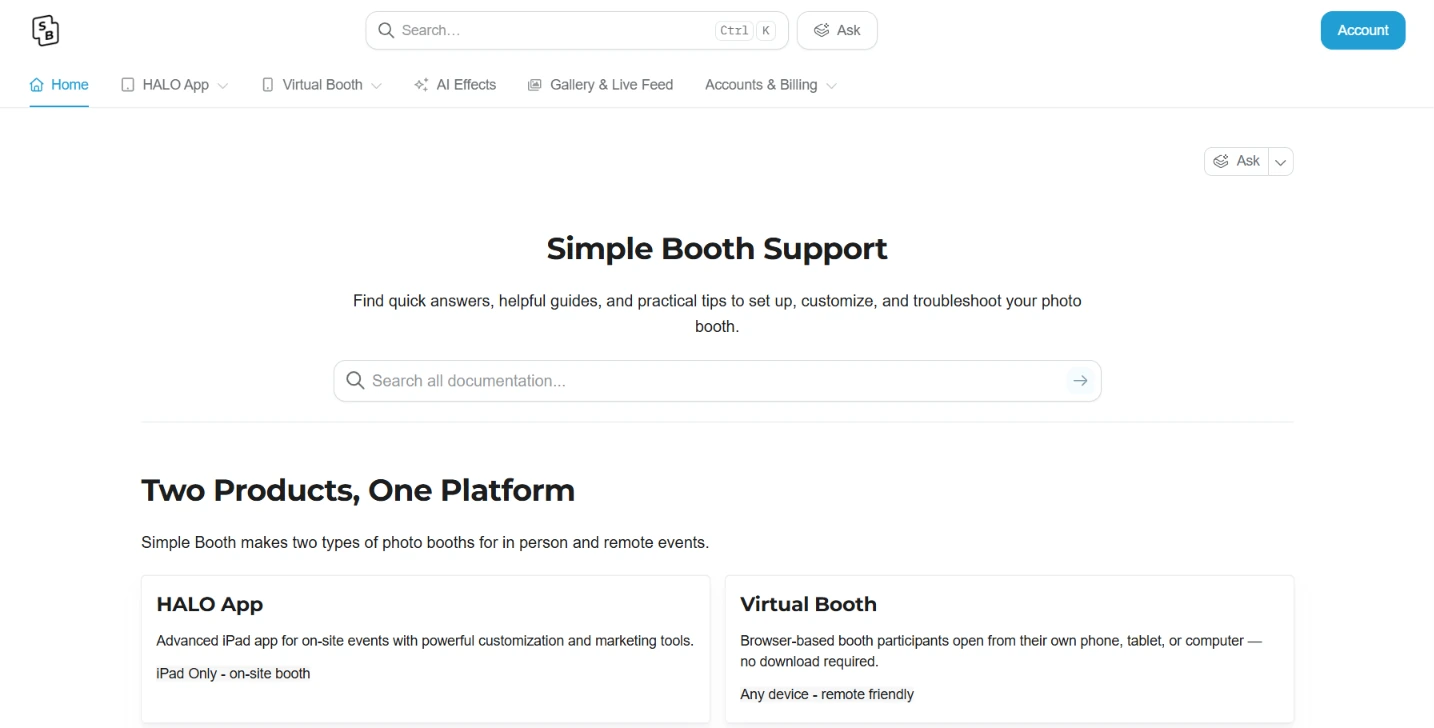
Source: Simple Booth
The numbered Start Guide walks new operators through setup in a sequenced onboarding format.
Touchpix’s 24/7 availability is a structural advantage for operators working evening and weekend events, though the quality of that support is a common concern.
Simple Booth’s tiered approach means phone support requires the Pro plan at $149/month, but the platform’s intuitive design reduces the need for support in the first place.
Simple Booth vs Touchpix: Which should you choose?
The choice depends on what kind of photo booth business you’re building and which capabilities matter most to your clients.
Choose Touchpix if:
- You operate or plan to operate 360-degree spinning video booths
- You need one app to cover 360, traditional, mirror booth, and AI formats
- You run multiple devices and don’t want per-device licensing costs
- You work on Android, Windows, or Linux devices rather than (or in addition to) iPads
- Offline media delivery without any internet is critical for your event venues
- You need on-site dye-sublimation printing with broad printer compatibility
- You want the lowest cost per concurrent event for a growing multi-booth fleet
Choose Simple Booth if:
- You run unattended selfie stands or drop-off events where the booth needs to operate reliably without staff on-site
- You want an integrated hardware-and-software system with studio-grade lighting
- Lead capture, first-party data, and marketing analytics are core deliverables for your clients
- You run iPad-based booths and value the Apple ecosystem’s reliability
- Custom branding depth matters: overlays, guest-editable text, per-frame AI prompts, branded galleries
- You serve brand marketers or experiential agencies who need measurable ROI from activations
- You’re scaling your team and need a platform that’s easy to train new staff on
- You want a virtual photo booth option for remote or hybrid events without additional hardware
- You prefer a turnkey system with sub-one-minute setup at an accessible $14.99/week entry point
Ready to deliver photo booth experiences that capture more than memories? Try Simple Booth free.
The photo booth software market has room for both approaches because operators have genuinely different needs.
An operator building a 360-booth fleet across Android and Windows devices will find Touchpix’s cross-platform reach and per-event pricing hard to match.
An operator focused on branded activations for corporate clients (where photo quality, data capture, and marketing analytics justify higher pricing) will find Simple Booth’s integrated system delivers more value per event.
Consider what your clients actually pay for. If they’re paying for the booth experience itself, Touchpix’s format versatility and lower multi-device costs make a strong case. If they’re paying for the marketing outcomes that experience generates, Simple Booth’s lead capture rates, analytics dashboard, and brand customization tools are the stronger foundation.
Simple Booth vs Touchpix FAQ
What is the main difference between Simple Booth and Touchpix?
Simple Booth is an integrated system pairing proprietary HALO ring-light hardware with an iPad app, focused on photo quality, marketing data capture, and reliable unattended operation. In development since 2012, it serves over 30,000 customers.
Touchpix is a cross-platform photo booth app running on iOS, Android, macOS, Windows, Linux, and Raspberry Pi, focused on format versatility including 360-degree booths, mirror booths, and six capture modes in one subscription. It launched in 2020 and is still maturing as a platform.
Does Touchpix support 360-degree photo booths while Simple Booth does not?
Yes. Touchpix has native Bluetooth trigger integration for 360-degree spinning arms and wired GoPro support (models 7 to 14), making it the dominant platform for 360 booth operators.
Simple Booth does not offer 360-degree booth functionality and is designed around stationary iPad-based setups with its HALO ring-light hardware.
Which platform is cheaper for operators running multiple booths?
Touchpix is typically cheaper for multi-booth operations because it charges per active event slot with unlimited devices, not per device. A MultiPass subscription at $879.99/year covers 4 concurrent events on as many devices as needed.
Simple Booth charges per device license, so running 5 booths on the Core plan costs $1,930/year in software alone, plus hardware costs.
Can Simple Booth run on Android or Windows devices?
No. The Simple Booth HALO app runs exclusively on iPad. This is the most-cited hardware limitation in user reviews. Touchpix runs on iOS, Android, macOS, Windows, Linux, and Raspberry Pi, giving operators full flexibility to use whatever devices they already own.
Which platform has better lead capture for marketing events?
Simple Booth has significantly more developed lead capture and marketing tools, including built-in data capture achieving 87 to 89% opt-in rates, native MailChimp integration, an Open API for custom CRM connections, branded galleries with social sharing, and demographic analytics via face detection on the Select tier.
Touchpix offers Advanced Surveys on its MultiPass Pro tier and above, but lacks native CRM integrations and comparable analytics depth.
How do the AI photo features compare?
Both platforms offer AI-powered photo transformations with custom prompt support. Touchpix provides 80+ ready-made styles with offline face replacement and background removal.
Simple Booth uses three Nano Banana models with automatic identity preservation, per-frame multi-prompt support for narrative strips, and guest input variables that personalize each generation.
AI credits cost $0.10 each at Simple Booth (no expiration) and $0.075–$0.12 each at Touchpix depending on volume.
Which platform works better without internet at event venues?
Touchpix has stronger offline sharing with its Scanpix 2 system, which delivers photos and videos to guests via QR code with no internet connection at all, and its AI face replacement and background removal run entirely on-device.
However, Touchpix experienced a significant cloud outage, and users report slow image and video rendering during events.
Simple Booth’s offline queue stores sessions and delivers them when connectivity returns, with over a decade of stability-focused development ensuring reliable unattended operation. Both platforms support AirDrop as an alternative sharing method.
Does either platform offer on-site printing?
Touchpix offers a more developed printing ecosystem with three options: the Printpix hardware box ($340, no computer required), and Windows and Mac print server applications. It supports over 3,000 dye-sublimation printer models.
Simple Booth supports printing through AirPrint-compatible printers and third-party solutions but does not sell dedicated print hardware or print server software.
Keep reading
 Showdowns
Simple Booth vs Darkroom Booth: Which Photo Booth Software Fits Your Business in 2026?
iPad turnkey vs Windows DSLR veteran. Simple Booth or Darkroom Booth?
 Showdowns
Simple Booth vs Flassh: Which Photo Booth Platform Fits Your Events in 2026?
Integrated system vs speedy setup. Simple Booth or Flassh?
 Showdowns
Simple Booth vs LumaBooth: Which Photo Booth Software Fits Your Business in 2026?
Turnkey hardware vs budget cross-platform app. Simple Booth or LumaBooth?