LumaBooth vs Touchpix (vs Simple Booth): Which Photo Booth Software Wins in 2026?

Choosing between LumaBooth and Touchpix for your photo booth business comes down to five questions:
- Do you need software that runs on the devices you already own, or will you invest in specific hardware for better results?
- Is 360-degree video your primary booth format, or do you run a mix of photo, video, and AI experiences?
- How important is offline operation at venues with unreliable Wi-Fi?
- Do you want the widest platform compatibility, or would you trade breadth for a more polished, integrated system?
- Does your photo booth need to capture marketing data and generate leads, or is the guest photo experience the entire deliverable?
In short, here’s what we recommend:
LumaBooth is the veteran choice for operators who want one subscription covering every booth type across both Windows and Apple devices. With over 14 years in the market and support for Canon, Nikon, and Sony cameras, it lets operators run photo, 360, mirror, glam, and AI portrait booths from a single license.
The LumaBooth Dashboard lets you configure events from any browser and sync settings to Windows or iPad devices at the venue. However, its feature set varies between Windows and Apple versions, and it lacks built-in marketing tools for lead capture beyond basic survey fields.
Touchpix is the platform-agnostic option built around 360-degree video booths. It runs natively on iOS, Android, macOS, Windows, Linux, and Raspberry Pi, giving operators the widest hardware flexibility in the category.
Its Scanpix 2 offline sharing delivers media to guests without any internet connection, and the subscription covers unlimited devices. But Touchpix’s entry-level plan caps you at two active events, App Store reviews document stability issues during live events, and its marketing and data capture tools are limited to higher tiers.
Both platforms give operators capable software for running professional photo booths. But they’re both software-only solutions, meaning the quality of your output depends on whatever lighting, hardware, and camera setup you bring to the venue. For operators who want consistent, professional results without assembling a DIY rig, there’s a different approach.
Simple Booth pairs its HALO iPad app with ring-light hardware machined from aluminum, producing studio-quality photos from an iPad that sets up in under a minute.
Beyond the photo experience, Simple Booth turns every session into a marketing opportunity with lead capture that achieves 87%+ opt-in rates, branded online galleries, social sharing analytics, and a Virtual Booth product that reaches audiences remotely with no hardware at all. For operators and brands that need a photo booth to do more than take pictures, Simple Booth is the complete system.
If a self-operating photo booth that doubles as a lead generation tool sounds like what your business needs, start a free trial of Simple Booth.
LumaBooth vs Touchpix vs Simple Booth at a glance
| LumaBooth | Touchpix | Simple Booth | |
|---|---|---|---|
| Platform support | Windows PC + iPad/iPhone/Mac | iOS, Android, macOS, Windows, Linux, Raspberry Pi | iPad only |
| Booth types | Photo, 360, mirror, glam, GIF, video, AI portraits | Photo, 360, mirror, GIF, video, AI, boomerang, slomo | Photo, GIF, video, boomerang, AI effects |
| Camera support | Canon, Nikon, Sony DSLR/mirrorless, GoPro, webcam | GoPro 7 to 14, Canon, Nikon, Sony DSLR/mirrorless | iPad camera + Canon & Sony DSLR/mirrorless (wired or wireless) |
| Dedicated hardware | None (software only) | Printpix print server box ($340) | HALO ring-light kits (machined aluminum) |
| Offline operation | Offline QR sharing via LumaShare | Scanpix 2 internet-free sharing on iOS and Android | Offline upload queue with auto-delivery |
| Lead capture | Basic surveys with CSV export | Advanced surveys (Pro tier and above) | Up to 10 custom fields, MailChimp sync, API |
| AI features | 170+ AI portrait presets, custom prompts | 80+ AI styles, custom prompts, offline face replacement | AI effects with identity preservation, guest input prompts |
| Free trial | Unlimited (watermark on output) | 14 days, full features | 7 days |
| Starting price | $17/month (annual) | $439.90/year (~$37/month) | $14.99/week (Lite) |
| Best for | Cross-platform operators with DSLR gear | 360 booth specialists on any device | Operators and brands wanting a complete system |
Software-only vs. integrated hardware changes what you can deliver
LumaBooth and Touchpix are both software-first.
You download the app, connect your own camera, rig your own lighting, and build your own enclosure or stand. This approach offers flexibility: you pick the components, you control the budget, and you can swap hardware between events.
The tradeoff is consistency. Your output quality depends on whatever ring light you bought on Amazon, how well your camera settings are dialed in, and whether the venue’s overhead fluorescents cast unflattering shadows. Two operators using the same software can produce very different results depending on their hardware.
Simple Booth takes a different approach.
The HALO chassis is machined from a single billet of aluminum with 112 LEDs producing up to 2,100 lumens through a diffuser. The iPad snaps in via a tool-less faceplate, and a concealed USB-C cable keeps it charged. Groups can stand six to eight feet back and still be evenly lit.
For operators who want professional camera output, Simple Booth connects to Canon and Sony DSLR/mirrorless cameras via USB or wirelessly over Wi-Fi (a wireless option most competitors don’t offer). The Preflight Check detects connected cameras and lets operators adjust exposure within the app.
This integration means every HALO deployment produces the same quality regardless of the operator’s technical skill. The hardware is rated for 50,000 hours of operation, which matters when you’re renting booths weekly. And the sub-one-minute setup counts when you’re running multiple events in a weekend.
Simple Booth has been developing iPad photo booth software since 2013, and that maturity shows in contingencies like an offline queue, automatic camera fallback if a DSLR disconnects, and image previews that render up to 12x faster than previous versions.
“It paid for itself pretty quickly. Now it’s just extra money coming in.” (Kurt Nielson Photography)
LumaBooth leads in cross-platform flexibility
If you need to run photo booths on both Windows PCs and iPads, LumaBooth is the only product in this comparison that covers both under a single brand.
The LumaBooth Dashboard syncs templates, overlays, and settings to Windows or Apple devices at the venue through a browser. Configure an event on your laptop the night before, and it’s ready on your iPad when you arrive.
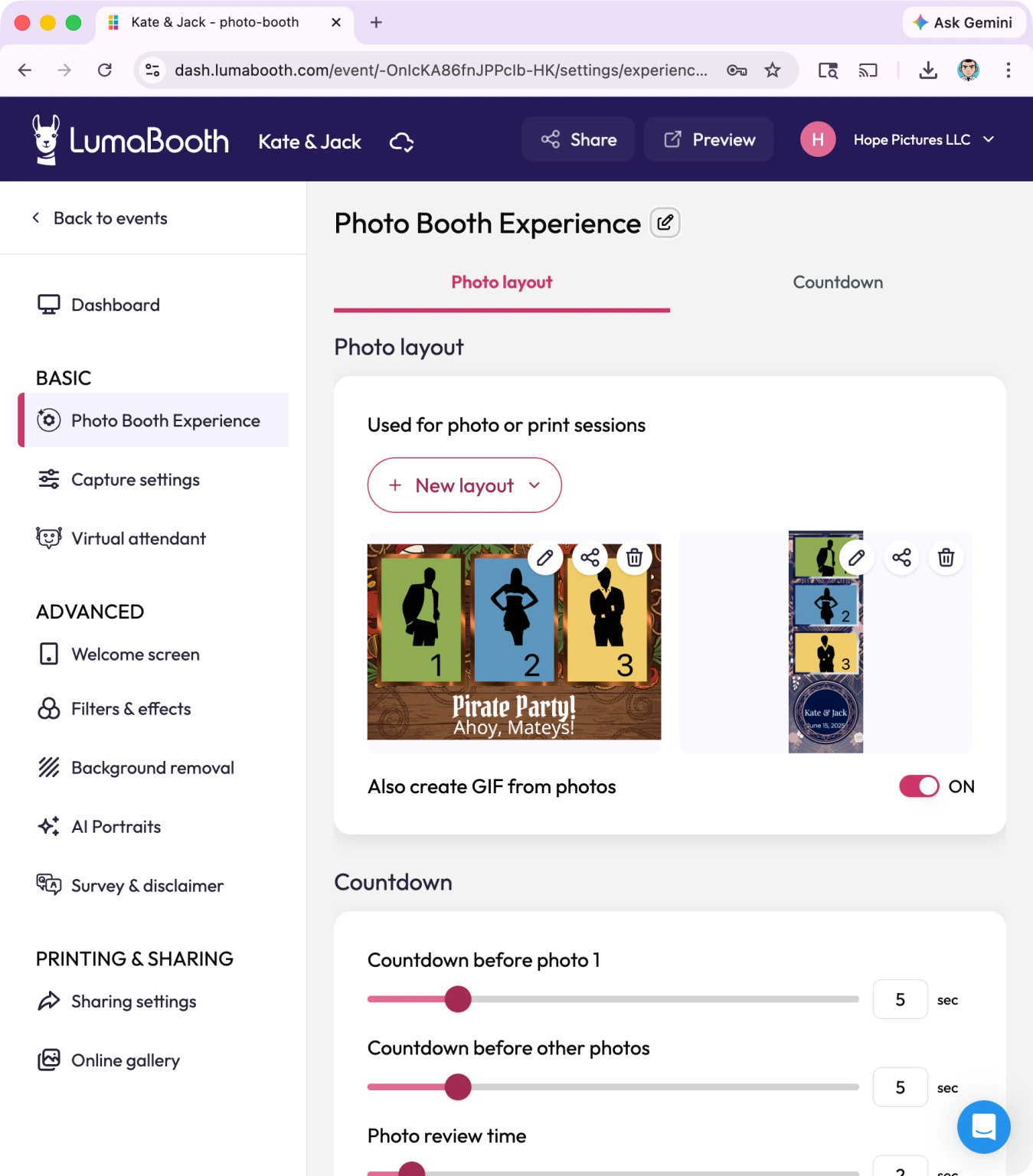
Source: LumaBooth
For operators with existing DSLR gear, LumaBooth’s camera compatibility is the broadest. The Windows version supports Canon, Nikon, and Sony DSLR/mirrorless cameras, GoPro 5 to 13, and webcams. The Apple version connects to Canon, Nikon, and Sony mirrorless models via USB. If you already own professional camera bodies, LumaBooth lets you put them to work without switching systems.
The subscription bundles booth types that competitors sell separately. A single LumaBooth license covers 360 Booth, Mirror Booth, Glam Booth, Green Screen, AI Portraits, Video Guestbook, and GIF Booth. That’s a wide feature set for $17/month on an annual plan.
The catch: LumaBooth’s Windows and Apple versions aren’t identical. Cashless payments, Booth CoPilot, and Hot-Folder importing are Windows-only. Event settings sync works only between Windows machines. And Sony cameras can’t capture boomerang or video on either platform. Operators running mixed fleets need to check which features work on which devices.
Touchpix dominates 360 video booths
If 360-degree spinning video is your primary booth format, Touchpix has the best feature set.
The app handles the full 360 workflow: Bluetooth trigger integration with the spinning platform, wired GoPro connectivity for reliability, speed ramps, overlays, and instant sharing from a single interface.
Running on six operating systems gives operators the widest hardware flexibility in the category. Every subscription tier includes unlimited devices, so adding a second or third booth doesn’t increase your software cost. For operators scaling a fleet on a budget, that’s a real advantage over per-device licensing.
Touchpix’s Scanpix 2 offline sharing stands out for outdoor events and venues with no Wi-Fi. Guests receive their media via QR code over a local network created by the booth device itself, with no internet required. Both iOS and Android guests are supported.
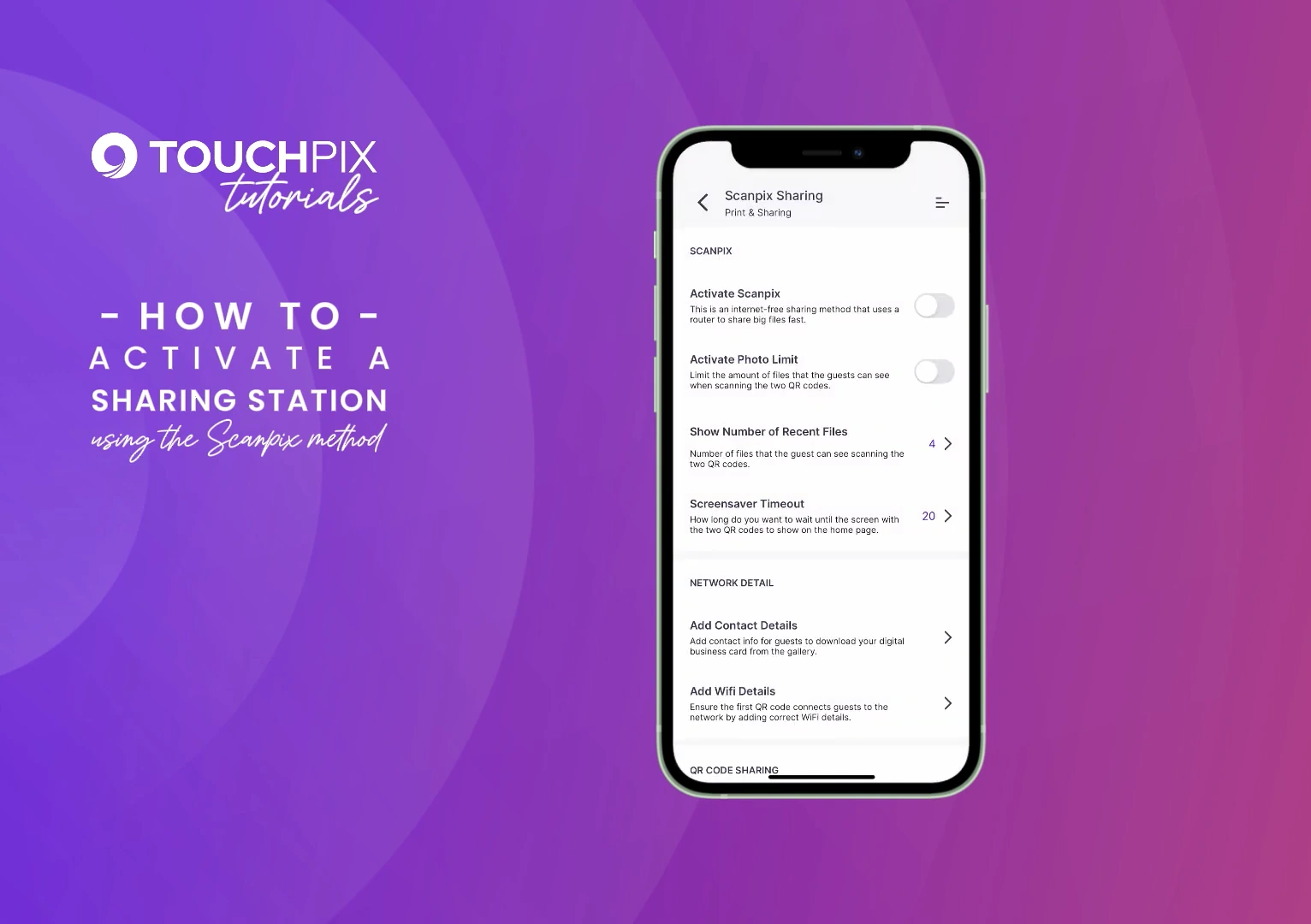
Source: Touchpix
LumaBooth offers a similar offline QR solution through LumaShare, but it requires a companion app running on a separate device and a local router.
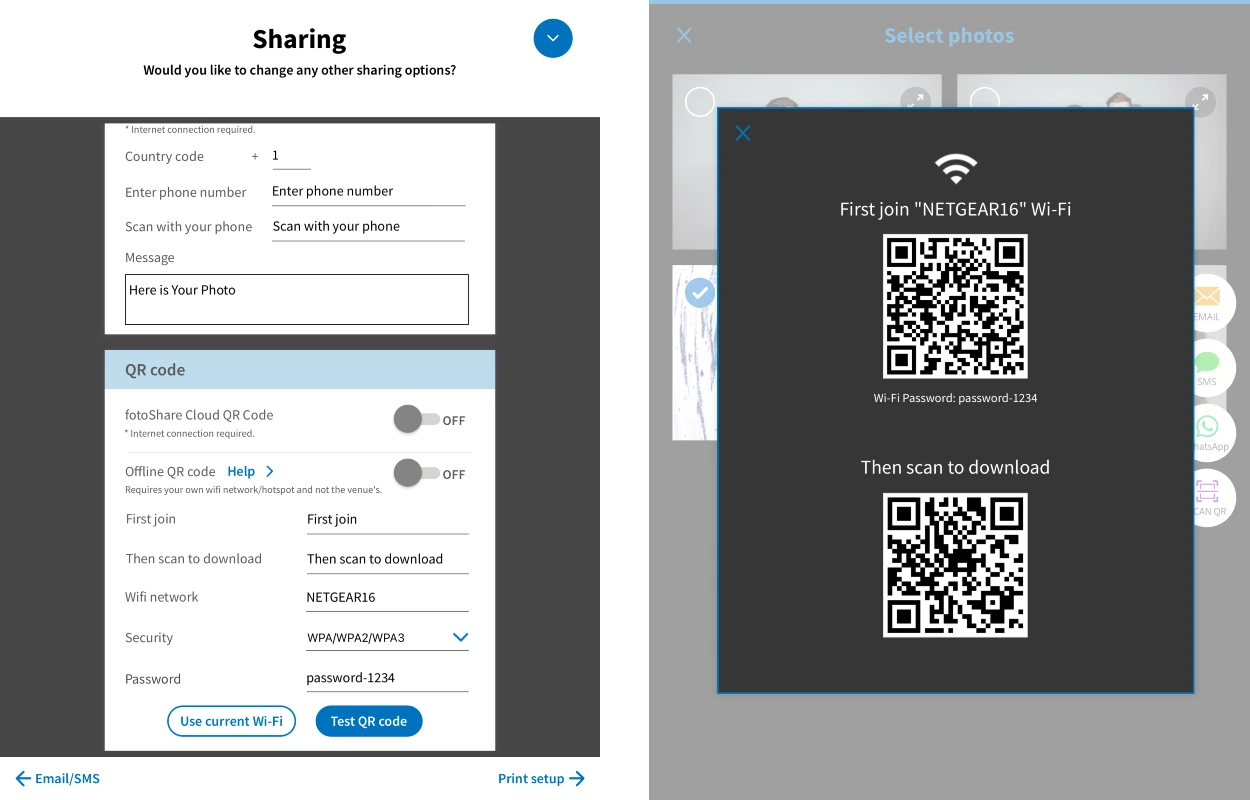
Source: LumaBooth
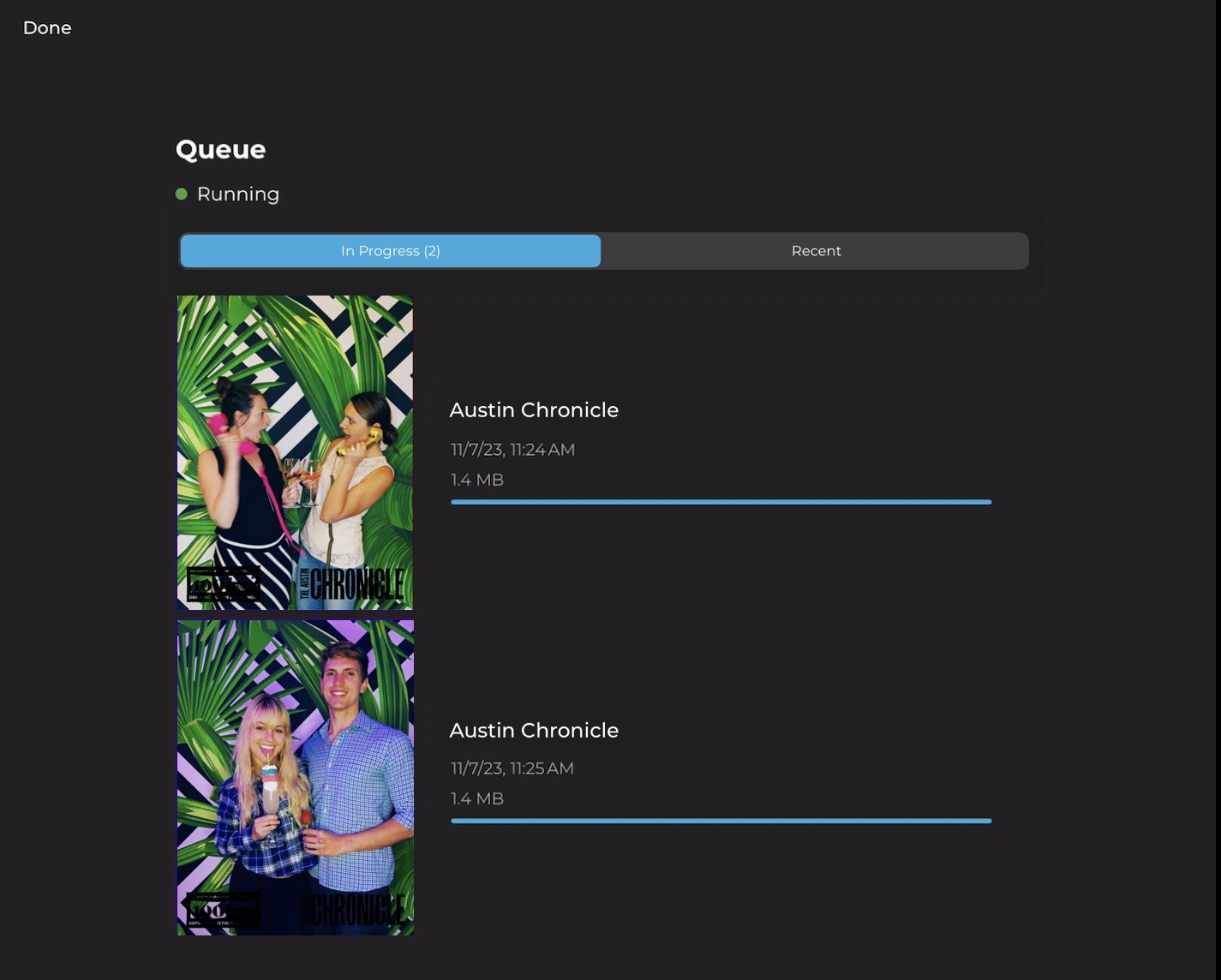
Simple Booth’s offline queue stores sessions and delivers them when connectivity returns, but doesn’t provide instant offline delivery the way Scanpix 2 does.
Source: Simple Booth
The concerns with Touchpix center on reliability. Touchpix launched in 2020 and grew quickly on the strength of its 360 focus, but hasn’t had the development runway to fully mature.
App Store reviews document the app freezing mid-edit and force-closing during live events with video data loss. GoPro disconnection after periods of inactivity is a recurring complaint. A cloud outage in 2025 disrupted event operations. Captured images and videos are also slow to render, creating wait times for guests (a contrast to Simple Booth, where optimized rendering delivers previews up to 12x faster).
For a tool used at paid engagements where failure means an unhappy client, these reports carry weight.
AI features take three different approaches
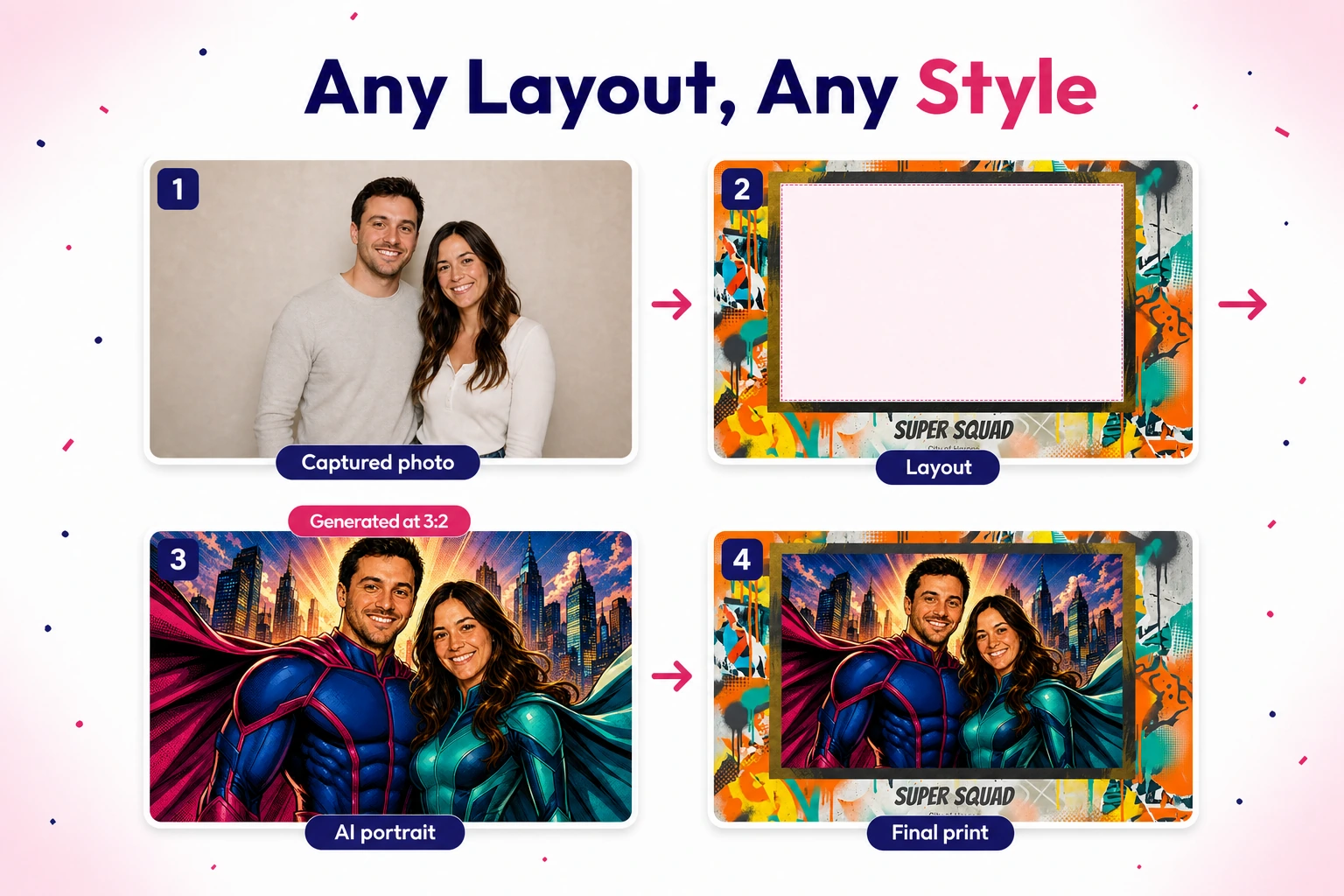
LumaBooth provides over 170 AI portrait presets organized by theme (superheroes, movies, fantasy, historical eras, sports, art styles) with processing in roughly 10 seconds per portrait.
The standout capability is Custom AI Prompts: operators write their own prompts, upload reference images, and inject per-guest personalization (name, jersey number, chosen theme) into the generated artwork. AI credits are purchased separately, starting at $14.99/month for 150 credits, with pay-as-you-go packs that never expire.
Source: LumaBooth
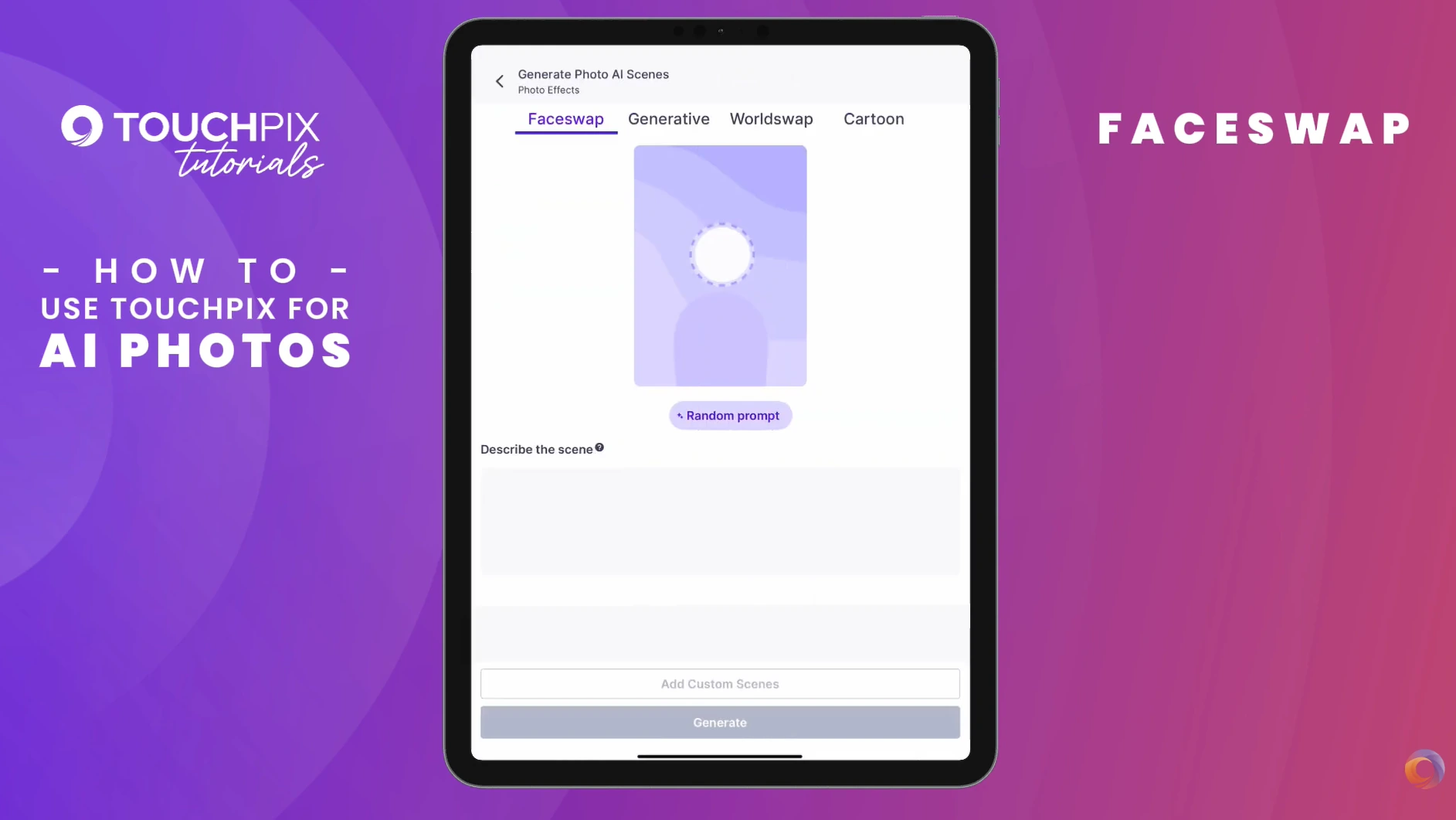
Touchpix offers 80+ AI styles with custom prompt support.
What sets it apart is that AI Face Replacement and background removal run entirely on-device without internet, so basic AI effects work at venues where cloud-based processing would fail. The cloud-based style transformations use credits (15 free on signup), with packs starting at $12 for 100 credits. AI features are available on every subscription tier, including the entry-level PhotoPass.
Source: TouchPix
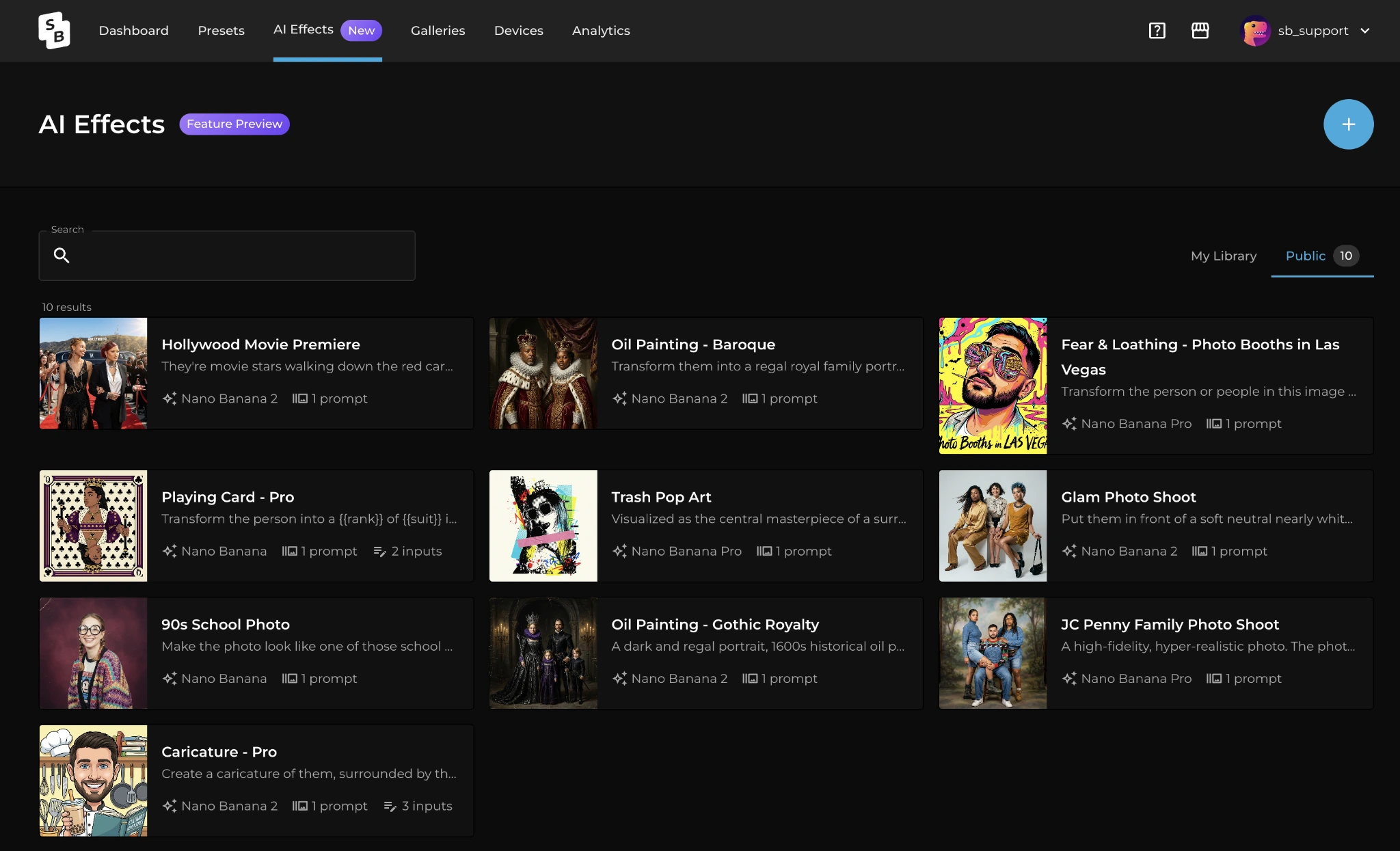
Simple Booth takes a different approach with its Nano Banana AI models, which come in three tiers balancing speed, quality, and group size.
Source: Simple Booth
The platform handles identity preservation and likeness at the system level, so the guest remains recognizable regardless of the transformation. Operators can assign a unique AI prompt to every individual frame in a multi-frame layout, enabling comic-strip or cinematic-scene photo strips.
Guest Input lets participants answer questions that feed into the AI prompt as template variables, producing personalized output per guest. Prompt testing outside booth mode is free and costs no credits.
For operators where AI is a premium upsell, all three deliver. LumaBooth has the largest preset library. Touchpix offers offline fallback. Simple Booth has the strongest identity preservation and the most creative multi-frame capability.
Simple Booth turns photos into marketing data
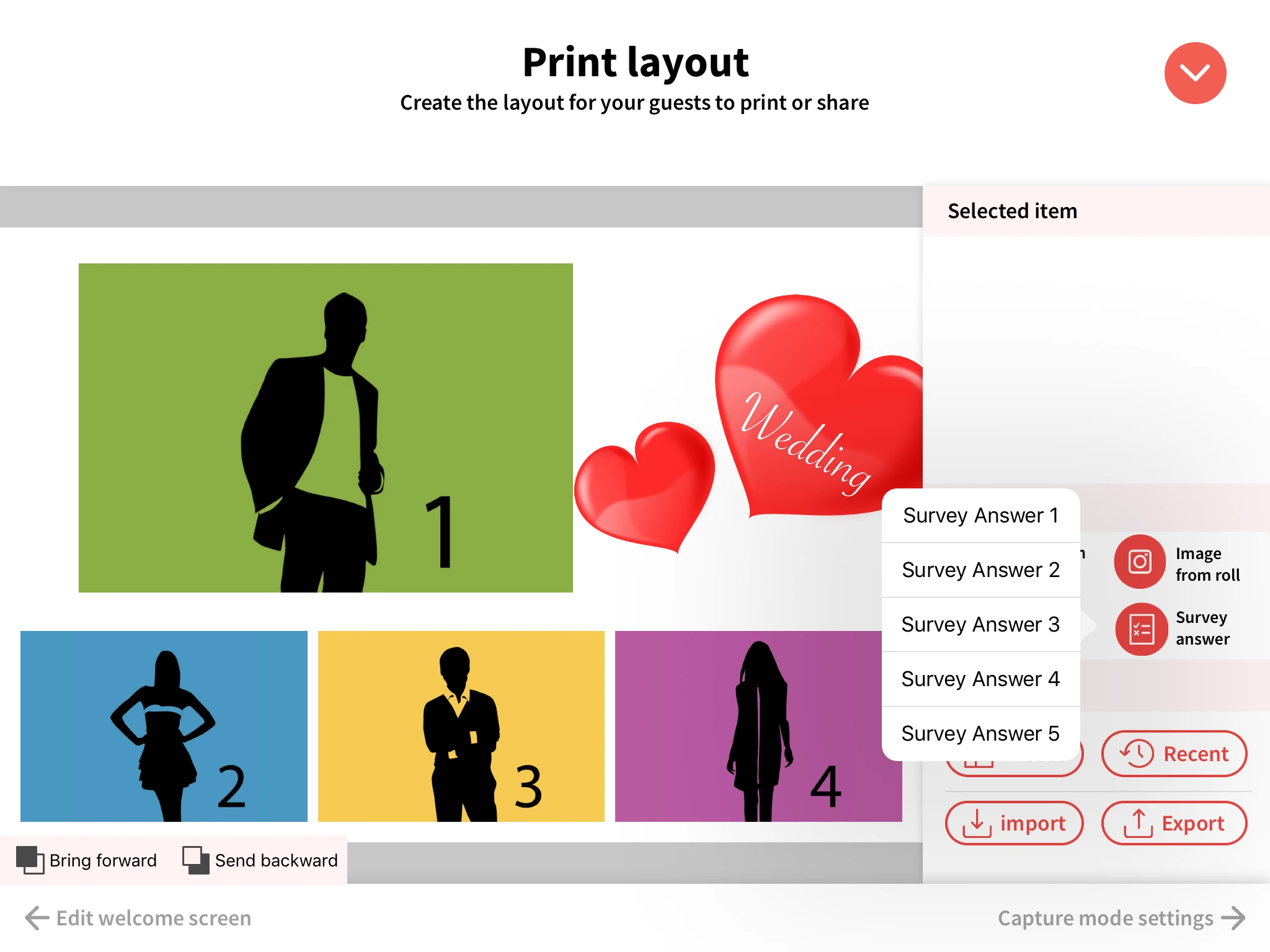
LumaBooth’s data capture is functional but limited.
The built-in survey collects guest answers and exports them to CSV. Email addresses and phone numbers are logged from shares. But there’s no native CRM integration, no analytics dashboard beyond basic share tracking, and no automated way to route leads to marketing tools.
Source: LumaBooth
Touchpix adds Advanced Surveys on the MultiPass Pro tier ($1,407.99/year), but the platform has no documented CRM integrations, no API for external systems, and no analytics beyond what the dashboard shows.
For operators whose clients want lead lists, Touchpix collects the data but doesn’t help you act on it.
Simple Booth treats data capture as a core feature, not an afterthought.
The platform achieves 87 to 89% opt-in rates when guests receive photos, because the data form is embedded in the natural photo-sharing flow rather than presented as a separate ask.
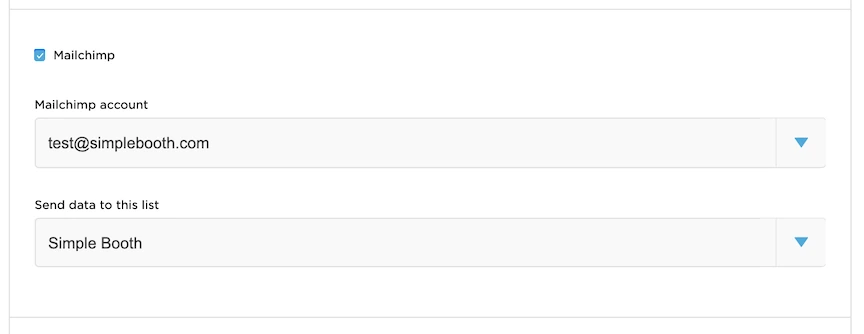
On the Pro tier, operators can capture up to 6 standard fields (email, name, phone, postal code, date of birth), and the Select tier supports up to 10 custom fields with checkboxes and required legal terms. Data syncs natively with MailChimp or routes to any CRM via the Open API.
Source: Simple Booth
The analytics dashboard tracks participants, gallery views, and social shares. Demographic insights via face detection (estimated age, gender breakdown, average group size) are available on the Select tier. For brand activators and marketing teams who need to prove ROI from an event activation, this data layer justifies Simple Booth’s premium pricing.
“Arizona Opera grew its email list by 1,000 addresses in just a few events using Simple Booth’s lead capture.” (Simple Booth)
Pricing models serve different business models
LumaBooth charges per device.
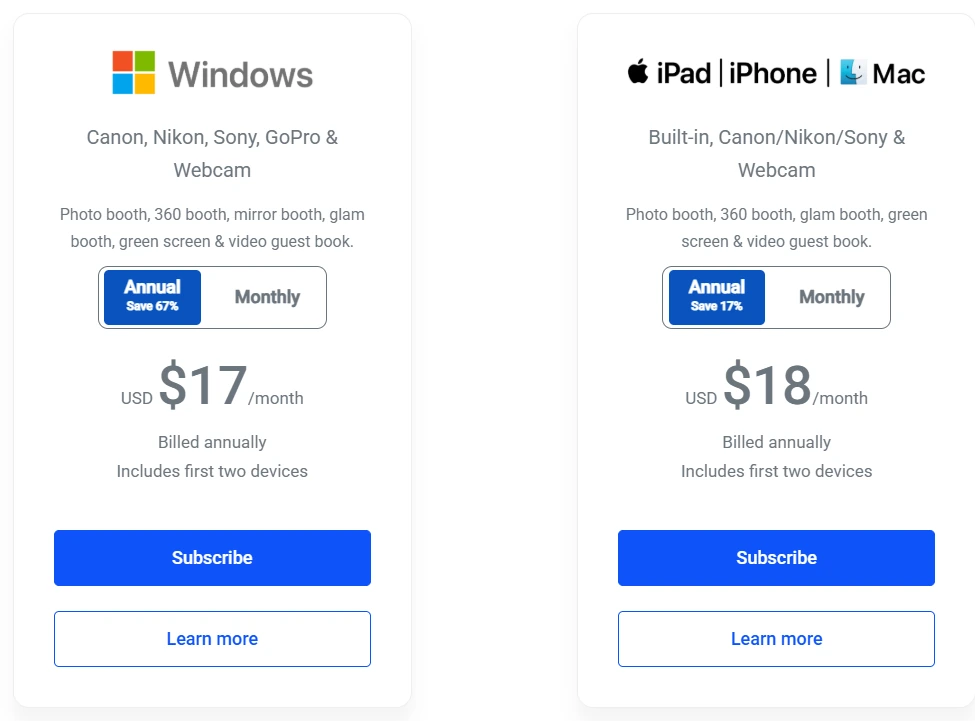
The Windows subscription is $17/month billed annually (or $49.99/month), and the Apple subscription is $18/month annually (or $19.99/month). Each subscription covers two devices. Additional devices require additional subscriptions.
The annual price is competitive for what’s included, but costs climb with add-ons: LumaShare at $7.99/month, fotoShare Cloud Plus at $19.99/month, SMS at $10/month, and AI credits on top. A fully loaded setup can quietly exceed $100/month.
Touchpix charges per active event slot.
The PhotoPass at $439.90/year covers 2 simultaneous events on unlimited devices, but limits you to photos and GIFs (no video, no boomerang). The MultiPass at $879.99/year adds video and 4 active events.
If you run more than 4 events simultaneously, you need MultiPass Pro at $1,407.99/year (8 events) or Enterprise at $2,199.99/year (12 events). The unlimited-device model works well for fleet operators, but the active event cap can force upgrades purely due to scheduling, not feature needs.
Simple Booth charges per device license on weekly, monthly, or annual billing.
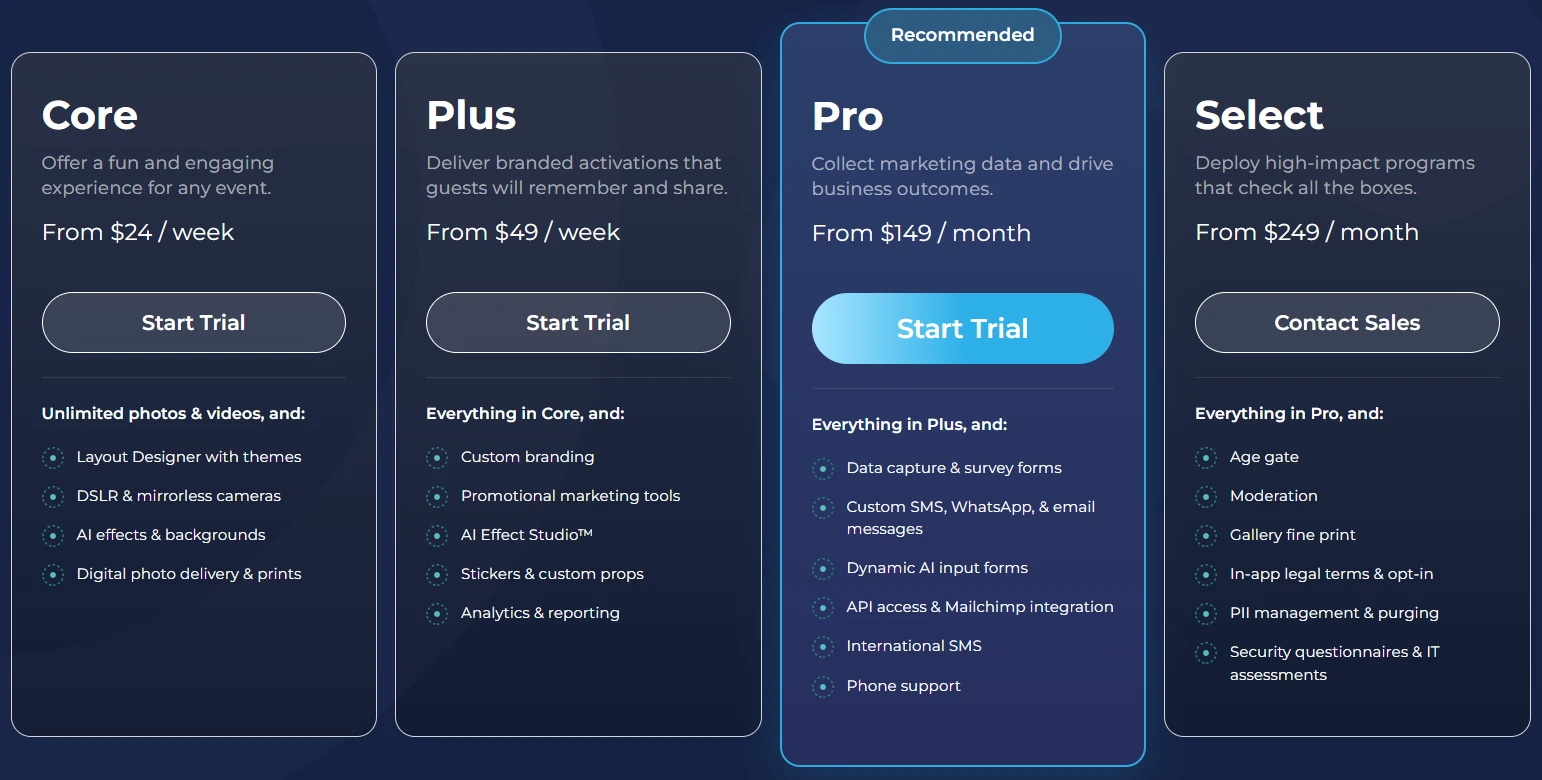
Lite at $14.99/week or $29.99/month covers basic photo booth functionality but includes ads and excludes custom branding, DSLR support, and data capture (it’s designed for personal events, not rental businesses). Core starts at $49/month (or $490/year), which includes DSLR support, video, background replacement, and AI effects. Plus at $99/month adds custom branding and analytics. Pro at $149/month unlocks lead capture, API access, and phone support.
Additional device licenses cost less than the first. The entry price is higher, but the plan includes capabilities that LumaBooth and Touchpix either lack or gate behind expensive add-ons.
For a solo operator running one booth at weddings, LumaBooth’s annual plan is the lowest-cost entry. For a fleet operator running multiple 360 booths, Touchpix’s unlimited-device model saves money at scale. For an operator whose clients pay for branded activations with lead capture, Simple Booth’s pricing reflects the value of the marketing tools included.
Sharing and guest delivery compared
LumaBooth provides email, SMS, WhatsApp, QR code, AirDrop, and Instagram sharing as built-in channels.
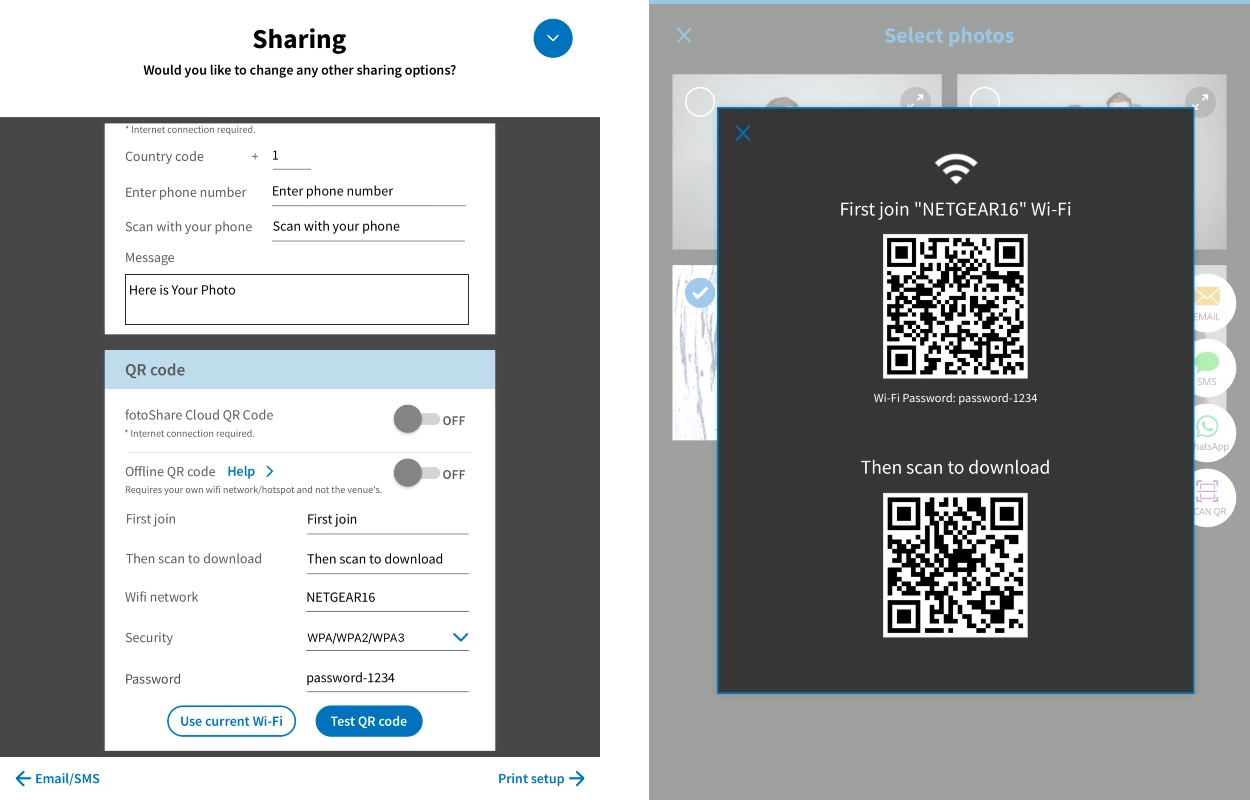
The LumaShare companion app runs on a separate iPad or Android device as a dedicated sharing and slideshow station, freeing the booth for the next guest. For venues without internet, the Offline QR Code system delivers media over local Wi-Fi. Shares queue and send when connectivity resumes.
Source: LumaBooth
Touchpix covers similar channels (email, SMS, WhatsApp, Facebook, Twitter, AirDrop, QR code) with the addition of Google Drive and Dropbox cloud backup.
Its Scanpix 2 offline sharing works without a companion app or external router, running directly from the booth device on both iOS and Android. For offline delivery, Touchpix’s implementation is the simplest of the three.
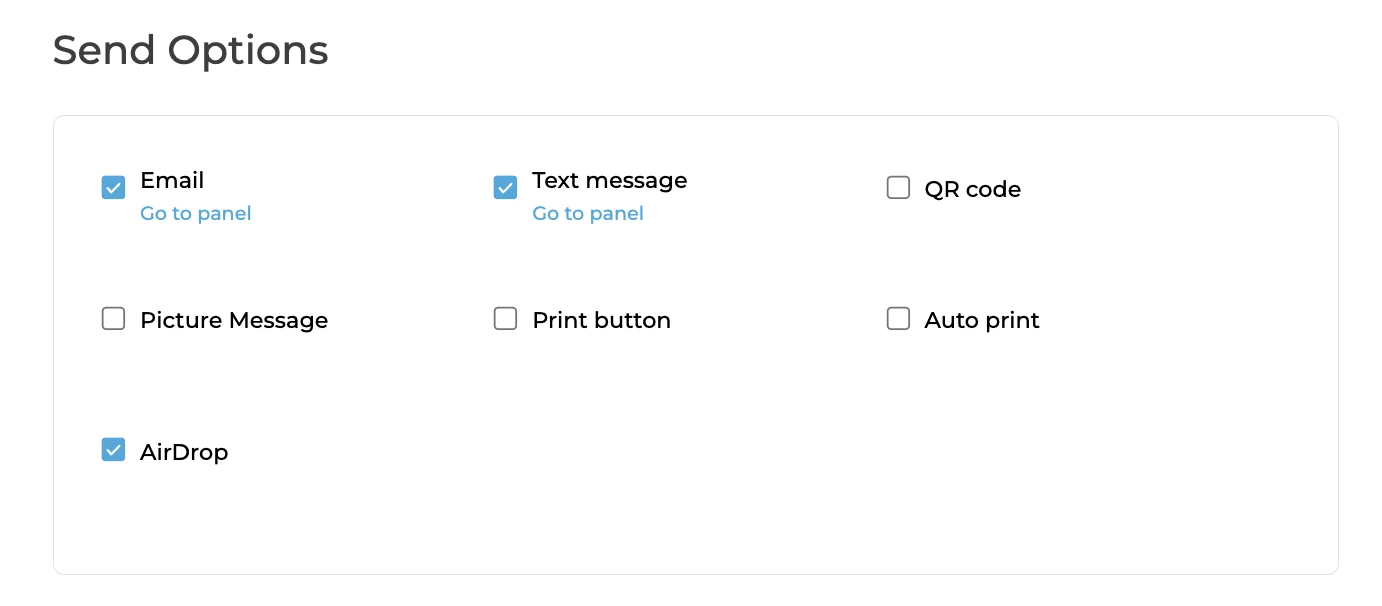
Simple Booth delivers via QR code, email, SMS, AirDrop, and WhatsApp.
Source: Simple Booth
The WhatsApp delivery added in HALO 5.0 opens international markets where SMS is less common. Each event generates a branded online gallery that aggregates all sessions, with configurable privacy levels. The gallery converts into a Live Feed slideshow for TV or projector display.
Where Simple Booth falls short is fully offline delivery: its offline queue stores sessions locally and delivers when internet returns, but it doesn’t offer instant offline QR sharing like Touchpix’s Scanpix 2 or LumaBooth’s offline QR system.
Remote management and multi-booth operations
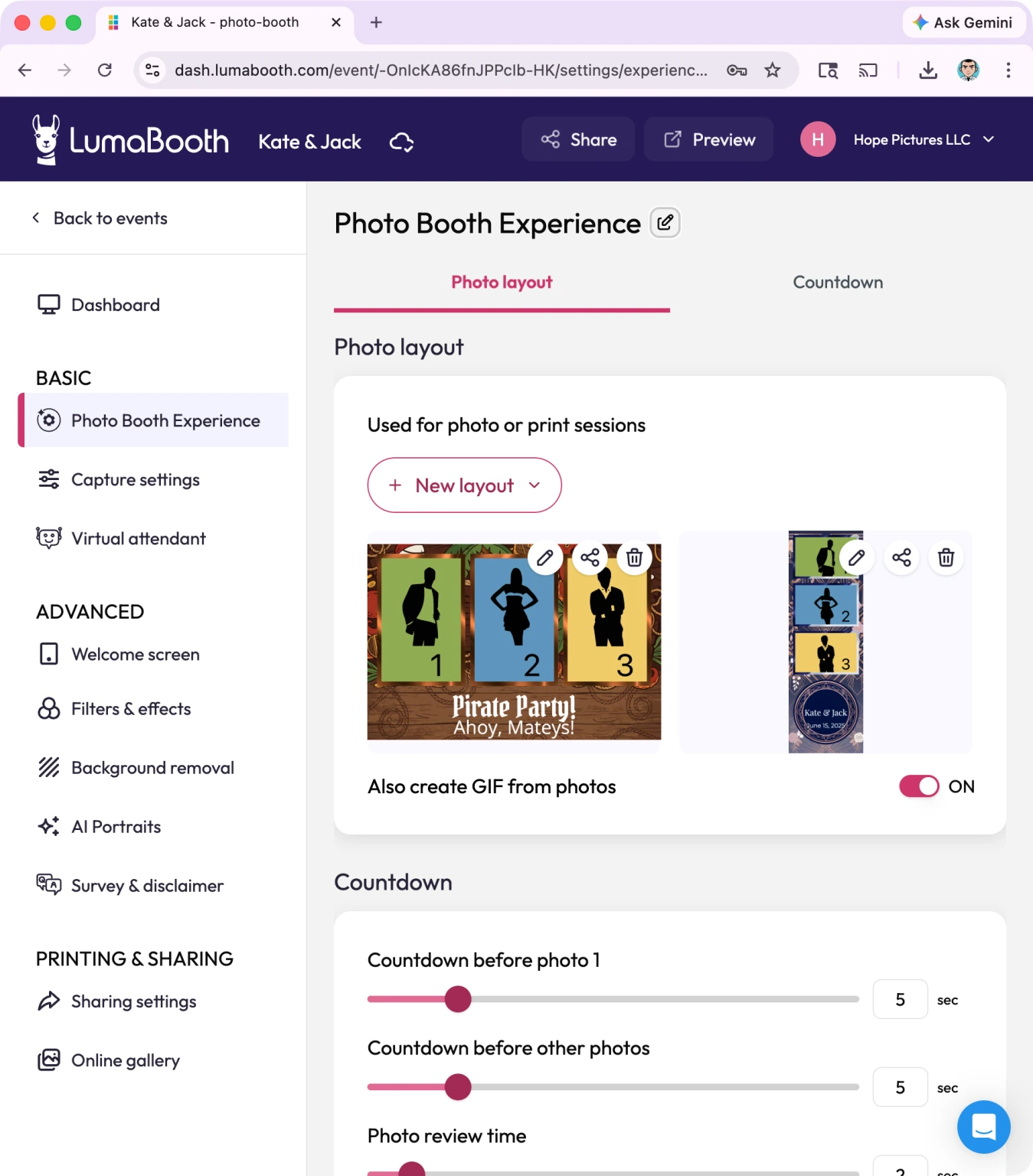
LumaBooth’s Dashboard is a browser-based control center where operators create events, configure templates from an 820+ design library, and push settings to any connected device.
Source: LumaBooth
Booth CoPilot, a free companion mobile app, lets operators monitor session counts and trigger prints remotely. Event sync across Windows machines doubles as disaster recovery: if a computer fails mid-event, a replacement can pull the full configuration from the cloud. The limitation is that this sync is Windows-to-Windows only.
Touchpix provides an online dashboard for remote event configuration and overlay design.
The 300+ design library gives operators quick-start templates. But the active event cap per tier (2, 4, 8, or 12) is the practical bottleneck for fleet operations. An operator running 5 booths on a Saturday needs at least the MultiPass Pro tier, regardless of whether they need its other features.
Simple Booth manages fleets through its online dashboard, where presets sync to devices automatically.
The Mission Control overlay, triggered by a two-finger pinch, lets operators monitor device health, adjust camera settings, and sync dashboard changes during a live event without disrupting the guest interface. The Preflight Check screen catches configuration issues before each event launch. Staff accounts let operators share presets with team members without exposing account-level settings.
Printing takes three different paths
LumaBooth supports printing via dual-printer setups and 2-per-page strip printing from the Windows app or through LumaShare on Apple devices.
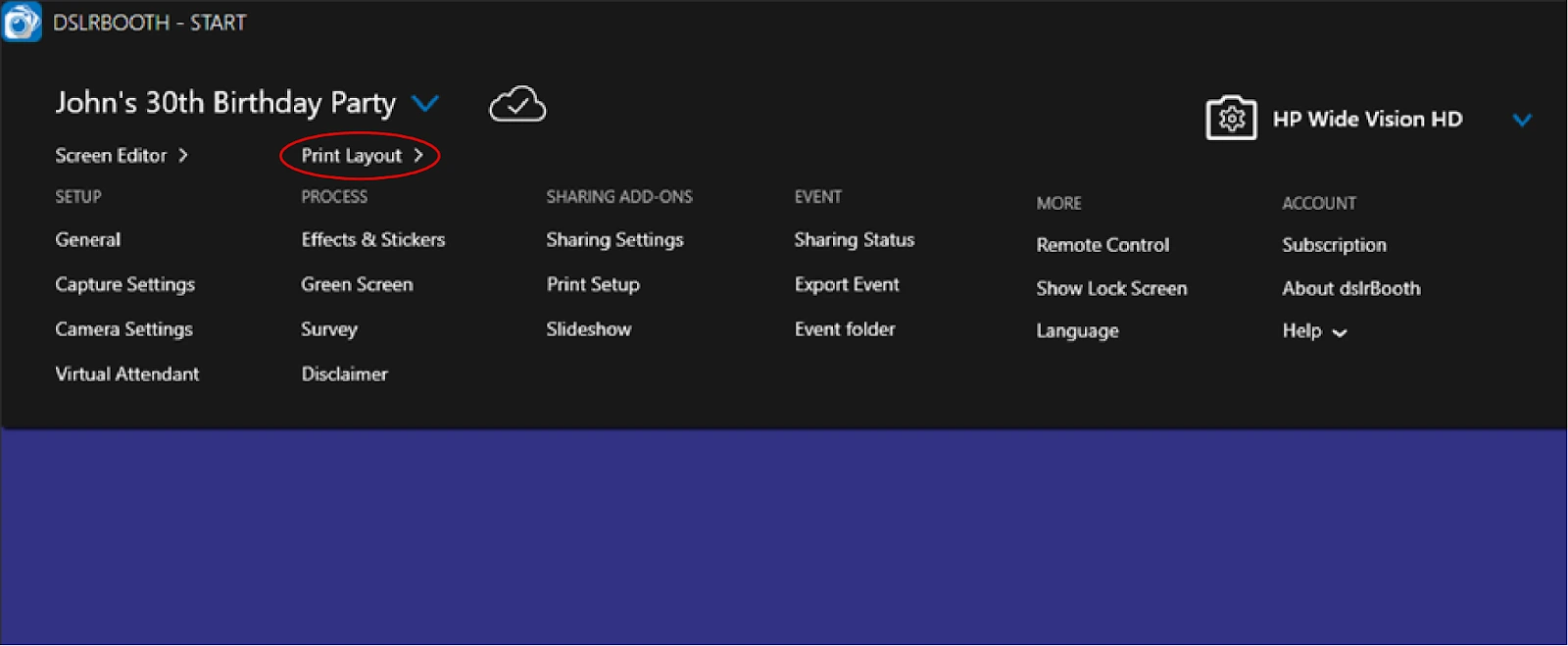
The built-in print layout editor lets operators design templates with photo placeholders, text, and branding elements without external software.
Source: LumaBooth
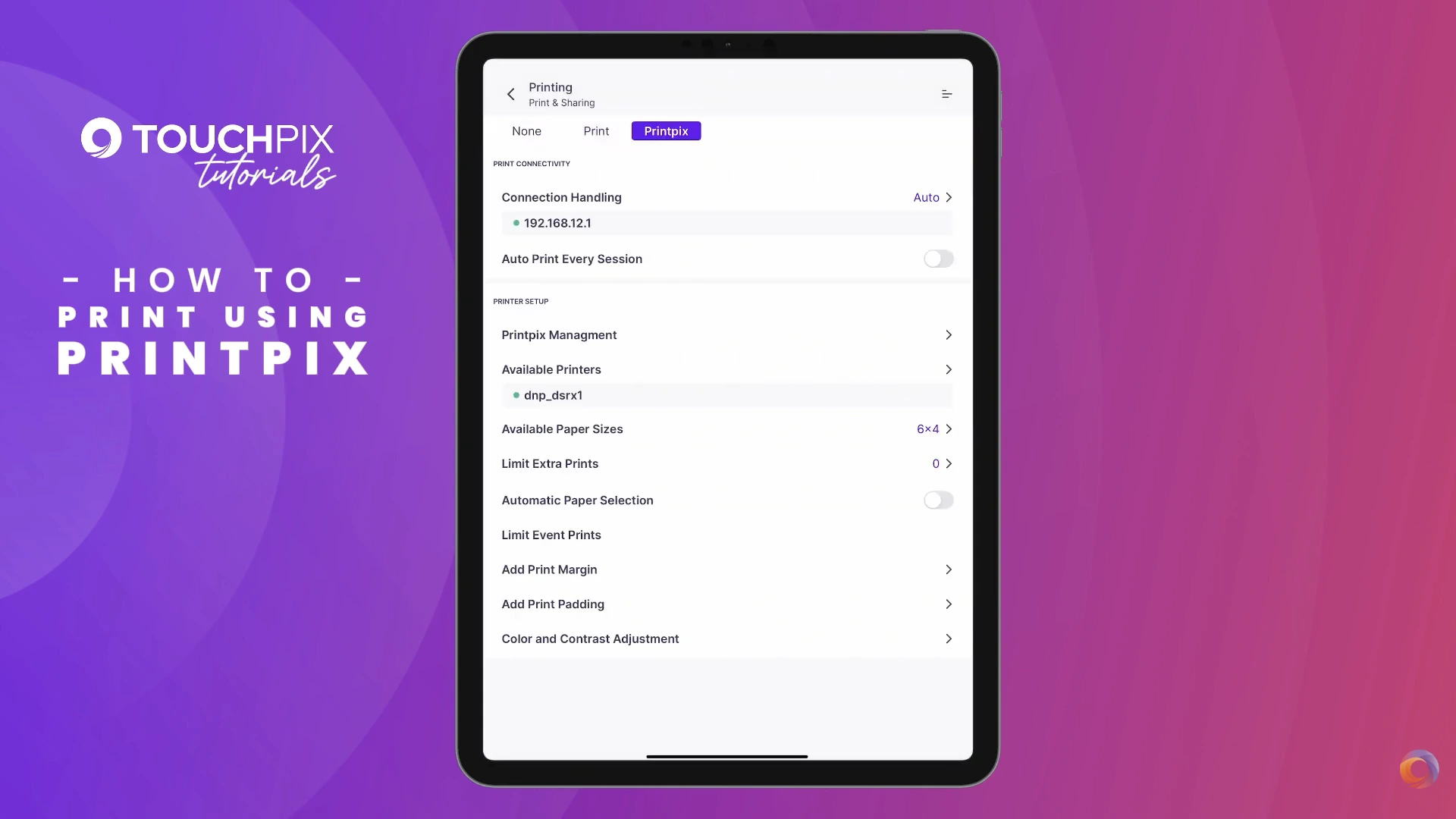
Touchpix offers three printing options: the $340 Printpix hardware box that connects directly to a dye-sub printer without requiring a computer, and downloadable Windows and Mac print server software for operators who prefer a laptop-based setup.
Source: Touchpix
Compatibility spans over 3,000 printer models across every major professional brand. For operators who want to eliminate the laptop from their kit, the Printpix box is a strong option.
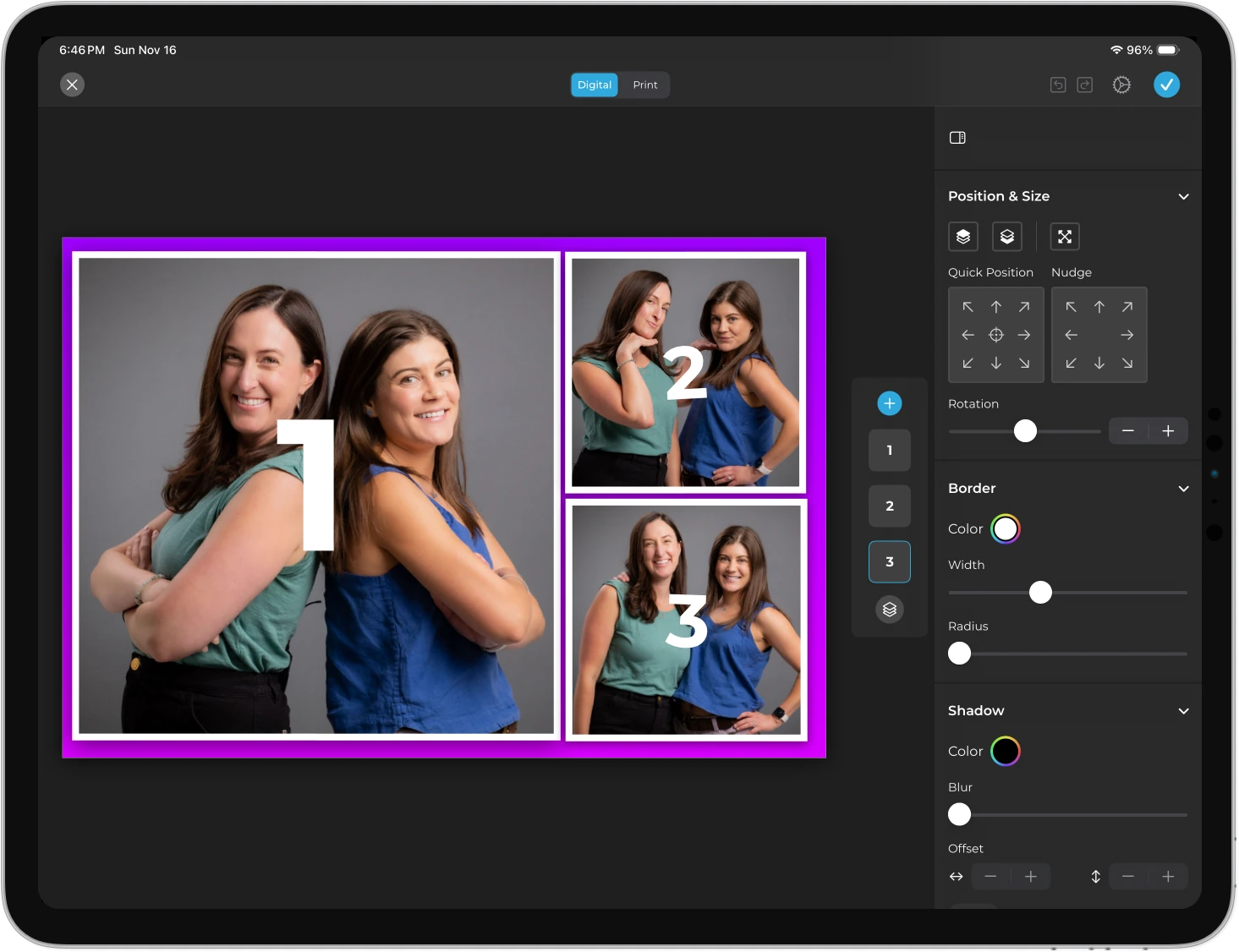
Simple Booth supports wireless printing through compatible dye-sub printers and the AirCast Pro and DNP WCM wireless interfaces. The Layout Designer handles strip design in-app. Printing is available on all subscription tiers.
Source: Simple Booth
LumaBooth vs Touchpix vs Simple Booth: Which should you choose?
The right photo booth software depends on your hardware, your business model, and what you’re delivering to clients.
Choose LumaBooth if:
- You run booths on both Windows PCs and iPads and need one platform across both
- You own Canon, Nikon, or Sony DSLRs and want to use them in your booth
- You need the broadest range of booth types (360, mirror, glam, green screen, video guestbook) in a single subscription
- Budget is a priority and $17/month annual pricing fits your model
- You’re comfortable sourcing and managing your own hardware setup
Get started with LumaBooth’s unlimited free trial.
Choose Touchpix if:
- 360-degree spinning video is your primary booth format
- You want to run the same software on any device you own (iOS, Android, Windows, Mac, Linux)
- Offline media delivery at venues without internet is a non-negotiable requirement
- You’re scaling a fleet and want unlimited devices per subscription
- You need a dedicated print server box that eliminates the laptop from your event kit
Try Touchpix free for 14 days.
Choose Simple Booth if:
- You want consistent, professional photo quality without assembling a DIY hardware rig
- Your clients expect branded activations with lead capture, analytics, and marketing data
- You need a self-operating booth that runs reliably without a trained attendant on-site
- You want both physical (HALO) and virtual (browser-based) photo booth capabilities under one platform
- You’re building a business where the booth is a marketing tool, not just entertainment
See Simple Booth in action with a free trial.
LumaBooth and Touchpix have built strong software platforms for operators who want flexibility in how they assemble their booth setup. Simple Booth offers something different: a complete system where hardware, software, and marketing tools are designed together.
For operators who measure success in photos delivered, either software-only option works well. For those who measure success in leads captured, brands served, and repeat business earned, Simple Booth’s integrated approach pays for the premium.
“10+ years, we’re big Simple Booth believers.” (G7 Entertainment Marketing, 136,000+ fan interactions)
LumaBooth vs Touchpix vs Simple Booth FAQ
What is the main difference between LumaBooth, Touchpix, and Simple Booth?
LumaBooth is photo booth software for Windows and Apple that works with a wide range of DSLR cameras and covers every booth type in a single subscription.
Touchpix is a cross-platform photo booth app running on six operating systems with a focus on 360 video booths and offline sharing.
Simple Booth is an integrated hardware-and-software system pairing an aluminum ring-light chassis with an iPad app, designed for consistent photo quality and marketing data capture.
Which platform is cheapest to get started with?
LumaBooth has the lowest entry price at $17/month billed annually for Windows or $18/month for Apple. Touchpix’s entry-level PhotoPass is $439.90/year (roughly $37/month) but includes unlimited devices. Simple Booth’s Core plan starts at $49/month or $490/year, plus the cost of HALO hardware for the full integrated experience. Simple Booth also offers a Lite version, starting at $14.99 per week.
Each pricing model serves different operator profiles: LumaBooth is cheapest per device, Touchpix is cheapest per fleet, and Simple Booth includes marketing tools that the others charge extra for or lack entirely.
Which platform is best for 360-degree video booths?
Touchpix is the strongest choice for 360 booths. It has native Bluetooth trigger integration with spinning platforms, wired GoPro 7-14 support, speed ramp controls, and 360-specific overlay effects. LumaBooth also supports 360 booths with high-frame-rate capture and animated overlays on both Windows (with GoPro) and Apple (with iPad camera). Simple Booth does not offer a dedicated 360 booth mode.
Can any of these platforms work without internet at events?
All three have offline capabilities, but the approach differs. Touchpix’s Scanpix 2 delivers media to guests instantly over a local network with no internet, running directly from the booth device. LumaBooth offers a similar offline QR system through LumaShare, requiring a companion device and local router setup.
Simple Booth queues sessions offline and delivers them automatically once connectivity returns, but does not provide instant offline guest delivery.
Which platform runs on the most devices?
Touchpix runs on six platforms: iOS, Android, macOS, Windows, Linux, and Raspberry Pi, with unlimited devices per subscription. LumaBooth covers Windows PC and iPad/iPhone/Mac. Simple Booth runs exclusively on iPad. If device flexibility is the top priority, Touchpix offers the widest compatibility.
Which platform is best for brand activations and marketing teams?
Simple Booth is designed for this use case. Its lead capture forms achieve 87-89% opt-in rates, data syncs to MailChimp natively and to any CRM via API, and the analytics dashboard tracks gallery views, social shares, and demographic insights. Virtual Booth extends the branded experience to remote audiences with no hardware.
LumaBooth and Touchpix focus on the photo capture experience and offer basic survey tools, but lack the marketing infrastructure that brand activation clients expect.
Do any of these platforms include their own hardware?
Only Simple Booth sells proprietary hardware. The HALO ring-light chassis is machined from aluminum with 112 LEDs rated for 50,000 hours, and comes in an Event Kit (selfie stand + travel case) or Install Kit (wall mount). LumaBooth and Touchpix are software-only (operators source their own cameras, lighting, stands, and enclosures). Touchpix sells a Printpix print server box ($340) but not booth hardware.
How do the free trials compare?
LumaBooth offers an unlimited-duration trial with a permanent watermark on all output until you subscribe. Touchpix provides a 14-day full-feature trial with no watermarks. Simple Booth offers a 7-day free trial with 25 AI credits included. LumaBooth’s trial is the most flexible for testing, but Touchpix’s 14 days of clean output let you test at a real event without watermarked photos going to guests.
Keep reading
 Showdowns
Simple Booth vs LumaBooth: Which Photo Booth Software Fits Your Business in 2026?
Turnkey hardware vs budget cross-platform app. Simple Booth or LumaBooth?
 Showdowns
Snappic vs Touchpix (vs Simple Booth): Which Photo Booth Software Should You Choose in 2026?
Multi-format all-rounder vs 360 video specialist. Snappic or Touchpix?
 Showdowns
LumaBooth vs Snappic (vs Simple Booth): Which Photo Booth Software Fits Your Business in 2026?
Budget multi-format app vs enterprise fleet platform. LumaBooth or Snappic?