Simple Booth vs LumaBooth: Which Photo Booth Software Fits Your Business in 2026?

Choosing between Simple Booth and LumaBooth for your photo booth business comes down to five questions:
- Do you need cross-platform support across Windows and iPad, or will an iPad-only system cover your events?
- Would you rather build a booth from your own camera gear and rig, or invest in an integrated hardware-software kit?
- Is your priority offering diverse booth formats (360, mirror, and glam), or capturing leads and marketing data alongside photos?
- Do you need a browser-based booth option for digital or hybrid activations?
- Are you optimizing for the lowest software subscription cost, or for a system that can run unattended?
In short, here’s what we recommend:
LumaBooth is cross-platform photo booth software that runs on Windows, iPad, iPhone, and Mac. It supports Canon, Nikon, Sony, GoPro, and webcam hardware, and includes dedicated modes for 360, mirror, glam, and video guestbook booths within a single subscription.
The LumaBooth Dashboard lets operators configure events from any browser and sync settings across devices. At $17/month annually for Windows, it covers a wide range at a low price. LumaBooth works well for operators who own their camera equipment and want flexibility across booth types and platforms.
Simple Booth is an integrated hardware and software photo booth system built around the HALO ring-light chassis and iPad app. The patented aluminum body houses 112 LEDs producing up to 2,100 lumens, delivering consistent lighting without external equipment.
The software captures first-party data at events, and a browser-based Virtual Booth extends branded photo experiences to any device without hardware. Core plans start at $490/year, with HALO kits sold separately. Simple Booth fits operators and brand marketers who want a self-operating system that generates leads alongside photos.
Both platforms produce professional results but serve different priorities. LumaBooth offers the widest platform and camera support at a lower subscription price, while Simple Booth provides an integrated system with built-in marketing tools designed to run without supervision.
Simple Booth vs LumaBooth at a glance
| LumaBooth | Simple Booth | |
|---|---|---|
| Platforms | Windows, iPad, iPhone, Mac | iPad only |
| Camera Support | Canon, Nikon, Sony, GoPro, webcam | iPad camera; Canon & Sony DSLR/mirrorless (Core+) |
| Booth Types | Photo, GIF, boomerang, video, 360, mirror, glam | Photo, GIF, boomerang, video |
| Hardware | Bring your own camera and rig | HALO ring-light kits (machined aluminum) |
| AI Capabilities | 170+ AI Portrait presets, custom prompts | AI Effects with per-frame prompts and guest input |
| Lead Capture | Survey with CSV export | Form-based with CRM sync |
| Remote Management | Browser dashboard, cross-platform sync | Browser dashboard, iPad sync |
| Starting Price (annual) | $17/month (Windows); $18/month (Apple) | ~$41/month ($490/year) for Core |
| Free Trial | Unlimited duration (watermarked output) | 7-day trial |
| Best For | Operators wanting cross-platform flexibility and diverse booth types | Operators and marketers wanting an integrated, self-operating system |
The core difference: Platform flexibility vs integrated system
LumaBooth started as dslrBooth, a Windows DSLR tethering tool first released in 2012. Over 14 years, it expanded to iPad, iPhone, and Mac, and in March 2026 unified all platforms under the LumaBooth brand with version 8.0 for Windows and 5.0 for Apple.
The philosophy has stayed the same: provide the software and let operators choose their own cameras, rigs, and enclosures. This bring-your-own approach lets operators build exactly the booth they want, from a basic webcam setup to a multi-camera 360 spinner.
LumaBooth calls itself the only photo booth software that connects Windows and iOS under one roof. The browser-based Dashboard lets operators configure an event once and push it to any connected device. For operators managing mixed-device fleets across multiple simultaneous events, this cross-platform reach is an advantage most competitors can’t match.
Simple Booth was founded in 2013 by Mark Hennings and Jeremy Cox as one of the first iPad photo booth apps for live events. By 2015, the company had developed the HALO hardware, a machined aluminum ring light with a built-in iPad mount.
Rather than leaving hardware decisions to the operator, Simple Booth integrated vertically: one vendor provides the chassis, the lighting, the software, and the cloud platform.
This narrows the hardware options (iPad only, no Windows or Android) but simplifies the operator’s experience. The preset editor displays the entire booth flow in a visual layout from start screen to photo delivery, making event setup faster than navigating nested settings panels.
The HALO sets up in under one minute without tools, the concealed USB-C cable keeps the iPad charged through the event, and the app’s Preflight Check catches configuration issues before guests arrive. The company ranked #414 on the Inc. 5000 in 2018 with 1,210% three-year revenue growth, evidence that the integrated approach found buyers.
LumaBooth offers more booth types and camera options
LumaBooth’s main advantage is the range of experiences it supports in a single subscription.
The 360 Booth captures high-frame-rate video as a motorized arm spins around guests, then applies speed ramps, overlays, and soundtracks. Windows supports cameras up to 120 fps, while recent iPads reach 240 fps. Motion detection can start recording automatically when the spinner moves, so the booth runs unattended.
The Mirror Booth uses a life-size touch display where a Virtual Attendant guides guests through the session with video animations. Guests touch the mirror surface to add their signature, stickers, and emojis to prints.

Source: LumaBooth
The Glam Booth applies real-time skin smoothing and optional black-and-white filters. The beauty filter shows in the live view before the shutter fires, so guests see the effect while posing. The Video Guestbook records short personal messages with optional Virtual Attendant prompts and runs on the same hardware as every other mode.
Simple Booth covers photos, GIFs, boomerang clips, and full-length video on Core plans and above, plus background blur, glam smoothing, and AI background replacement as software effects. But it does not offer dedicated 360, mirror, or video guestbook modes. Operators who rely on these formats to differentiate their services will find LumaBooth more versatile.

Source: Simple Booth
Camera compatibility follows the same pattern. LumaBooth for Windows supports Canon, Nikon, Sony mirrorless, GoPro 5-13, and webcams. LumaBooth for Apple connects to Canon, Nikon, and 18+ Sony mirrorless models via USB.
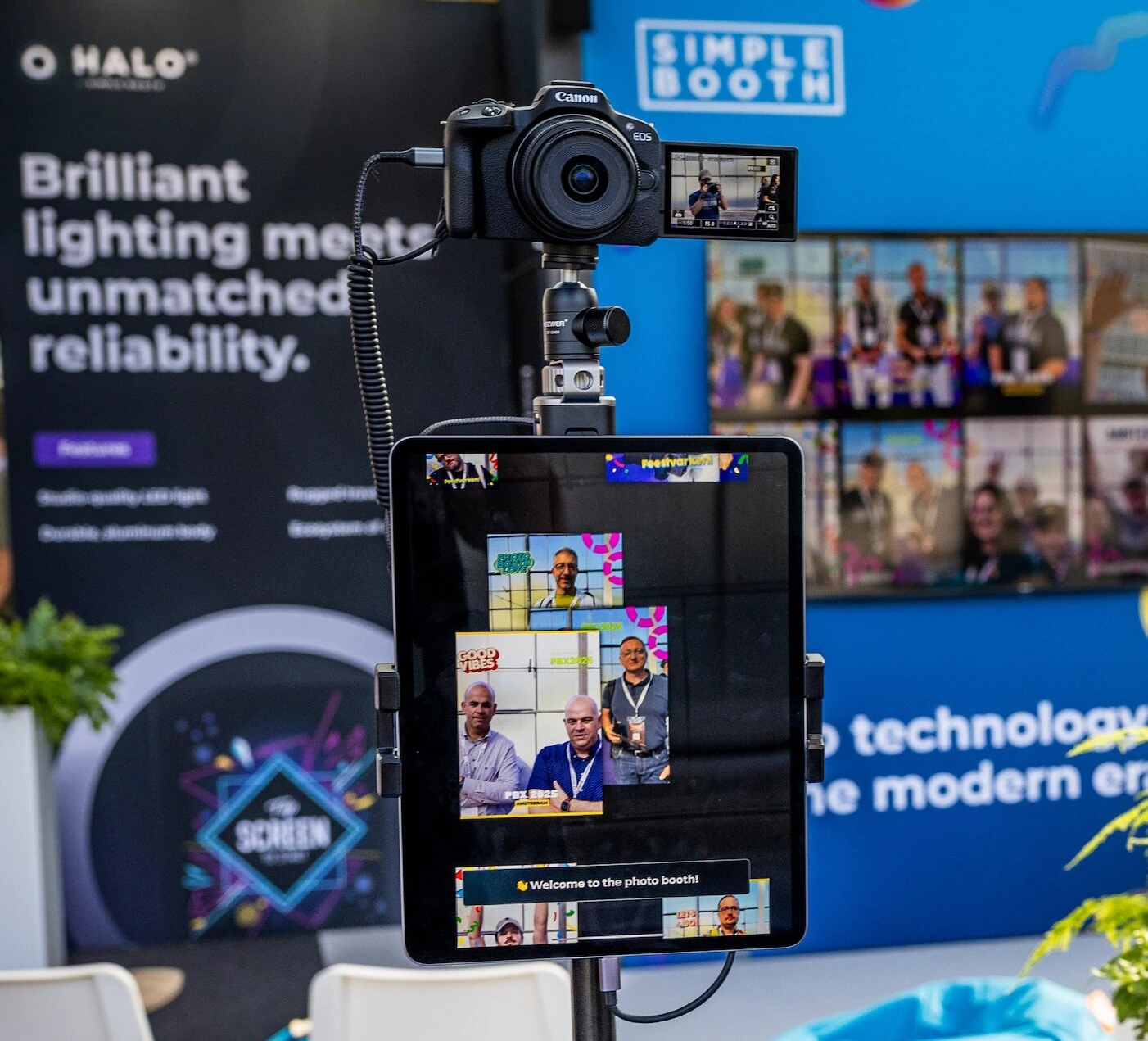
Simple Booth supports Canon and Sony DSLR and mirrorless cameras on Core+ plans via wired USB or wireless Wi-Fi, with Nikon support listed as coming soon. The wireless option sets it apart from most competitors. Operators who need GoPro or webcam support will find broader compatibility in LumaBooth.
Source: Simple Booth
LumaBooth also includes cashless payments on Windows, letting operators charge guests per print or per download through a QR code. The system accepts Apple Pay, Google Pay, PayPal, and credit/debit cards via Stripe, with no extra hardware. Simple Booth does not offer built-in payment processing.
Simple Booth adds proprietary hardware and a virtual booth option
Where LumaBooth asks operators to source their own equipment, Simple Booth provides the full package.
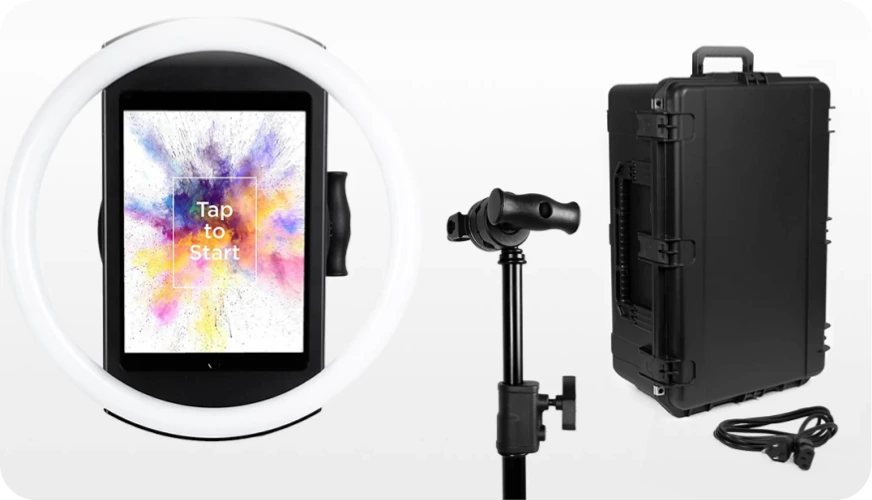
The HALO body weighs 6.5 lbs, supports portrait and landscape orientation, and is cut from a single billet of anodized aluminum with LEDs rated for 50,000 hours. The ring light illuminates groups standing 6-8 feet back from the camera, with brightness adjustable via a physical dial.
Source: Simple Booth
Two kit configurations cover the most common use cases: the Event Kit pairs the HALO with an adjustable selfie stand and waterproof travel case for rental operators, while the Install Kit includes a steel wall mount for permanent venues.
The HALO runs on AC power with dual voltage support (110V-240V) for international use. Compatible portable batteries provide 6+ hours of runtime for events without wall outlets.
The software complements the hardware with features built for unsupervised operation. Mission Control, triggered by a two-finger pinch, lets operators monitor device health and adjust settings without breaking the guest-facing interface. The offline upload queue stores sessions when Wi-Fi drops and delivers them when connectivity returns.
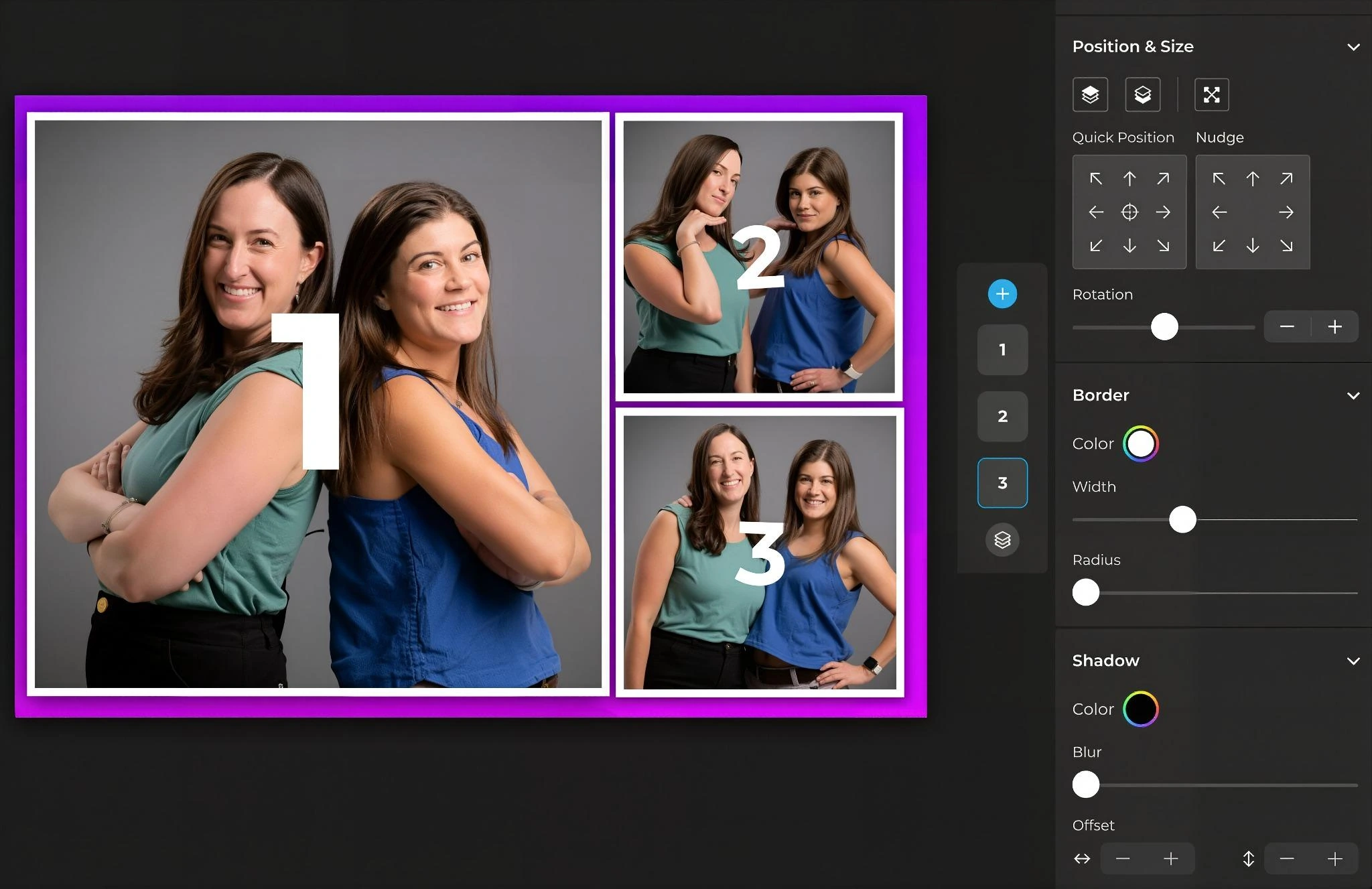
The HALO 5.0 update (November 2025) added a Layout Designer on Core plans and above for creating templates in the app or web dashboard, with 60+ importable themes, dynamic QR codes, multiple motion types per layout, and layer-level control over every design element.
Source: Simple Booth
The designer offers more template tools than LumaBooth’s layout editor, eliminating the need for external graphics software. The same update introduced WhatsApp delivery for international markets.
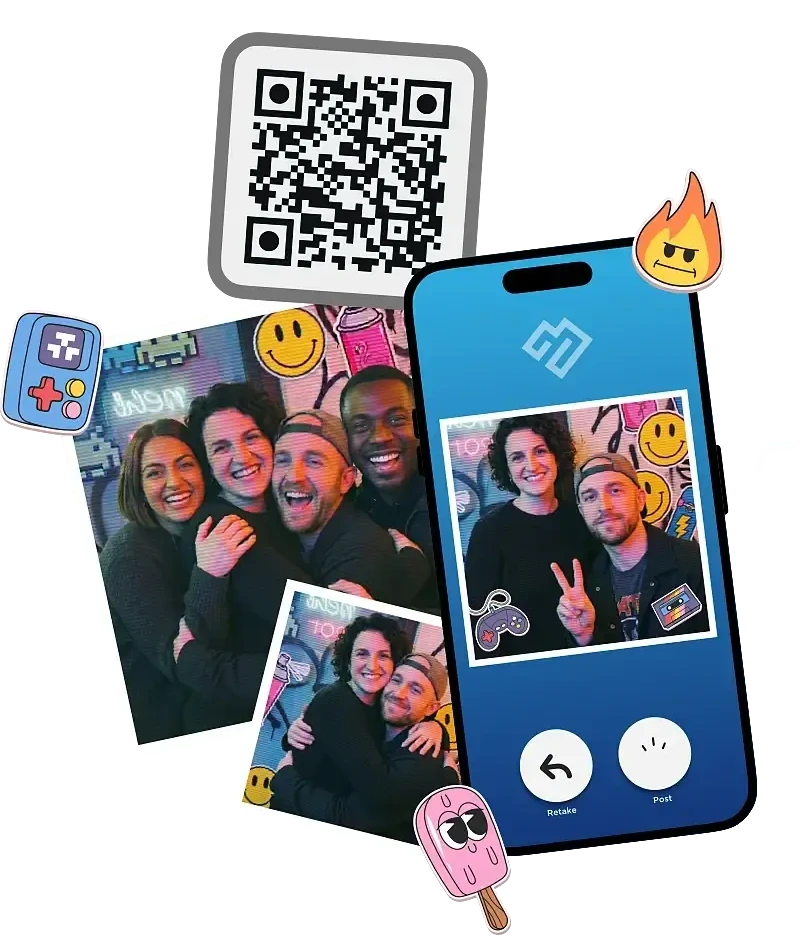
Simple Booth also offers something LumaBooth does not: Virtual Booth, a browser-based photo experience that requires no hardware or app. Participants join via a link or QR code, take or upload a photo, apply overlays and AI effects, and submit to a branded gallery.
Source: Simple Booth
Virtual Booth supports automatic localization in nine languages and can run unlimited concurrent events under one account. For brand marketers running hybrid activations or always-on campaigns embedded in emails and packaging, it extends the photo booth concept beyond physical events.
Amore Entertainment launched a photo booth business during COVID with no prior experience and scaled to multiple booths using Simple Booth’s integrated system. (Amore Entertainment)
AI capabilities compared
Both platforms offer AI photo transformation, but they differ in library depth vs. creative flexibility.
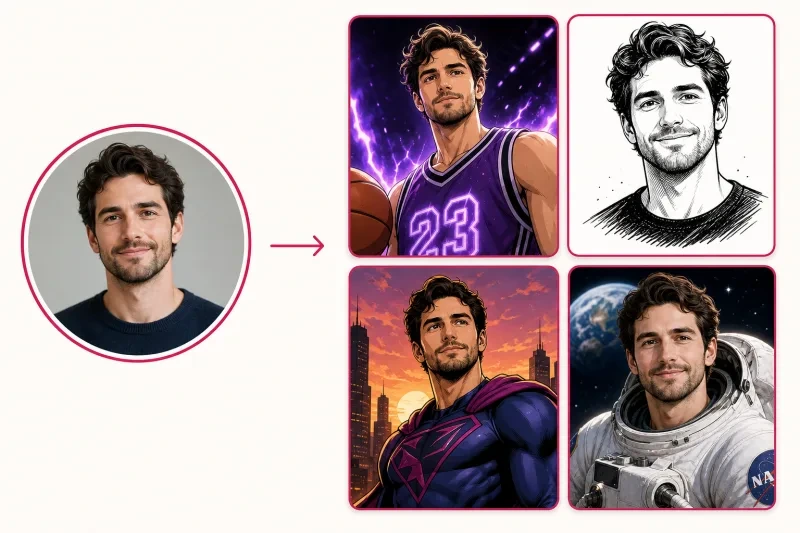
LumaBooth ships with over 170 AI Portrait presets organized into categories like Superheroes, Fantasy, Historical Eras, Art Styles, and Figurines. Each generation takes about 10 seconds and runs in LumaBooth’s cloud.
The Custom AI Portraits feature lets operators write free-text prompts, upload reference images, and attach per-guest questions so answers (name, jersey number, chosen theme) render directly into the artwork.
Source: LumaBooth
AI credits come in monthly plans ($14.99 for 150 credits up to $199.99 for 2,000 credits) or as pay-as-you-go packs that never expire. New subscribers receive 20 free credits.
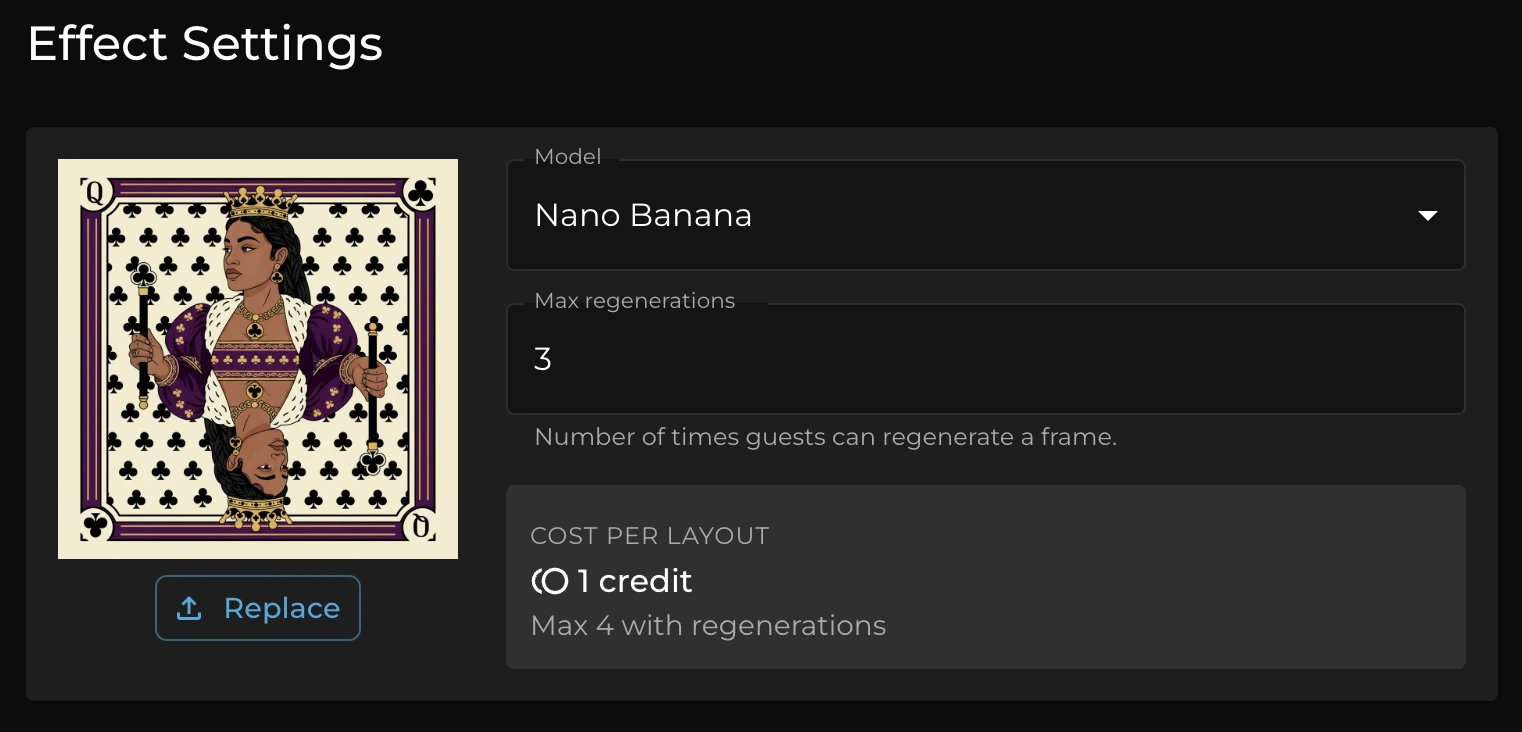
Simple Booth uses three Nano Banana AI models that balance speed, quality, and group support. Nano Banana 1 is fastest at 1 credit per generation for individuals. Nano Banana 2 handles groups up to 5 at 2 credits. Nano Banana Pro produces the highest quality at 3 credits.
Source: Simple Booth
Simple Booth’s distinguishing AI feature is per-frame prompt assignment: operators can apply a unique prompt to each frame in a multi-frame layout, creating sequential comic-strip panels or cinematic scene strips rather than a single-style transformation.
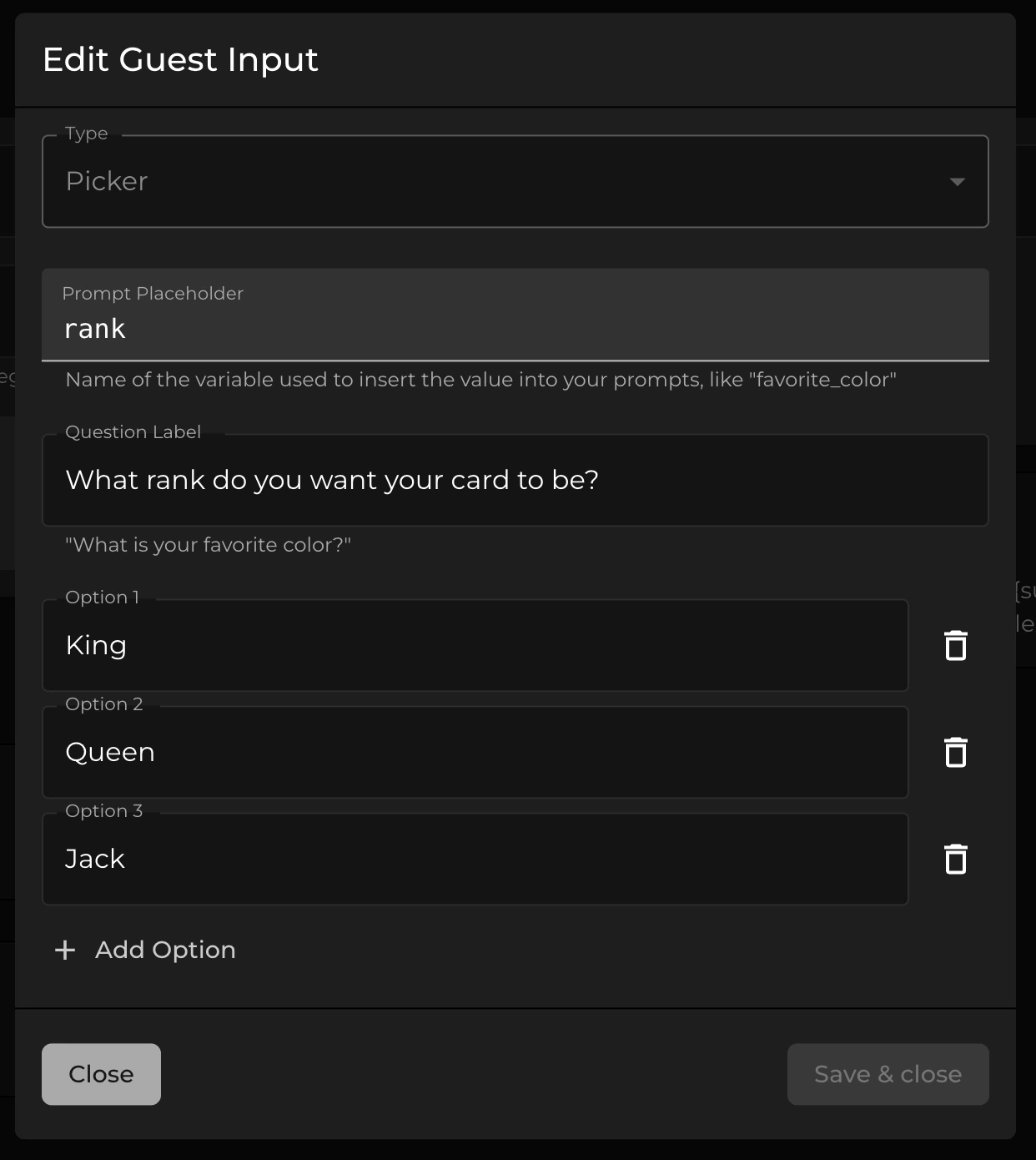
The Guest Input system injects participant answers into prompts as template variables, producing a personalized output for every guest. The platform also offers zero-cost prompt testing outside booth mode, so operators can iterate freely before events. Credits cost $0.10 each and do not expire.
Source: Simple Booth
LumaBooth’s larger preset library makes it easy to offer variety with minimal setup. Simple Booth’s per-frame system and guest input variables give operators more creative control for custom branded activations.
Sharing, lead capture, and marketing
LumaBooth delivers photos through built-in sharing and the LumaShare companion app. Channels include email, SMS, WhatsApp, AirDrop, Instagram, and QR code. LumaShare runs on iPad, iPhone, Mac, and Android as a separate sharing and slideshow station, keeping the main booth free for the next guest.
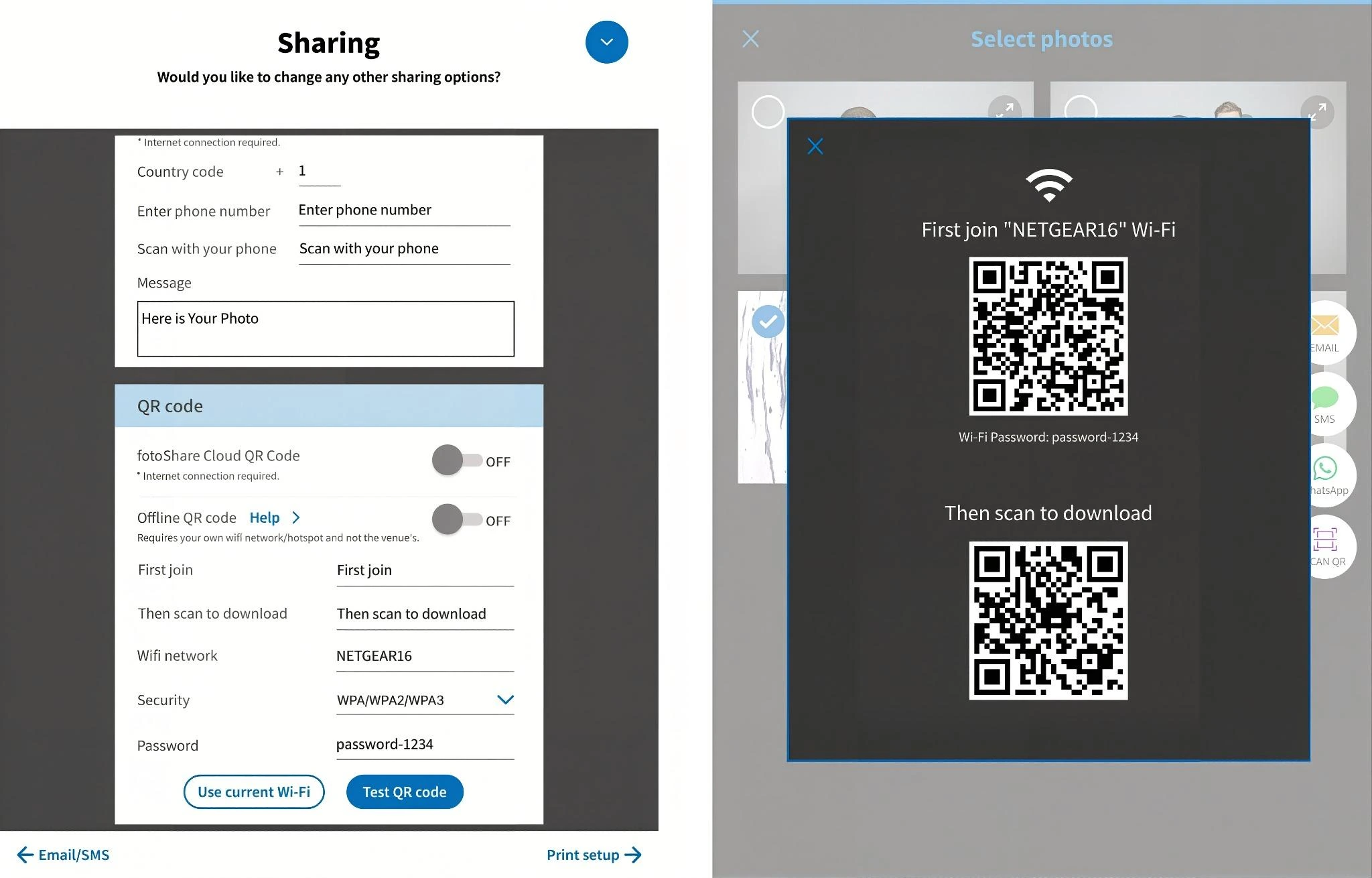
A notable feature is offline QR code sharing: guests scan a QR code to join a local Wi-Fi network, then scan a second code to receive their media on their phone, no internet required. For venues with unreliable connectivity, this two-step delivery solves a problem cloud-only sharing cannot.
Source: LumaBooth
All media uploads to fotoShare Cloud, which creates branded event galleries with guest sharing and contact data export. The Basic plan is free; Plus ($19.99/month) and Business ($39.99/month) add password protection, custom subdomains, Google Analytics integration, and per-event analytics.
For data collection, LumaBooth’s survey tool supports short answer, long answer, and multiple choice questions, with CSV export. Operators can mark individual questions as required, and survey answers can print directly onto the guest’s photo as personalized text.
Simple Booth treats lead capture as a central feature, not an add-on. The data capture form sits inside the booth flow at the moment guests receive their photo.
Pro plans support 6 standard fields (email, name, phone, postal code, date of birth), while Select supports up to 10 custom fields with checkboxes and required legal terms. Data syncs to MailChimp natively or exports via the Open API on Pro and Select plans.
The analytics dashboard tracks participants, gallery views, and social sharing activity. Demographic insights via face detection (age estimation, gender breakdown, average group size) are available at the Select tier. A Live Feed turns any public gallery into a real-time slideshow for TVs or projectors.
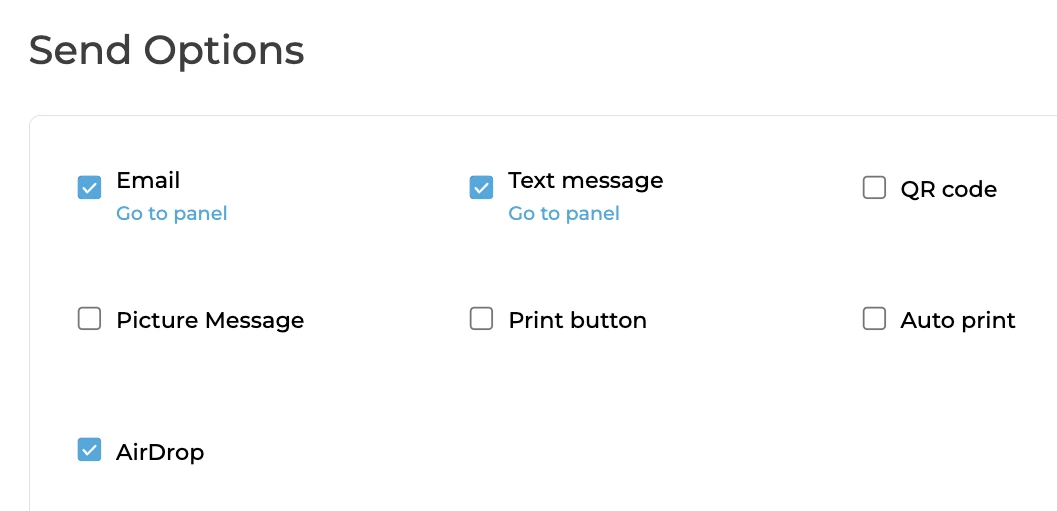
For sharing, Simple Booth supports QR code, email, SMS, AirDrop, and WhatsApp delivery. It converts layouts into Instagram-compatible files automatically when the original format won’t upload directly, reducing friction between booth capture and social posting.
Source: Simple Booth
The difference in philosophy is clear: LumaBooth gives operators sharing and data collection tools alongside the booth; Simple Booth builds the marketing workflow into the booth itself.
Treetop Golf captured 150,000 unique email addresses across its venues by collecting contact information through Simple Booth’s built-in data capture. (Treetop Golf)
Pricing comparison
LumaBooth uses a single subscription tier per platform that unlocks all software features. Each subscription includes two devices:
| Platform | Annual | Monthly |
|---|---|---|
| LumaBooth for Windows | $17/month (billed annually, ~$204/year) | $49.99/month |
| LumaBooth for Apple | $18/month (billed annually, ~$216/year) | $19.99/month |
The free trial has no time limit; a watermark appears on all output until a subscription is activated.
Potential add-on costs include: fotoShare Cloud Plus at $19.99/month or Business at $39.99/month, LumaShare at $7.99/month, an SMS plan at $10/month, and AI credits starting at $14.99/month for 150 credits. Operators running standard photo, GIF, and green screen booths without AI or premium cloud features can run on the base subscription alone.
Simple Booth uses a tiered model where higher plans unlock more features:
| Plan | Annual | Monthly | Weekly |
|---|---|---|---|
| Lite | $289.99/year | $29.99/month | $14.99/week |
| Core | $490/year | $49/month | $24/week |
| Plus | $990/year | $99/month | $49/week |
| Pro | $1,490/year | $149/month | - |
| Select | $2,490/year | $249/month | - |
Each plan includes one device license. Additional devices require add-on licenses at a discounted rate. HALO hardware kits are sold separately. A 7-day free trial is available with 25 free AI credits.
Weekly billing is unique to Simple Booth and matters for seasonal rental operators who want to avoid paying during slow months. No other photo booth software in this comparison offers that option.
The subscription cost gap is large. LumaBooth’s annual Windows subscription runs about $204/year and covers two devices. Simple Booth’s Core plan costs $490/year for one device. An operator running two booths on Simple Booth Core would pay roughly $850/year ($490 first license + $360 add-on), about four times LumaBooth’s Windows annual rate.
But the comparison isn’t purely about subscription cost. LumaBooth operators need to source their own ring lights, stands, enclosures, and iPad mounts separately, while Simple Booth bundles lighting and mounting into the HALO kit.
Operators who already own camera rigs and enclosures will save with LumaBooth. Those starting from scratch may find Simple Booth’s total cost more competitive once hardware is factored in.
Feature gating also affects the math. Custom branding requires Simple Booth Plus ($990/year). Lead capture requires Pro ($1,490/year). Demographic analytics and compliance tools require Select ($2,490/year).
LumaBooth includes all software features in its single subscription tier, though its data collection is limited to surveys with CSV export and does not include CRM integration or analytics dashboards.
Simple Booth vs LumaBooth: Which should you choose?
Choose LumaBooth if:
- You need cross-platform support on both Windows and iPad/iPhone/Mac
- You own Nikon or GoPro cameras you want to use with your booth
- 360 booth, mirror booth, or video guestbook formats are important to your business
- You want cashless pay-per-print capability at public venues or festivals
- Budget is a primary concern and you already have camera hardware
- You want all features unlocked in a single subscription tier
- You prefer an unlimited-duration free trial before committing
Choose Simple Booth if:
- You want an integrated hardware and software system from a single vendor
- Lead capture, analytics, and marketing ROI are core business requirements
- You need a browser-based Virtual Booth for digital or hybrid activations
- You value unattended operation with built-in safeguards (Mission Control and offline queuing)
- You are starting a photo booth business and want a complete setup without sourcing equipment separately
- Enterprise compliance features (moderation, age gate, custom legal terms) matter for your clients
- Weekly billing fits your seasonal event calendar
Both platforms produce professional results, but they fit different operator profiles. LumaBooth serves operators who want hardware flexibility, diverse booth formats, and cross-platform management at a lower subscription price. It rewards operators who bring their own equipment and want to build a custom setup.
Simple Booth serves operators and brand marketers who want a system that works from the moment they set it up, captures marketing data when guests engage, and runs reliably without an attendant. Its narrower hardware support is the trade-off for a more integrated experience.
The right choice depends on what you’re building. If your business revolves around 360 spinners, mirror booths, and multi-camera setups across Windows and iPad, LumaBooth gives you the flexibility. If your business depends on reliable unattended operation, first-party data capture, and a branded experience from a single vendor, Simple Booth delivers that in one package.
Simple Booth vs LumaBooth FAQ
What platforms does each software support?
LumaBooth runs on Windows PC, iPad, iPhone, and Mac, making it the more versatile option for operators with mixed-device setups. Simple Booth runs only on iPad. Neither platform offers an Android booth app.
Can I use my existing DSLR or mirrorless camera with both platforms?
LumaBooth supports Canon, Nikon, Sony mirrorless, and GoPro cameras on Windows, and Canon, Nikon, and Sony on Apple devices. Simple Booth supports Canon and Sony DSLR and mirrorless cameras on its Core plan and above via wired or wireless connections, with Nikon support coming soon.
Which platform is cheaper for software alone?
LumaBooth costs less. Its Windows annual subscription runs about $204/year and includes two devices with all software features unlocked. Simple Booth’s Core plan is $490/year for one device, and features like custom branding, lead capture, and analytics require higher-tier plans ranging from $990 to $2,490/year.
Does Simple Booth offer 360 or mirror booth modes?
No. Simple Booth supports still photos, GIFs, boomerang clips, and full-length video, but does not include dedicated 360, mirror, or video guestbook modes. LumaBooth includes all three within its standard subscription.
Which platform is better for lead capture and marketing?
Simple Booth is the stronger choice for marketing-focused deployments. Its data capture forms report opt-in rates as high as 87-89%, with native MailChimp integration and API access for custom CRM delivery on Pro and Select plans. LumaBooth provides a survey tool with CSV export but does not include native CRM integrations or analytics dashboards.
Does LumaBooth offer a virtual booth option?
No. LumaBooth requires a physical device running its software at every event. Simple Booth’s Virtual Booth runs entirely in a web browser, letting participants join from their own phone or laptop via a link or QR code without any app or hardware.
What hardware do I need for each platform?
LumaBooth requires operators to supply their own camera, ring light, stand, and enclosure. Simple Booth sells the HALO ring-light kit as a package that includes the aluminum chassis and either a selfie stand or wall mount, with the iPad as the only separate purchase. Operators starting from scratch may find Simple Booth’s bundled approach simpler, while those with existing equipment can save by choosing LumaBooth.
How do the free trials compare?
LumaBooth offers an unlimited-duration free trial with no credit card required, but all output carries a watermark until a subscription is activated. Simple Booth offers a 7-day free trial with 25 free AI credits. LumaBooth’s trial is better for extended evaluation, while Simple Booth’s trial gives full access for a shorter window.
Keep reading
 Showdowns
Simple Booth vs Darkroom Booth: Which Photo Booth Software Fits Your Business in 2026?
iPad turnkey vs Windows DSLR veteran. Simple Booth or Darkroom Booth?
 Showdowns
Simple Booth vs Flassh: Which Photo Booth Platform Fits Your Events in 2026?
Integrated system vs speedy setup. Simple Booth or Flassh?
 Showdowns
Simple Booth vs POV Camera: Professional Photo Booth or Crowdsourced Guest Photos in 2026?
Branded booth vs crowdsourced phone snaps. Simple Booth or POV Camera?