Simple Booth vs Booth.Events: Which iPad Photo Booth App Fits Your Business in 2026?

If you’re comparing Simple Booth and Booth.Events for your photo booth business, the decision often comes down to these five questions:
- Do you need integrated ring-light hardware, or will you bring your own lighting and stands?
- Is affordable per-iPad software cost a priority, or would you invest more for a complete system?
- Do you need browser-based photo booth capabilities for virtual or hybrid events?
- How many iPads will you run simultaneously, and how flexible does licensing need to be?
- Are enterprise compliance features, brand moderation, and marketing analytics part of your requirements?
In short, here’s what we recommend:
Booth.Events is an iPad and iPhone photo booth app built for event professionals who want professional output without buying proprietary hardware. Changes you make in the web dashboard push instantly to every running iPad through Live Sync, so you can adjust a template mid-event from your phone.
SMS sharing works out of the box with no Twilio account to set up, and events can stay active for up to a year for long-running kiosk installations. With a 4.8-star App Store rating from 900+ reviews and licensing that only charges for iPads running simultaneously, it fits independent operators and growing businesses that want professional features at a competitive price.
Simple Booth pairs proprietary HALO ring-light hardware with a subscription iPad app, cloud dashboard, and browser-based Virtual Booth. The HALO chassis delivers consistent lighting from a machined aluminum body that sets up in under a minute with no tools.
Virtual Booth lets you run branded photo experiences for remote audiences without shipping equipment (participants join from their own device through a link or QR code).
With 30,000+ customers, a 4.7-star rating from 2,400+ reviews, and 40 million+ moments captured, Simple Booth serves operators and brand marketers who want a complete system with enterprise features and documented lead capture achieving 87%+ opt-in rates.
Both platforms run professional photo booths on iPads, but they take different approaches to hardware, pricing, and who they serve best.
Simple Booth vs Booth.Events at a glance
| Simple Booth | Booth.Events | |
|---|---|---|
| Core Focus | Integrated hardware + software platform | Cloud-first software platform |
| Proprietary Hardware | HALO ring-light kits (machined aluminum) | None (bring your own) |
| Platform Support | iPad only | iPad, iPhone, macOS |
| Virtual/Browser Booth | Yes (Virtual Booth) | No |
| DSLR Camera Support | Canon, Sony (Core+); Nikon coming soon | Canon, Nikon, Sony, GoPro |
| AI Background Removal | Included (Core+) | Included and works offline (all plans) |
| Built-in SMS | Standard delivery | No Twilio account required |
| Live Remote Device Control | Dashboard preset sync | Remote-In (Pro+) |
| App Store Rating | 4.7 stars (2,400+ ratings) | 4.8 stars (897 ratings) |
| White-Label Options | Plus+ and above | No platform logo on any plan |
| Starting Price | $49/month (Core, 1 device) | Not publicly listed |
| Pro-Tier Price | $149/month (Pro, 1 device) | $129/month (Pro+, 4 devices) |
| Best For | Premium rentals and brand activations | Cost-conscious operators and growing businesses |
The core difference: Premium ecosystem vs affordable flexibility
Simple Booth and Booth.Events solve the same problem (turning an iPad into a professional photo booth) but reflect different philosophies about how to do it.
Simple Booth started in 2013 when Mark Hennings, a wedding videographer, built one of the first photo booth apps designed for live events using an iPad. By 2015, co-founder Jeremy Cox had contributed the HALO hardware prototype, and Simple Booth became a vertically integrated company selling both hardware and software.
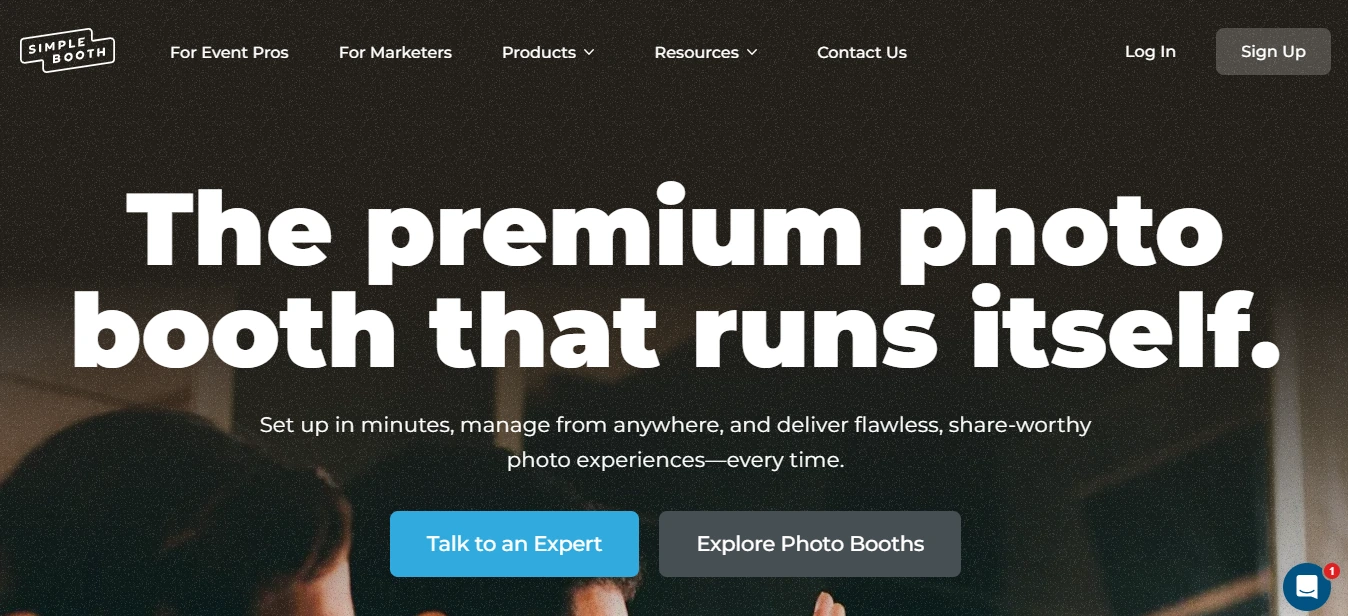
The company appeared on iPad demo loops in nearly every US Apple Store and was ranked #414 on the Inc. 5000 in 2018 with 1,210% three-year growth. Today it sells a complete system where lighting hardware, capture software, design tools, and marketing analytics all come from one vendor.
Booth.Events took a different path. Founded by Tim Carr, a professional photographer frustrated with the available photo booth apps, the company launched its cloud-first product around 2020 after Carr’s earlier Wifibooth app proved the concept.
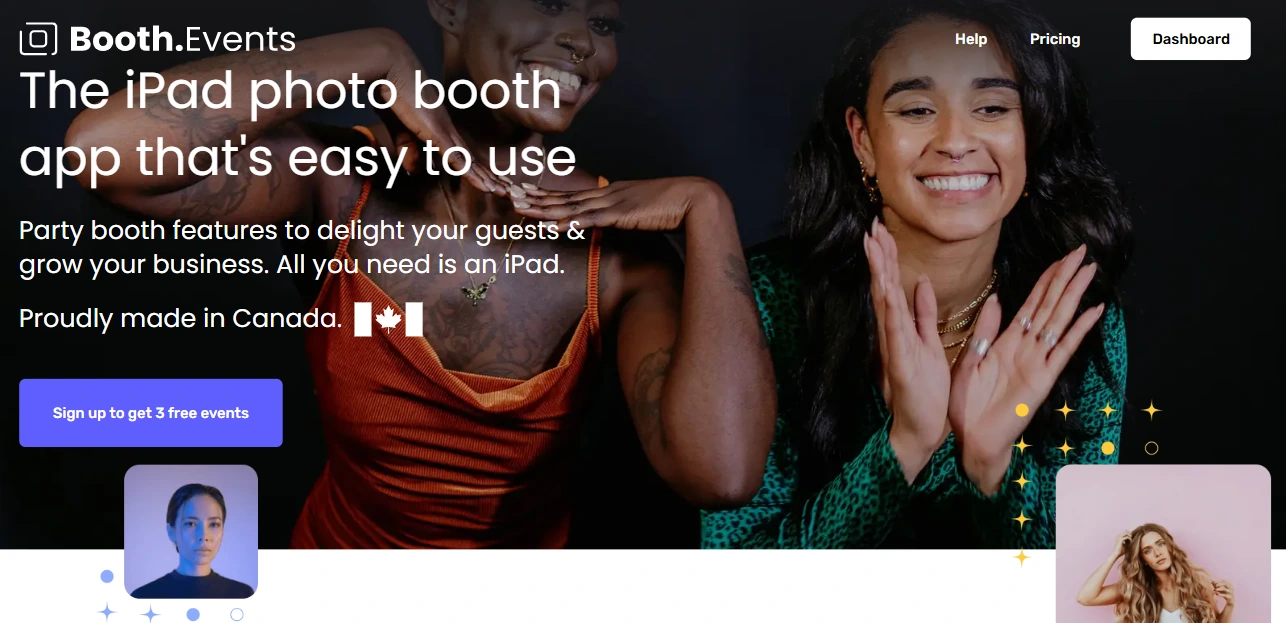
Where Simple Booth invested in proprietary hardware, Booth.Events invested in cloud infrastructure: a web dashboard that controls everything, Live Sync that pushes changes to iPads without restarts, and a licensing model that keeps costs lower by letting operators use their own equipment. The company’s homepage pitch captures its philosophy: “All you need is an iPad.”
This distinction shapes every decision downstream. Simple Booth controls the full experience from hardware lighting to software rendering. Booth.Events gives operators freedom to choose their own hardware while focusing software resources on operational tools like Remote-In and Scheduled Events.
Simple Booth adds proprietary hardware and virtual capabilities
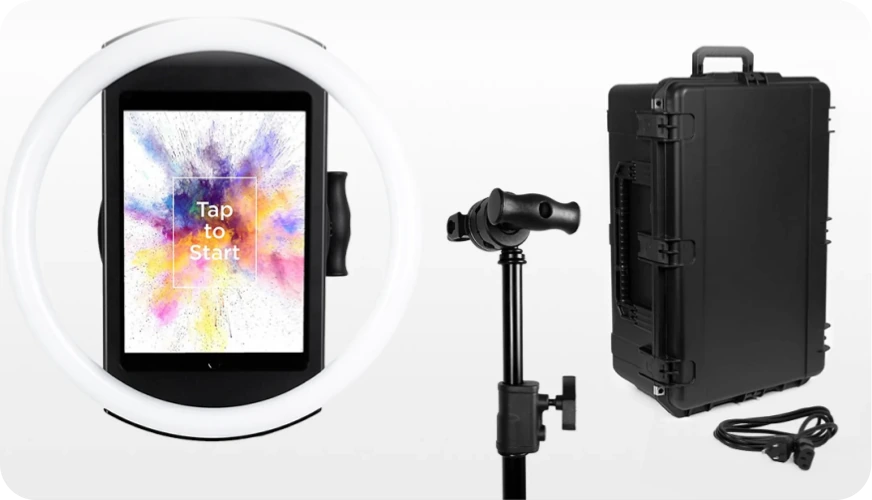

Simple Booth’s most obvious differentiator is the HALO photo booth kit, hardware that no software-only competitor can match. The chassis is machined from a single billet of anodized aluminum with a patented ring-light system containing 112 LEDs producing up to 2,100 lumens. The ring light evenly illuminates groups standing 6 to 8 feet away, and the LEDs are rated for 50,000 hours of operation.
Source: Simple Booth
Setup is fast. The iPad snaps into a tool-less faceplate, and a concealed USB-C cable keeps the device charged throughout the event. The full Event Kit (including a selfie stand and waterproof rolling travel case) weighs 49 pounds. Simple Booth claims setup takes under one minute, a real advantage for operators running multiple events per week.
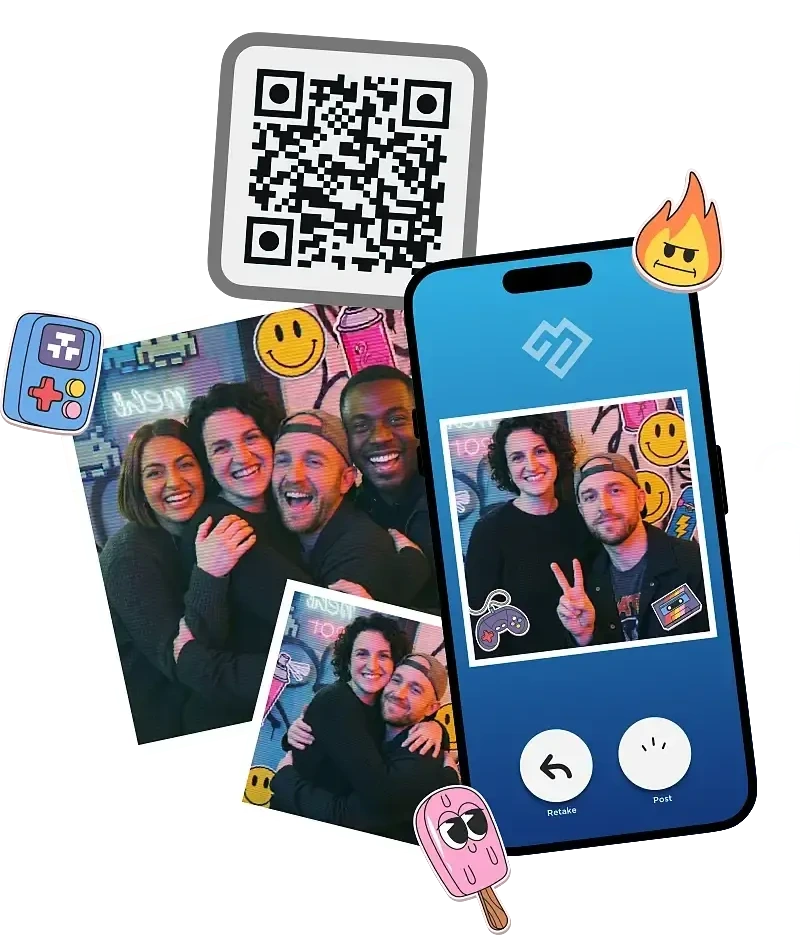
The second differentiator is Virtual Booth, a browser-based photo experience that requires no hardware or app installation from participants. Guests visit a link or scan a QR code, take a photo or upload one, apply effects and overlays, and submit to a branded gallery.
Source: Simple Booth
This opens use cases Booth.Events cannot serve: virtual events, hybrid activations, QR codes on product packaging, or persistent campaigns on a brand’s website. Virtual Booth localizes automatically into nine languages including Spanish, French, German, and Dutch. All submissions feed the same analytics and gallery infrastructure as the physical HALO app.
Booth.Events does not support virtual events or external photo uploads, so operators who need browser-based activation must look elsewhere.
Amore Entertainment launched their photo booth company with no prior experience, scaling to multiple booths with a system intuitive enough for their team to operate independently. (Amore Entertainment Case Study)
Booth.Events leads in operational flexibility
Where Simple Booth invests in hardware and breadth, Booth.Events invests in operational tools that make day-to-day booth management easier and cheaper.
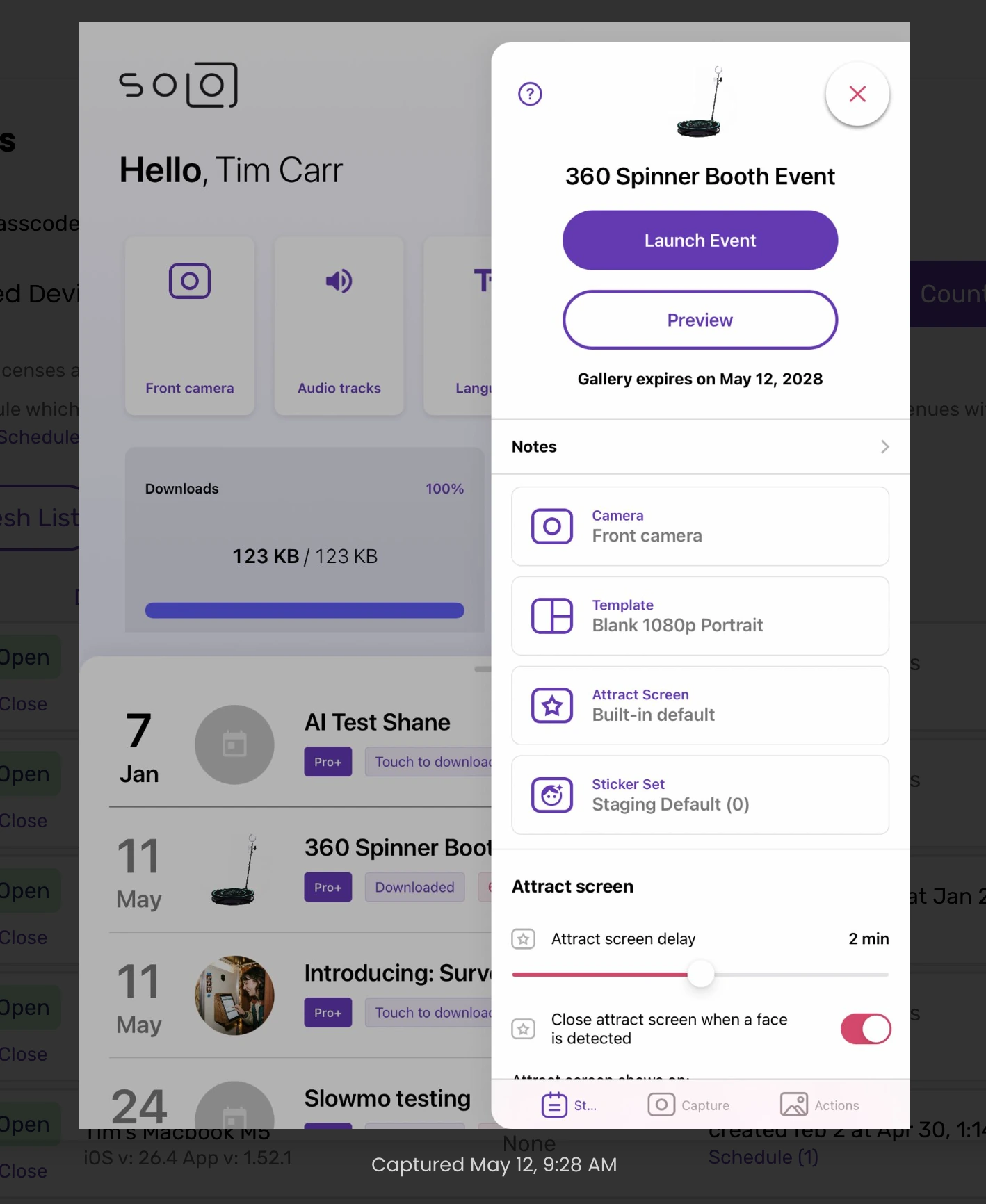
Live Sync is the flagship feature. When an operator changes a template, adjusts settings, or updates branding in the web dashboard, those changes push to all connected iPads automatically without requiring a restart or interrupting guests. Competitors typically require manual sync or full event restarts.
For operators running multiple iPads at a large event, fixing a typo in an overlay or swapping a template takes seconds from a phone browser.
Flexible iPad licensing keeps multi-device costs low. Licenses are assigned automatically and can be reassigned freely. An operator with six iPads but only three running at any given time only needs three licenses. iPhones can serve as share stations or capture devices without an additional license. The Pro+ plan includes four iPads in its base price.
Remote-In (Pro+) goes beyond dashboard sync. It streams the iPad display in real time to a browser and transmits touches back to the device, giving operators full control from anywhere. A Drawing mode lets operators annotate the live screen to guide on-site staff. Even without Remote-In, all plans get passive device screenshots refreshed every five minutes for basic fleet monitoring.
Source: Booth.Events
Built-in SMS removes another friction point. Most photo booth apps require operators to create and register their own Twilio A2P campaign, a process that can take a week or longer and costs extra. Booth.Events handles all SMS infrastructure internally at no extra charge, covering the USA, Canada, and additional countries on higher tiers.
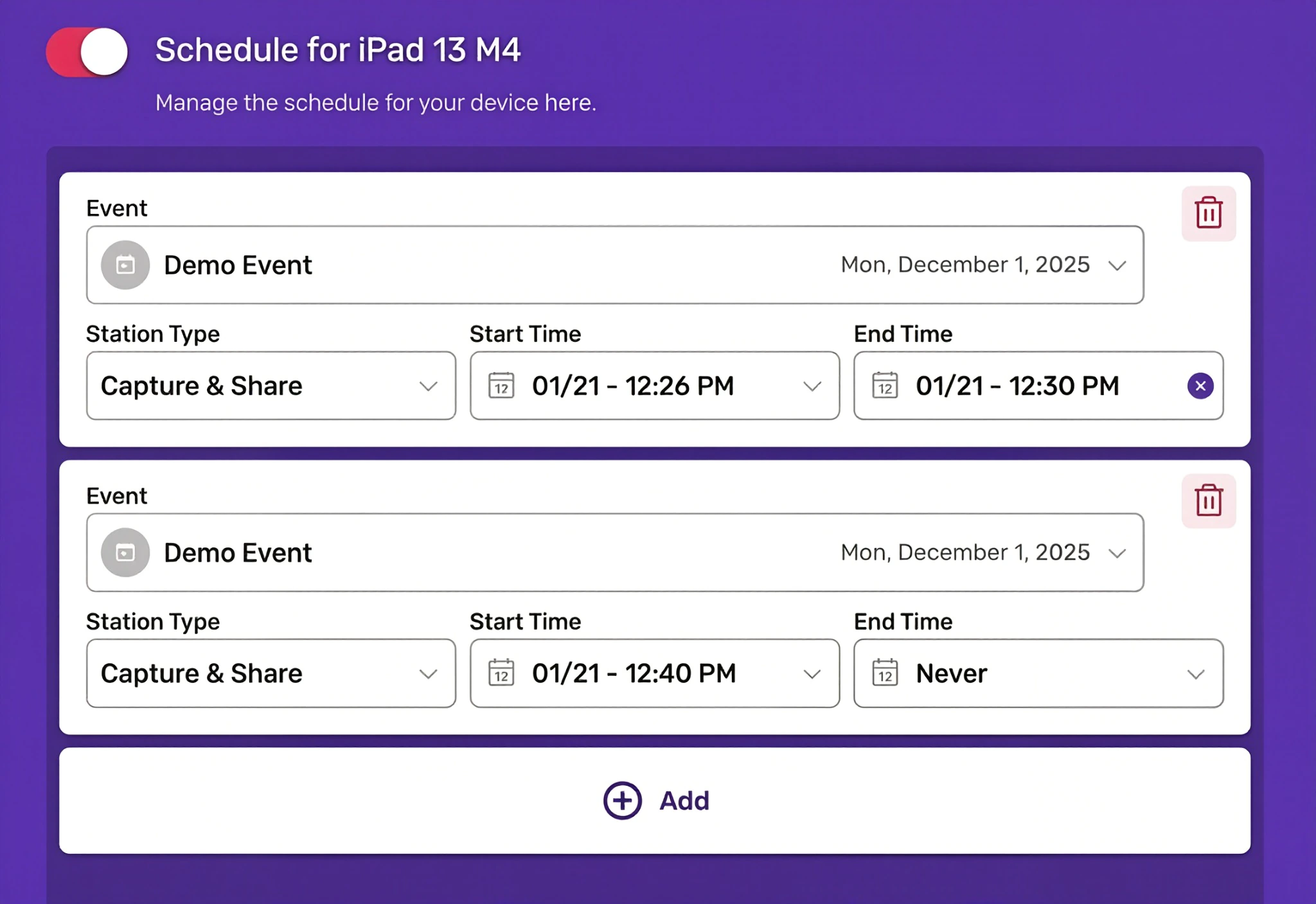
Event duration is also flexible. Most photo booth apps cap events at roughly one day; Booth.Events allows events to remain active for up to a year, making it suited to permanent kiosk installations, multi-day conferences, and long-running retail activations. Scheduled Events (Pro+) automate booth open and close windows for drop-off rentals where the operator is not present.
Source: Booth.Events
Booth.Events also runs on iPad, iPhone, and macOS, while Simple Booth’s HALO app is iPad-only. For 360 spinner booth setups, Booth.Events uses an iPhone on the spinner arm as the capture device with motion-detection auto-start via the accelerometer.
Camera support and capture formats
Both platforms use the iPad’s built-in camera as the default capture device, but their external camera support differs.
Booth.Events supports USB tethering for Canon, Nikon, Sony DSLR and mirrorless cameras, plus GoPro Hero Black Series 9+, using only the cable that shipped with the camera. This broad compatibility matters because operators who already own Nikon or Sony gear can use it immediately without switching brands.
Simple Booth supports Canon and Sony DSLR and mirrorless cameras on Core plans and above, with Nikon support listed as coming soon. It also offers wireless DSLR connectivity over WiFi alongside standard wired USB tethering, giving operators more flexibility in how they position the camera relative to the booth.
The HALO ring light’s 2,100-lumen output also makes the iPad’s built-in camera produce higher-quality results than most software-only setups, reducing the need for an external camera.
Source: Simple Booth
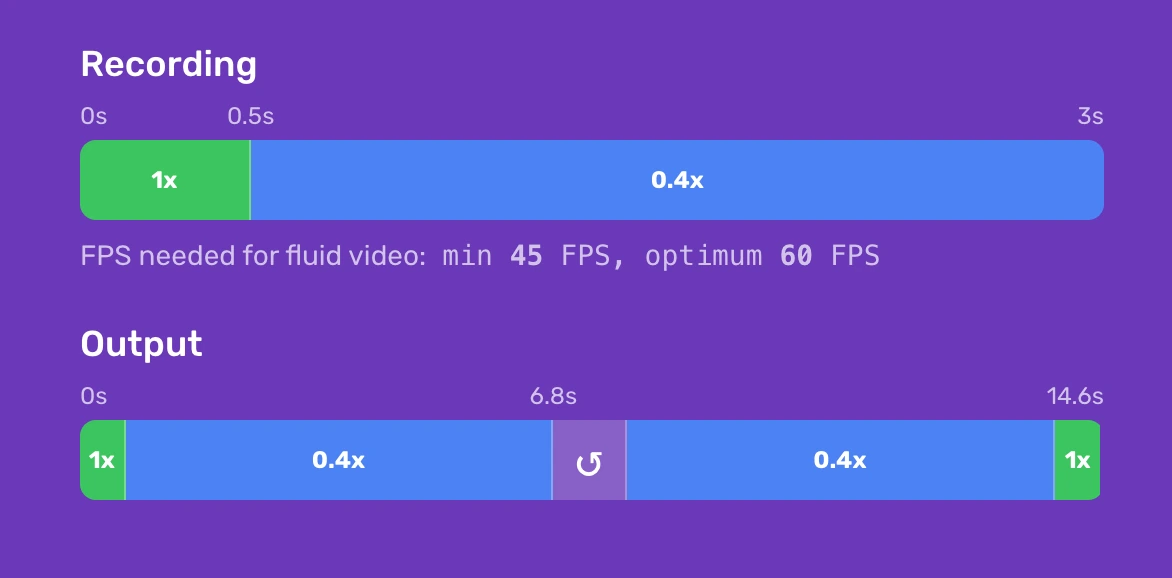
Capture formats overlap substantially. Both platforms support still photos, GIFs, boomerang-style clips, and video. Booth.Events adds slow-motion video with a multi-segment timing editor for 360 spinner booths, plus video testimonials up to 2 minutes.
Source: Booth.Events
Simple Booth offers Live GIFs, Rebound clips, and full-length video from 5 to 120 seconds, along with background blur and bokeh that the company claims was first for an iPad photo booth.
For 360 spinner booths, Booth.Events has a clear advantage. The app detects spinner rotation via the iPhone’s accelerometer and auto-starts recording without a button press. The slow-mo timing editor lets operators set speed ratios, segment durations, and bounce direction independently. Simple Booth does not document equivalent 360 spinner workflows.
AI features and photo effects
Both platforms use Nano Banana AI models for generative photo transformations, and both include beauty filters and AI background removal. The differences are in implementation and pricing.
Booth.Events offers two AI products. AI Prompts lets operators write text-based prompts that transform guest photos into any artistic style.
Three model tiers are available: Nano Banana 1K (1 credit), Nano Banana Pro 2K (3 credits), and Nano Banana Pro 4K (4 credits). AI Portraits uses pre-trained models to generate styled portraits with strong facial likeness, drawing from 160+ pre-built styles. Operators can commission a custom-trained filter for $200 with a two-week lead time. AI Prompts supports groups while AI Portraits handles only individual subjects.

Source: Booth.Events
Simple Booth offers Booth Mode AI Effects with three Nano Banana models consuming 1x, 2x, or 3x credits per generation. A notable capability is per-frame multi-prompt storyboarding: operators assign a unique AI prompt to each frame in a multi-frame layout, creating sequential narrative strips.
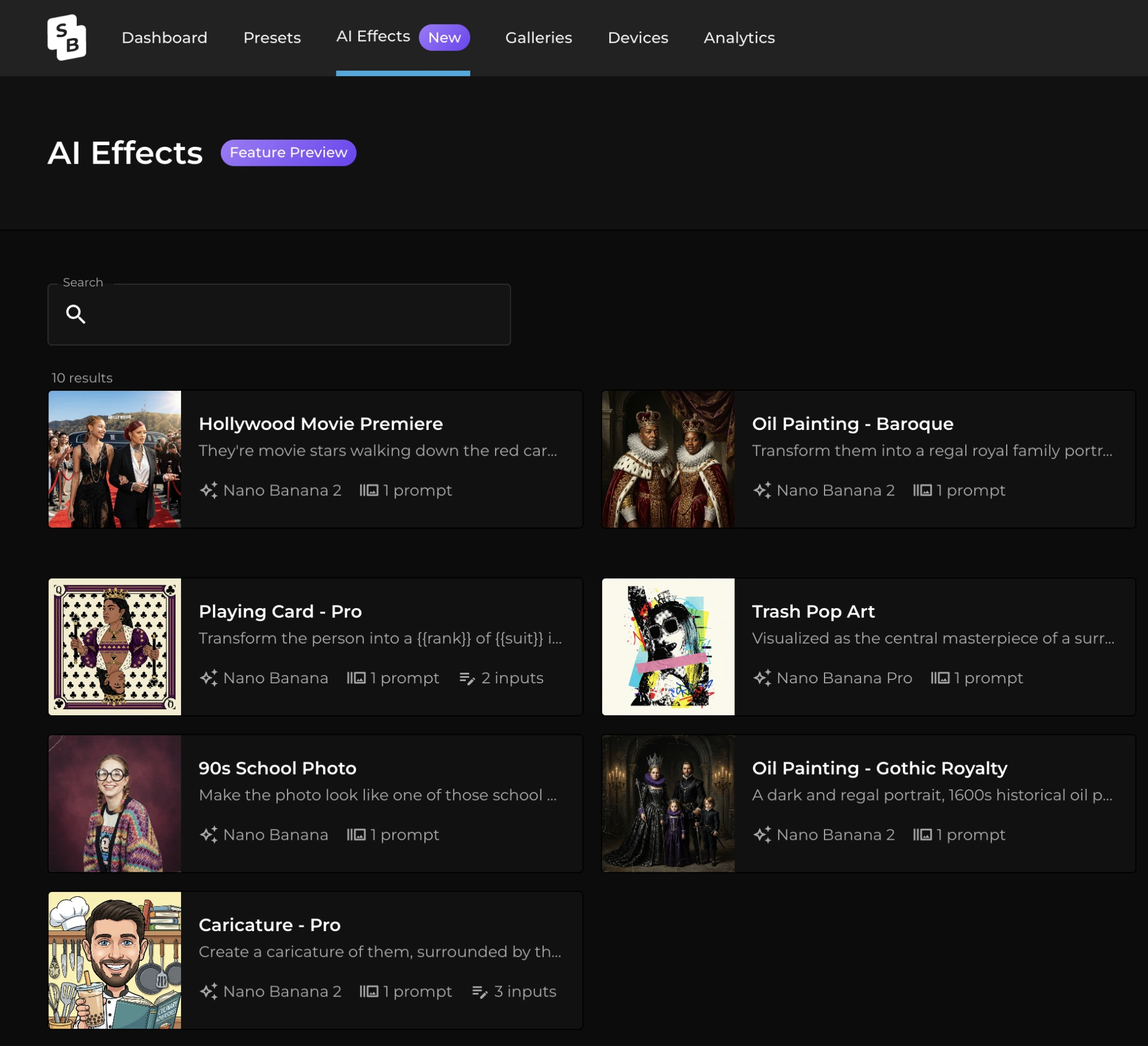
Source: Simple Booth
Guest Input (Pro/Select) lets participants answer questions that feed into the AI prompt as template variables, producing personalized results. Simple Booth also handles identity preservation automatically without requiring prompt engineering.
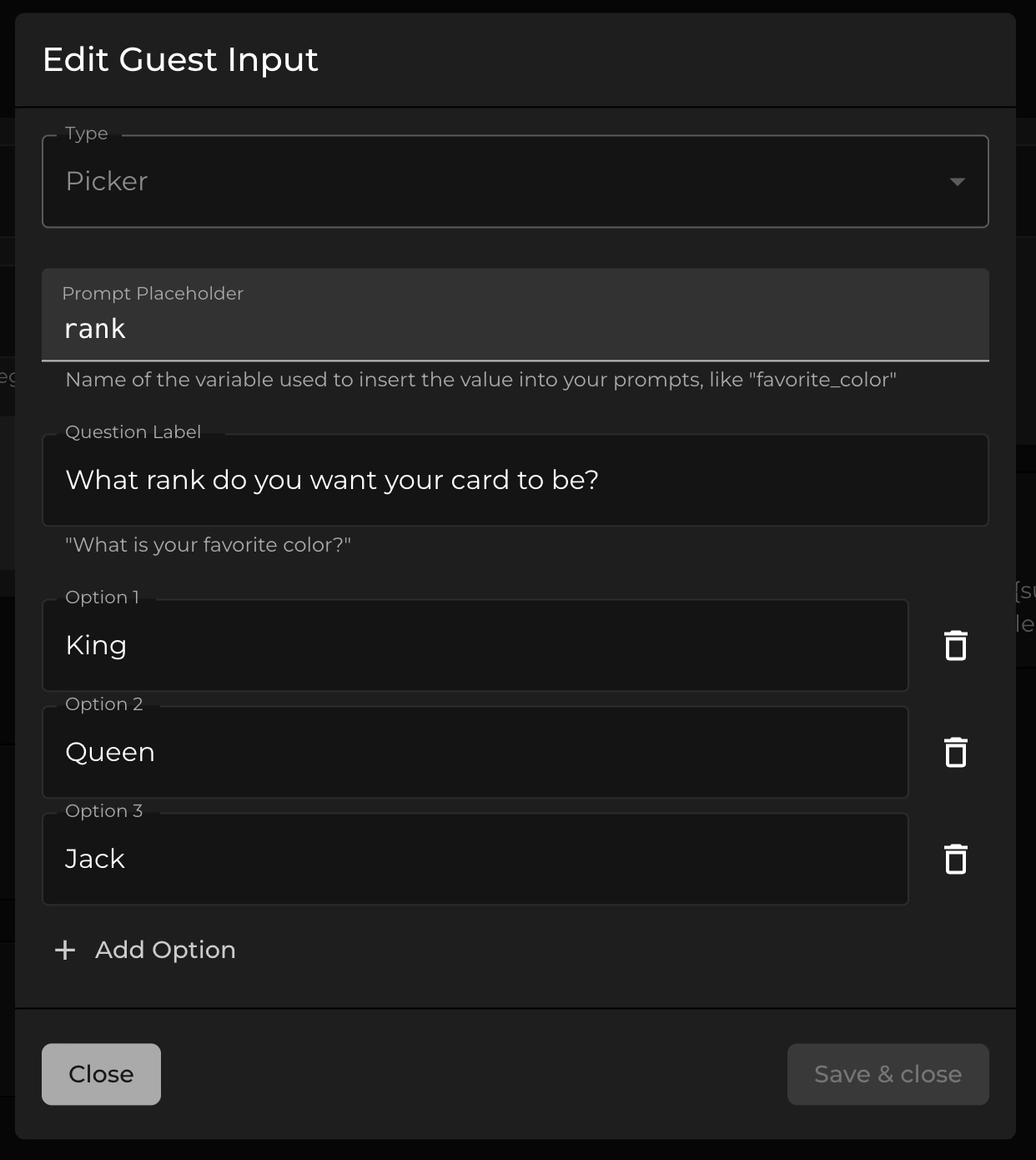
Source: Simple Booth
A practical advantage for Simple Booth: prompts can be tested outside booth mode without consuming credits, so operators iterate freely before events. AI-generated layout images for design elements like borders and frames also cost no credits.
For non-AI photo processing, both platforms include beauty filters and AI background removal without a green screen. Booth.Events’ SceneSelect background removal works offline and is included on all plans with no credit cost. Simple Booth’s background replacement requires Core or above.
Booth.Events’ AI Glam Filter is unlimited on Pro plans with an adjustable intensity slider. Simple Booth’s Glam effect is available on all plans.
Credits are priced similarly: Simple Booth charges $0.10 per credit, while Booth.Events charges $8 for 100 credits ($0.08 each). Both give bonus credits to new subscribers.
Templates, branding, and customization
Both platforms offer full template customization, but their design tools reflect different philosophies.
Simple Booth introduced the Layout Designer in HALO 5.0, an in-app design tool with layers, fonts, gradients, QR code embedding, and multi-layout support per event. Operators build complete template designs without external software. The app includes 60+ themes and 100+ digital props. Guest-editable text layers (Plus+) let participants type names or captions directly onto their photo before sharing.
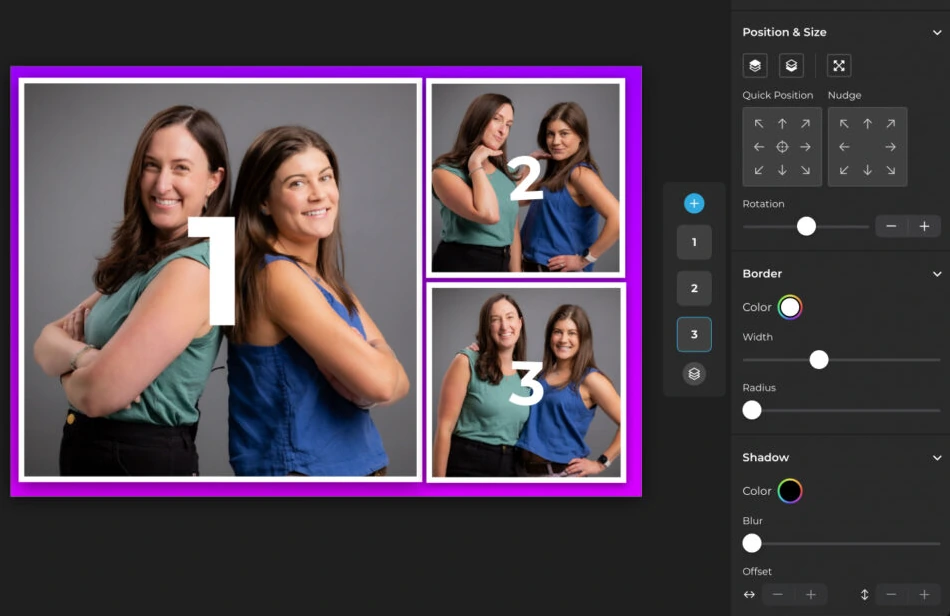
Source: Simple Booth
Booth.Events uses a browser-based template editor that handles both templates and attract screens in one interface. A notable design tool advantage: Canva PDF import lets operators save a Canva design as a non-flattened PDF and import it with editable layers, lowering the skill barrier for operators who already use Canva.
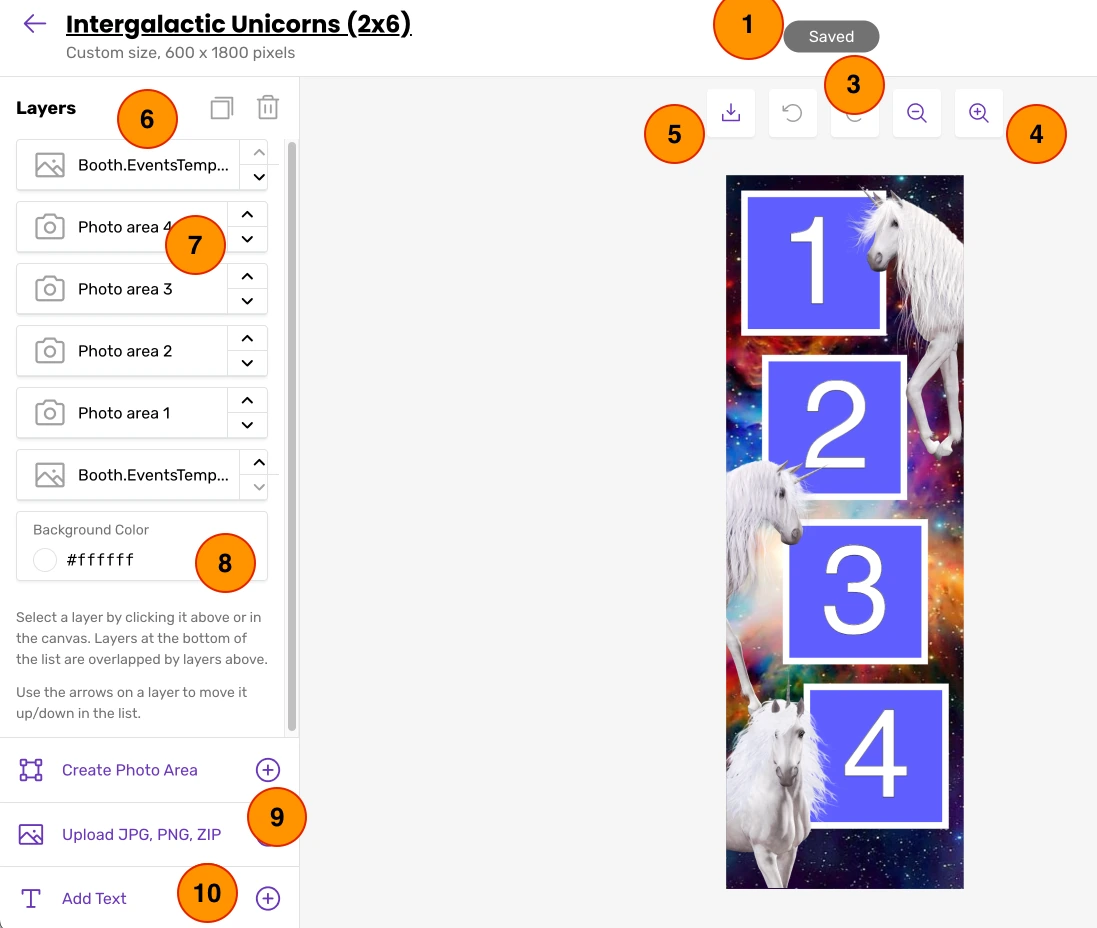
Source: Booth.Events
Booth.Events is also the only photo booth app supporting fully custom pixel dimensions, allowing any width and height rather than forcing preset sizes.
On branding, Booth.Events is more generous at entry-level tiers. No plan shows the Booth.Events logo to guests, including the cheapest subscription. Simple Booth’s Lite plan includes ads in the app, and custom branding requires Plus ($99/month) or above. At the top tier, Booth.Events Pro+ offers a custom domain for galleries and a fully white-labelled iPad app, plus cross-account event duplication for reseller setups.
Both platforms offer attract screen customization. Booth.Events supports video backgrounds (MP4/MOV), live-view blending with the camera feed at adjustable opacity, and face-detection dismissal. Simple Booth offers customizable start screens with AI-generated start screens announced as coming soon.
W Hotel Austin captured 12,765 photos from 31,730 participants, generating 92,579 gallery views from a single ongoing HALO installation. (Simple Booth)
Sharing, galleries, and lead capture
Photo delivery works similarly on both platforms: guests receive their photos via email, SMS, QR code, and AirDrop. Simple Booth adds WhatsApp delivery (added in HALO 5.0), which opens international markets where SMS is less common. Booth.Events handles SMS delivery with no third-party account setup, while Simple Booth relies on standard carrier-based delivery.
Both create online galleries automatically for each event. Booth.Events galleries persist for 3 months on Basic, 1 year on Pro, and 2 years on Pro+, with cancellation not shortening the paid gallery expiration.

Simple Booth galleries include a Live Feed mode that turns any public gallery into a real-time slideshow for a TV or projector. Booth.Events offers a similar slideshow feature accessible by opening the gallery URL in any browser.
Source: Simple Booth
Lead capture is where Simple Booth’s marketing orientation shows. The platform captures up to 6 standard fields on Pro and 10 custom fields on Select, including checkboxes and required legal terms.
Data syncs natively with MailChimp (Pro+) and can be pushed to external systems via the Open API (Pro+).
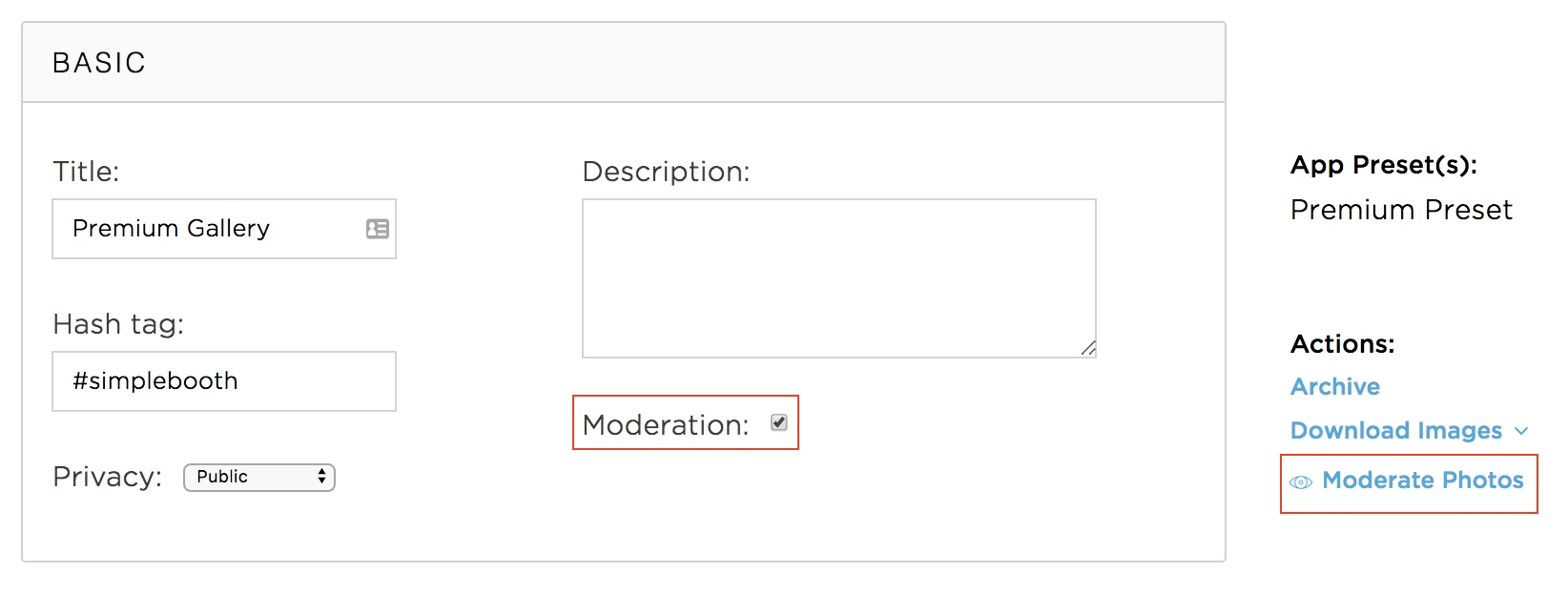
Demographic insights via face detection (Select) estimate age, gender breakdown, and average group size from photos. Brand moderation (Pro/Select) lets operators approve photos before they appear in the gallery or reach guests.
Source: Simple Booth
Booth.Events takes a different approach with Surveys offering two independently toggled stages (pre-session and post-capture), with ten field types including rich text blocks for GDPR consent language.
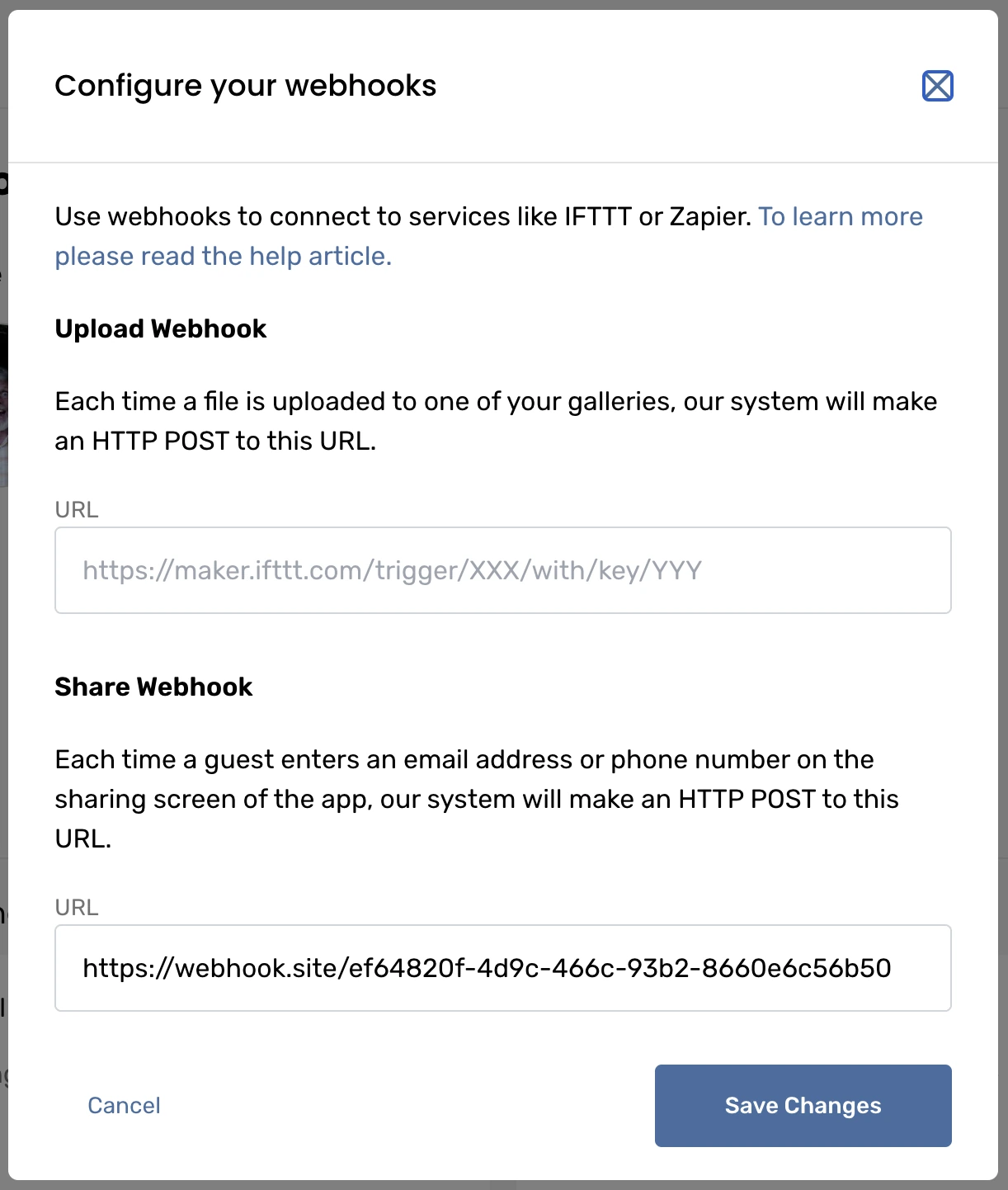
For programmatic data delivery, Booth.Events uses two webhook types (Pro+): an Upload Webhook that fires on every file upload and a Share Webhook that fires when a guest enters contact information, both connecting to Zapier, IFTTT, or any HTTP endpoint. Simple Booth’s API is a more structured REST endpoint but narrower in scope, limited to reading and purging data capture records.
Source: Booth.Events
Treetop Golf built a database of 150,000 unique email addresses across their locations using Simple Booth’s lead capture during the photo booth experience. (Simple Booth)
Pricing and licensing models
Pricing structures differ between the two platforms, especially for operators running multiple iPads.
Simple Booth uses a per-license subscription model with weekly, monthly, and annual billing. Each plan includes one device license, with additional devices at a discounted add-on rate. The main tiers:
| Plan | Monthly Price | Annual Price | Add-On License (Monthly) |
|---|---|---|---|
| Lite | $29.99 (App Store only) | $289.99 | Not confirmed |
| Core | $49 | $490 | $36 |
| Plus | $99 | $990 | $74 |
| Pro | $149 | $1,490 | $111 |
| Select | $249 | $2,490 | $186 |
Lite is available only through the App Store and includes ads in the app. Core is the first ad-free professional tier, adding DSLR camera support, background replacement, and Dropbox integration. Plus adds custom branding, analytics, and guest-editable text. Pro and Select add lead capture, API access, phone support, moderation, and compliance features.
Hardware is sold separately. HALO kits start at approximately $2,090 for an Event Kit with iPad and Simple Care protection plan, with 0% financing available. A 7-day free trial is available with no permanent free plan.
Booth.Events uses a flat-fee subscription model with no per-use charges on core features. Three subscription tiers exist:
- Basic - 1 iPad or 1 iPhone, 3-month gallery storage, limited SMS coverage
- Pro - 1 iPad + unlimited iPhones, 1-year gallery storage, worldwide SMS, custom HTML microsites
- Pro+ - 4 iPads included + unlimited iPhones, 2-year gallery storage, plus custom domain, white-label app, Remote-In, webhooks, Scheduled Events, and emergency phone support
A permanent Starter account allows 3 free events (100 photos, 7-day gallery). All paid plans include a 14-day free trial. Non-subscription options include a 1 Week Pass and a 4x Pro Event Credits pack.
The multi-device cost gap is substantial. Simple Booth’s per-device add-on model makes multi-booth operations more expensive. However, Simple Booth’s weekly billing (Core at $24/week, Plus at $49/week) offers flexibility for rental operators with variable demand, since they can scale costs week to week rather than committing monthly.
Both platforms charge separately for AI-generated content: Simple Booth at $0.10 per credit and Booth.Events at $0.08 per credit. Background removal and beauty filters are free of credit charges on both platforms.
Simple Booth vs Booth.Events: Which should you choose?
The choice depends on your business model, budget, and the type of events you serve.
Choose Booth.Events if:
- You already own your own iPad stands, lighting, and camera equipment
- You run multiple iPads and need affordable per-device licensing
- Live Sync and Remote-In for managing devices remotely are priorities
- You want built-in SMS delivery without setting up a Twilio account
- You use Nikon cameras and need immediate USB tethering support, or want GoPro compatibility
- You operate kiosks or multi-day installations that need events lasting weeks or months
- Budget is a primary constraint and you want professional features at a lower price
- You need 360 spinner booth support with motion-detection auto-start
Choose Simple Booth if:
- You want a complete hardware-and-software system with ring lighting
- Virtual or browser-based photo experiences are part of your offering
- You serve brand marketers who need lead capture, moderation, analytics, and compliance tools
- Enterprise features like age gating, custom legal terms, and security questionnaire support matter
- You want an in-app design tool that eliminates dependence on external design software
- WhatsApp photo delivery is important for your international events
- You value a proven platform with 30,000+ customers and a 13-year track record
- You need face-detection demographic analytics for post-event reporting
G7 Entertainment Marketing captured over 136,000 fan interactions across more than 10 years of partnership with Simple Booth. (G7 Case Study)
Get a 7-day free trial with Simple Booth here!
Both platforms will continue evolving. Booth.Events is investing in AI capabilities, remote fleet management, and EU market expansion. Simple Booth is pushing deeper into AI effects, enterprise compliance, and the Layout Designer.
Your choice comes down to whether you want a vertically integrated system or a flexible, affordable software platform. Operators who invest in HALO hardware get lighting quality and brand consistency that are hard to replicate with off-the-shelf equipment. Operators who bring their own gear and need to keep per-iPad costs low will find Booth.Events’ licensing model and operational tools hard to beat.
Simple Booth vs Booth.Events FAQ
What is the main difference between Simple Booth and Booth.Events?
Simple Booth is a vertically integrated platform that sells proprietary HALO ring-light hardware alongside its iPad app and cloud dashboard, plus a browser-based Virtual Booth for remote activations.
Booth.Events is a software-only platform where operators bring their own iPad, lighting, and camera equipment. Simple Booth emphasizes hardware quality and enterprise marketing features; Booth.Events emphasizes affordable pricing, flexible iPad licensing, and operational tools like Live Sync and Remote-In.
Which platform supports more camera brands for DSLR tethering?
Booth.Events supports USB tethering for Canon, Nikon, Sony, and GoPro Hero Black Series 9+. Simple Booth supports Canon and Sony DSLR and mirrorless cameras on Core plans and above, with Nikon support coming soon. Simple Booth also offers wireless DSLR connectivity over WiFi alongside standard wired USB tethering. Operators with Nikon gear who need immediate support would need Booth.Events.
How does multi-iPad licensing work on each platform?
Booth.Events Pro+ includes four iPads in its base subscription, with iPhones usable as free share stations. Licenses auto-assign based on which devices are running simultaneously. Simple Booth includes one device license per plan, with each additional device costing $36 to $186 per month depending on the plan tier. For a four-iPad setup, the cost difference can be significant.
Does either platform work without an internet connection?
Both offer some offline functionality. Booth.Events’ SceneSelect background removal works entirely offline, and the iPad camera operates without connectivity for basic capture. Simple Booth’s HALO app queues sessions in an offline upload queue and delivers them when connectivity returns. AI features on both platforms require an active internet connection.
Which platform has better 360 spinner booth support?
Booth.Events has dedicated 360 spinner booth features, including motion-detection auto-start via the iPhone accelerometer, a slow-motion timing editor with multi-segment controls, and the ability to use an iPhone on the spinner arm as the capture device with a separate iPad as the share station. Simple Booth does not document equivalent 360 spinner workflows in its current feature set.
Can either platform run a virtual photo booth without physical hardware?
Only Simple Booth offers this through Virtual Booth, a browser-based product that works on any device without an app download. Participants join via a link or QR code, take or upload a photo, apply effects, and submit to a branded gallery. Booth.Events does not support virtual events or external photo uploads.
How do pricing models compare for occasional-use operators?
Simple Booth offers weekly billing starting at $24 per week for Core, making it possible to activate and deactivate subscriptions around event schedules. Booth.Events offers a non-renewing 1 Week Pass for Basic-level access and a 4x Pro Event Credits pack for operators who only need per-event access. Both approaches serve variable-demand businesses, but through different mechanisms.
Which platform is better for brand activations and marketing events?
Simple Booth is built for this use case, with lead capture forms achieving documented 87%+ opt-in rates, native MailChimp integration, an Open API for CRM delivery, brand moderation to approve photos before public display, face-detection demographic analytics, and a Virtual Booth option for remote activations.
Booth.Events offers surveys and webhooks for data capture but does not include native CRM integrations, moderation tools, or demographic analytics.
Keep reading
 Showdowns
Simple Booth vs Darkroom Booth: Which Photo Booth Software Fits Your Business in 2026?
iPad turnkey vs Windows DSLR veteran. Simple Booth or Darkroom Booth?
 Showdowns
Simple Booth vs Flassh: Which Photo Booth Platform Fits Your Events in 2026?
Integrated system vs speedy setup. Simple Booth or Flassh?
 Showdowns
Simple Booth vs LumaBooth: Which Photo Booth Software Fits Your Business in 2026?
Turnkey hardware vs budget cross-platform app. Simple Booth or LumaBooth?