Simple Booth vs Snapbar: Which Photo Booth Platform Fits Your Events in 2026?
Choosing between Simple Booth and Snapbar comes down to five questions:
- Do you need a self-serve system you control, or a managed platform where the vendor helps design every event?
- Are you a photo booth rental operator, a venue, or an enterprise brand running large-scale marketing events?
- Do you want published, predictable pricing or custom final quotes tied to each event?
- Is your priority fast, independent setup or custom AI experiences with hands-on support?
- Do you need physical hardware with built-in lighting, or a browser-based platform that runs on any device?
In short, here’s what we recommend:
Simple Booth is the self-operating photo booth system for rental companies, venues, and brand marketers who want control over their events. Its HALO hardware pairs a patented aluminum ring light with an iPad app and cloud dashboard.
Setup takes under a minute, operators manage events remotely, and guests receive photos via QR code, SMS, email, AirDrop, or WhatsApp. With 30,000+ customers, a 4.7-star App Store rating from 2,400+ reviews, and plans starting at $24/week, it gives operators a complete system they can run without calling a vendor for every event.
Snapbar is the managed event marketing platform for enterprise brands and agencies running large activations. With eight experience types (AI Photo Booth, AI Video, AI Stories, Persona Quiz, Trading Cards, and more), custom AI styles per event, and a central dashboard for lead capture and reporting, it handles everything from design collaboration to branded email delivery.
Enterprise clients use it for events ranging from 500 to 50,000+ attendees, though custom final pricing, a self-rated DIY score of 3/10, and the need for vendor involvement mean it requires more planning and a larger budget.
Both platforms generate branded photo experiences and capture lead data, but they serve different operators and event scales.
Simple Booth vs Snapbar at a glance
| Simple Booth | Snapbar | |
|---|---|---|
| Core Philosophy | Self-operating photo booth system | Managed event marketing platform |
| Target Audience | Rental operators, venues, brand marketers | Enterprise brands, agencies, event marketers |
| Hardware | Proprietary HALO aluminum ring light + iPad | No proprietary hardware (iPad kiosks or guests’ phones) |
| Setup Model | DIY, under 1 minute with HALO stand | Collaborative, 2 to 3 week design-to-launch timeline |
| AI Capabilities | AI effects, background replacement, AI layout images | Custom AI styles, AI Video, AI Stories, Persona Quiz |
| Photo Delivery | QR code, SMS, email, AirDrop, WhatsApp | Branded email delivery |
| Lead Capture | Up to 10 custom fields, MailChimp sync, API | Custom fields, CSV export for CRM import |
| Experience Types | Photos, GIFs, video, photo strips, AI effects, Virtual Booth | AI Photo Booth, AI Video, AI Stories, Persona Quiz, Trading Cards, Event Headshots, Digital Photo Booth |
| Pricing Transparency | Published plans from $24/week | Published starting prices; final pricing is custom-quoted |
| Starting Price | $24/week (Core) | $1,995 (Digital Photo Booth) |
| Free Trial | 7-day free trial with 25 AI credits | No documented free trial |
| Best For | Operators who want full control | Enterprise brands investing in managed activations |
The core difference: Self-serve control vs managed experience design
The split between these platforms is who controls the event experience and how much vendor involvement each event requires.
Simple Booth was founded in 2013 by Mark Hennings, a wedding videographer who built one of the first iPad photo booth apps for live events. The company grew around a clear idea: give operators a complete system they can set up and run on their own.
The HALO hardware pairs with the iPad app and cloud dashboard so that one operator can configure an event, deploy the booth, and manage everything remotely. No vendor call, no design consultation, no multi-week lead time.
This self-serve philosophy runs through every product decision. The Layout Designer lets operators build custom templates inside the app without external design software.
Mission Control, a hidden overlay triggered by a two-finger pinch, lets operators monitor device health and adjust settings during a live event without disrupting the guest experience. Weekly billing exists for rental companies with variable event calendars.
Snapbar was founded in 2012 by brothers Sam and Joe Eitzen, starting as a physical photo booth rental company before pivoting to software during the pandemic. Today it calls itself “an AI-focused tech company” building event marketing activations.
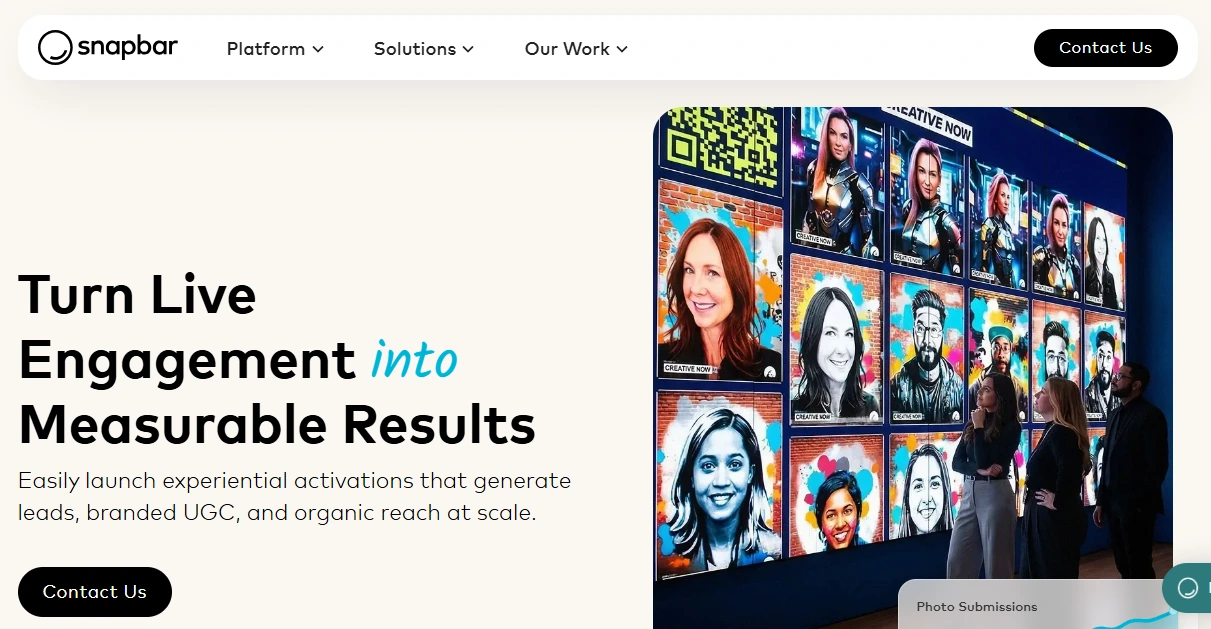
The operating model is collaborative: Snapbar’s team works with each client on branding, AI transformation styles, lead capture fields, microsite design, and email templates before an event goes live.
This managed approach produces customized outputs. Each activation can use a custom DALL-E pipeline built around the brand’s visual themes rather than preset filters.
But it also means longer timelines (typically 2 to 3 weeks from concept to launch) and higher costs. Snapbar acknowledges that its “starting cost is higher, meaning our platform is not the most budget-friendly option for smaller events or organizations.”
Simple Booth provides a complete hardware-software system
Simple Booth’s biggest difference from Snapbar is that it sells an integrated hardware and software product, not just an app.
The HALO chassis is machined from a single billet of anodized aluminum with a patented ring-light system: 112 LEDs producing up to 2,100 lumens, rated for 50,000 hours of operation. Groups can stand 6 to 8 feet from the camera and still get even illumination. A tool-less faceplate snaps the iPad into place, a concealed USB-C cable keeps it charged, and the full Event Kit travels in a 49-pound rolling hard case.
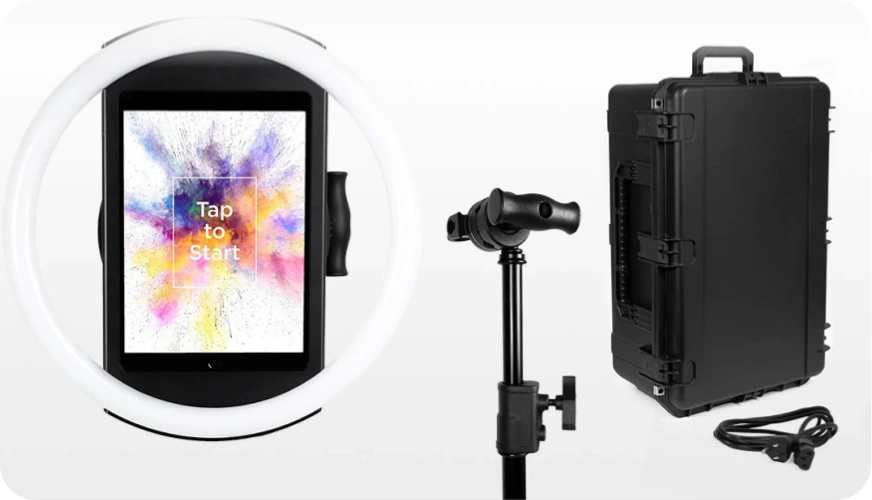
Source: Simple Booth
This matters for operators who run multiple events per week. Setup takes under one minute with no tools. The Preflight Check screen catches configuration issues before the event starts. If Wi-Fi fails mid-event, the offline upload queue stores sessions and delivers them when connectivity returns. For venues without wall power, compatible portable batteries provide 6+ hours of runtime.
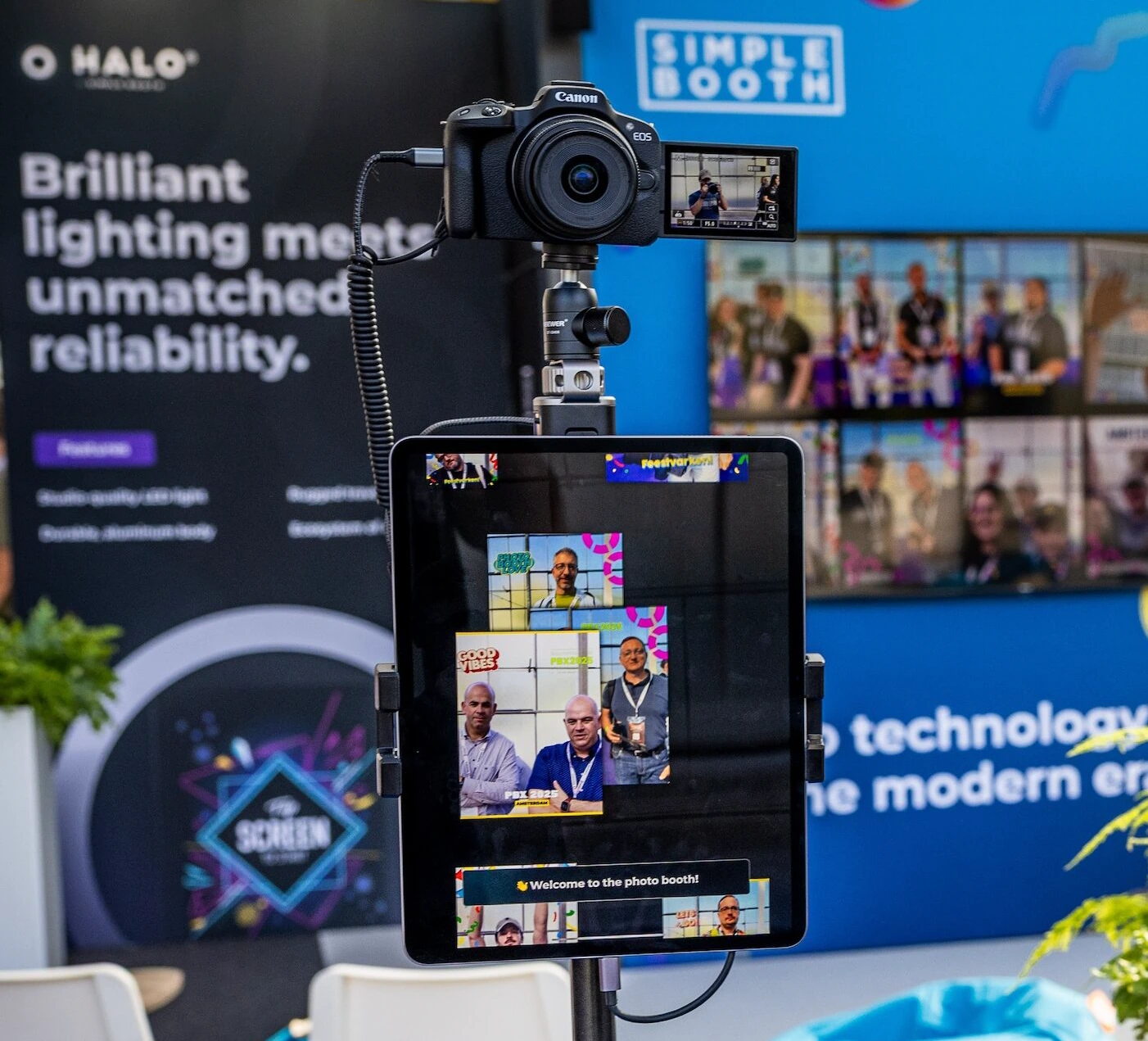
HALO 5.0 (November 2025) added DSLR and mirrorless camera support on Core plans and above, letting operators who own Canon or Sony cameras get higher image quality through the HALO workflow. The same update introduced WhatsApp delivery, opening international deployments that SMS-only systems cannot serve.
Source: Simple Booth
Photo quality goes beyond hardware. AI background replacement works without a physical green screen, Glam skin smoothing adjusts portraits automatically, and DSLR-style bokeh adds background blur (a feature Simple Booth claims was a first for iPad photo booths).
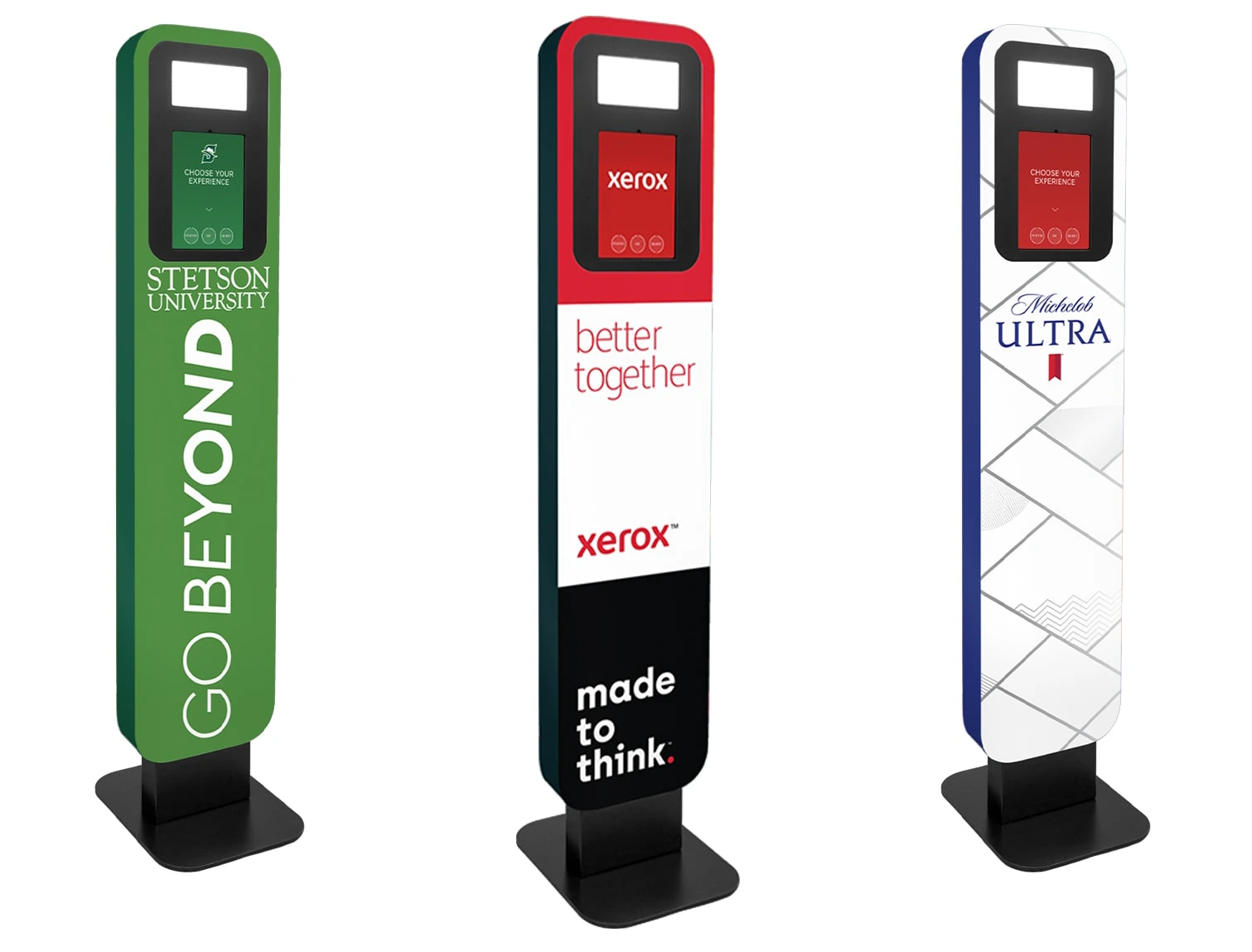
Snapbar takes a different approach to hardware. Its Selfie Stations, invented in 2017, are portable iPad-based kiosks designed for global shipping.
Source: Snapbar
But the core platform is browser-based and hardware-agnostic; guests access experiences via QR code on their own phones, making dedicated hardware optional. Snapbar does not manufacture proprietary lighting or camera equipment; the Onsite Setup Guide recommends standard iPads, a third-party stand, and a separate ring light.
“It paid for itself pretty quickly. Now it’s just extra money coming in.” (Kurt Nielson Photography)
Snapbar leads in experience variety and enterprise AI customization
Where Simple Booth focuses on perfecting the photo booth interaction, Snapbar covers a wider range of experience types, each designed for a specific marketing objective.
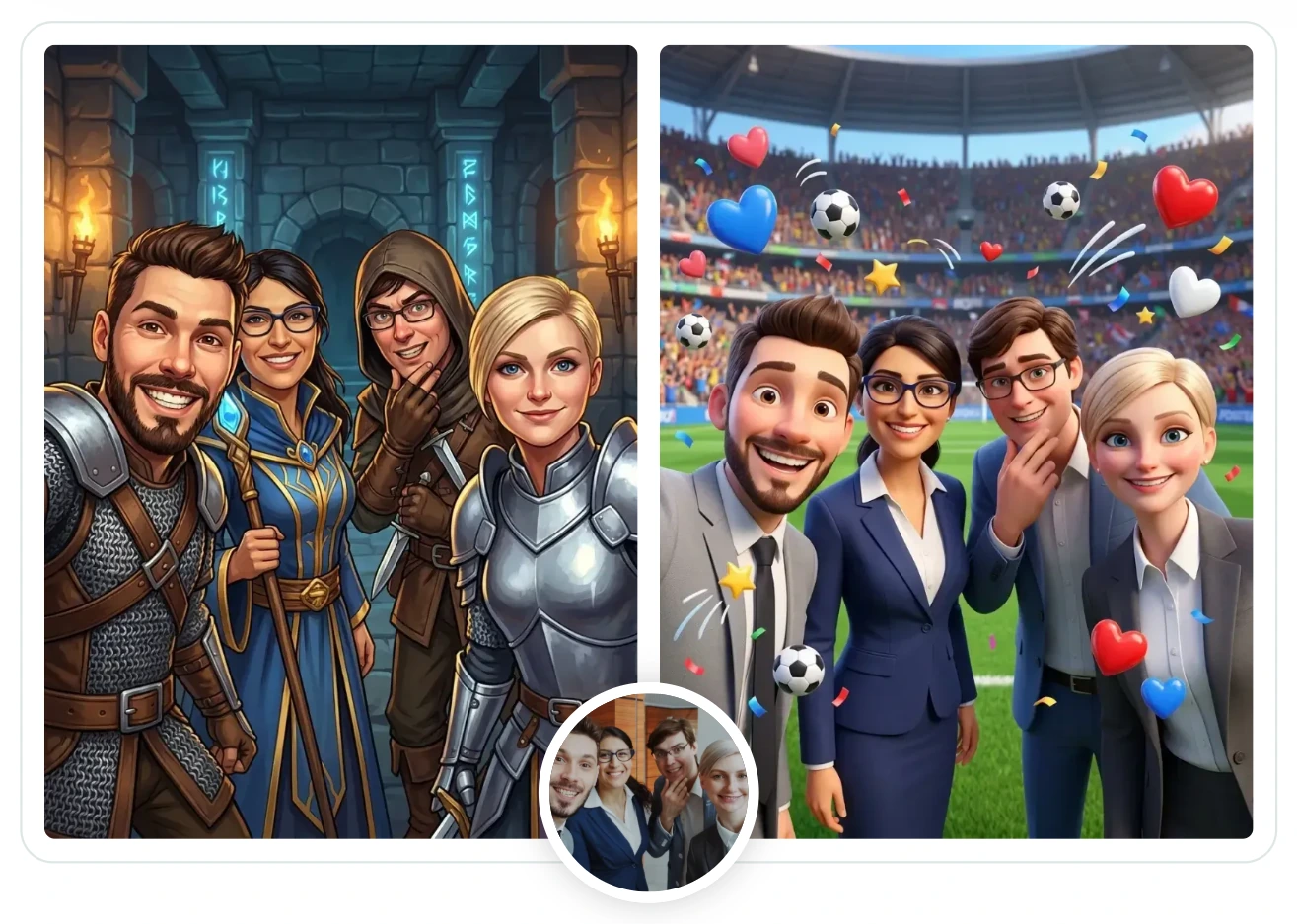
The AI Photo Booth is the closest analog to Simple Booth’s AI effects, transforming guest selfies into AI-generated imagery. But where Simple Booth offers a library of public prompts and lets operators create custom prompts within the app, Snapbar builds custom AI styles per activation with its design team. Each activation’s visual output is unique to that brand and event, not a preset filter available to every customer.
Source: Snapbar
Beyond photos, Snapbar offers formats with no Simple Booth equivalent:

- AI Video transforms guest photos into 5-second animated video clips optimized for social sharing, rendered in seven aspect ratios covering every major social platform.
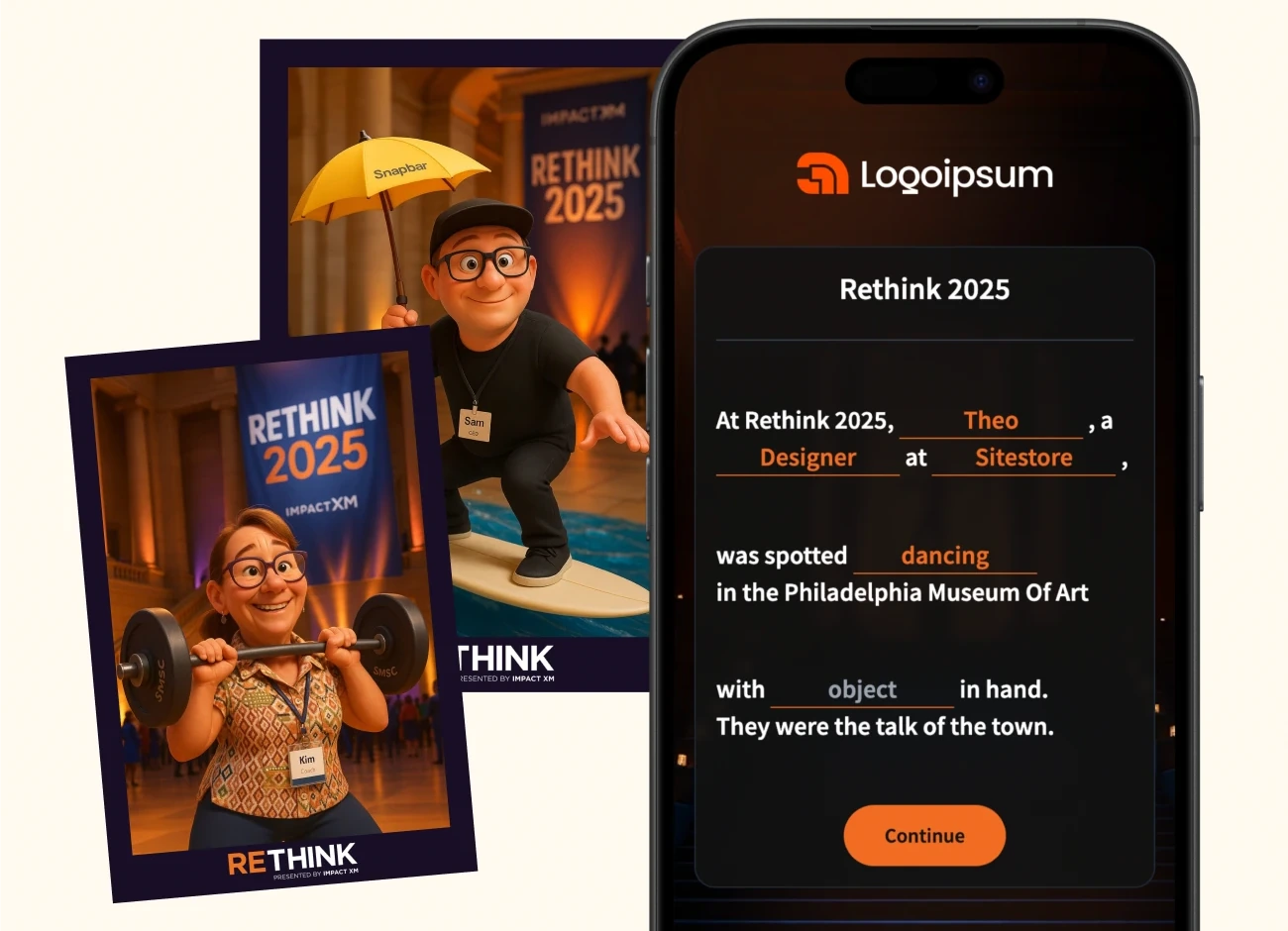
- AI Stories uses fill-in-the-blank narrative templates where guest answers shape the AI-generated portrait, capturing qualitative data alongside contact information.
- Persona Quiz matches guests to brand-defined personas through a Buzzfeed-style quiz, tagging each lead record with a persona for segmented post-event follow-up.
- Trading Cards turn attendee photos into collectible digital cards with custom survey data populating visible card fields.
- Event Headshots deliver professional headshots at scale with five output methods, from real photos with branded backgrounds to fully stylized AI generation.
Source: Snapbar
Snapbar also provides real-time displays: Live Slideshows, Social Walls (via a Walls.io partnership included at no extra cost), Mosaics, and Photo Booth Galleries that show user-generated content on venue screens during the event. Seeing others’ content on the big screen drives more participation.

Simple Booth’s Live Feed converts any public gallery into a real-time slideshow for TV or projector, covering the basic display use case. But it does not include social wall aggregation, mosaic generation, or the range of display formats Snapbar offers.
Source: Simple Booth
Lead capture and marketing tools serve different workflows
Both platforms capture attendee data, but they serve different marketing workflows.
Simple Booth embeds lead capture directly into the photo booth flow. The data capture form collects up to 6 standard fields on Pro (email, name, phone, postal code, date of birth) and up to 10 custom fields on Select, including checkboxes and required legal terms. The platform reports opt-in rates of 87 to 89% because guests provide their information as a natural step in receiving their photo.
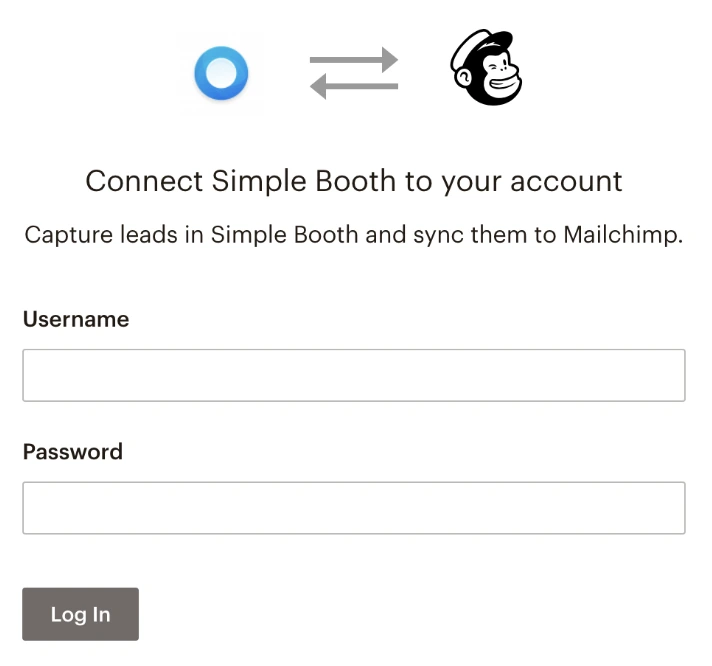
Data routes to MailChimp via native sync (no code required) or to custom CRM systems via the Open API on Pro and Select plans. The analytics dashboard tracks gallery views, social shares, and participation over time, with demographic insights via face detection (estimated age, gender breakdown, average group size) available at the Select tier.
Source: Simple Booth
For social sharing, Simple Booth pre-populates event hashtags on X/Twitter and Facebook and reformats layouts for Instagram compatibility, since Instagram prohibits direct third-party uploads.
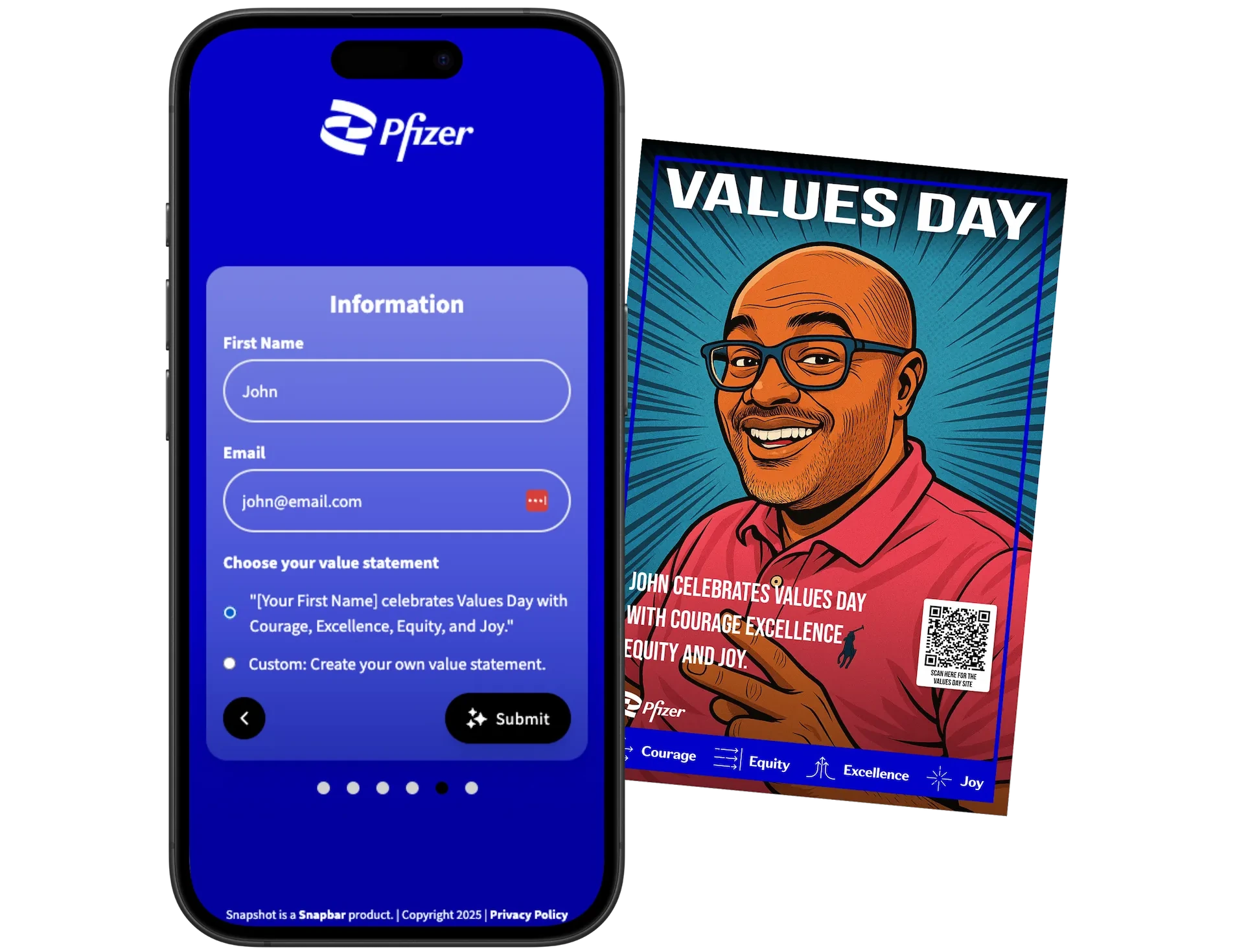
Snapbar treats lead capture as the primary business outcome, not a secondary feature. Every experience type doubles as a data collection tool: quiz answers from Persona Quiz, story blanks from AI Stories, and survey fields from Trading Cards all produce structured lead records alongside standard contact information.
Source: Snapbar
The platform captures name, email, company, job title, and custom fields as part of the content-retrieval flow.
Snapbar reports a 95% email open rate on content delivery emails, a high number because guests are waiting for their personalized result, not receiving a cold marketing message. Lead data exports in CRM-ready CSV format for Salesforce, HubSpot, and Marketo import, though there is no native real-time push connector to these CRMs documented on the main platform.
The Experiential Marketing Platform (in early access, general availability summer 2026) adds AI-enriched company matching to identify the industry mix of attendees, branded stakeholder reports exportable as PDFs, and a single dashboard for tracking submissions, leads, and content across activations.
The gap: Simple Booth gives operators direct control over data collection and basic CRM delivery. Snapbar produces richer data per interaction but requires more vendor involvement and manual CSV export to move it into downstream systems.
Arizona Opera grew its email list by 1,000 addresses in a few events using Simple Booth’s lead capture at performances.
Setup and operations reflect different buyer needs
The day-to-day experience of running these two platforms is different.
Simple Booth is designed for operators who set up and tear down booths repeatedly, often multiple times per week. The 1-minute setup with no tools, the rolling travel case, and the remote dashboard (where preset changes sync to the iPad without exiting booth mode) all serve this use case. One operator can configure an event, hand the booth to untrained venue staff, and monitor it remotely.

The onboarding path follows a numbered Start Guide (Steps 0-5) covering plan selection through event-day operations. The HALO 5.0 redesigned preset editor presents the booth flow visually, and the Layout Designer brings template creation in-house, with no Photoshop or Canva needed. Documentation spans 148+ help articles plus a dedicated 5.0 Transition Guide with an AI-powered search assistant.
Source: Simple Booth
Snapbar requires a different operational cadence. The Product Turn Around Schedule requires clients to approve the quote 8 business days before the event and submit design assets 6 business days out.
A Customer Success Manager handles onboarding; account setup starts via a link from the CSM, not a self-serve signup. Gallery-level settings like password protection and manual photo approval require a CSM to enable and are not self-service by default.
Snapbar self-rates its DIY capability at 3/10, acknowledging that “because we can customize most aspects of the user experience, it can be a little overwhelming to fine-tune every element for a specific event.” For enterprise buyers who want collaborative setup with a dedicated team, this is a feature. For operators who want to configure and launch on their own, it is a constraint.
On-site, Snapbar’s browser-based model means attendees participate via QR code with no app download, a low-friction entry point at events where IT restrictions make app installs impractical.
Hardware requirements are modest: a recommended iPad, stand, ring light, and reliable Wi-Fi. But without integrated hardware, on-site photo quality depends on the operator’s choice of lighting and environment, not a dedicated system.
Pricing comparison
Simple Booth publishes transparent pricing across five tiers with three billing cycles each:
| Plan | Weekly | Monthly | Yearly |
|---|---|---|---|
| Lite | $14.99 | $29.99 | $289.99 |
| Core | $24 | $49 | $490 |
| Plus | $49 | $99 | $990 |
| Pro | - | $149 | $1,490 |
| Select | - | $249 | $2,490 |
Each plan includes one device license. Additional devices require add-on licenses (e.g., Core add-ons at $36/month or $360/year each). AI effects cost $0.10 per credit, with models consuming 1x, 2x, or 3x credits per generation depending on quality tier. Purchased credits do not expire.
HALO hardware kits sell separately, starting at approximately $2,090 for an Event Kit with iPad and Simple Care protection plan, with 0% financing available.
The Lite plan is App Store only, includes ads, and excludes custom branding, analytics, and lead capture. Most professional operators need Core ($24/week) at minimum for DSLR support, video, background replacement, and ad removal.
Pro ($149/month) unlocks lead capture, API access, moderation, and phone support. Select ($249/month) adds demographic analytics, in-app legal terms, and security questionnaire support.
A 7-day free trial is available with 25 free AI credits.
Snapbar publishes starting prices for its individual experience types, but the final price is custom-quoted. The pricing page offers a “build your own quote” flow based on product selection, experience level, and expected participation. Every customer operates under an individually negotiated Master Services Agreement. Snapbar states that its starting cost is higher than competitors like Simple Booth.
No free trial or freemium tier is documented. Because the published starting rates do not show the final cost, budget-conscious buyers cannot determine their total spend before engaging sales, a deliberate trade-off for a platform targeting enterprise marketing budgets rather than independent operators.
The pricing divide reflects each platform’s market: Simple Booth grows through self-serve adoption by rental operators and venues who need predictable costs. Snapbar grows through enterprise sales cycles where custom pricing is standard and marketing teams evaluate cost per lead rather than monthly subscription fees.
Virtual and hybrid event capabilities
Both platforms offer browser-based experiences for remote audiences, though with different scope.
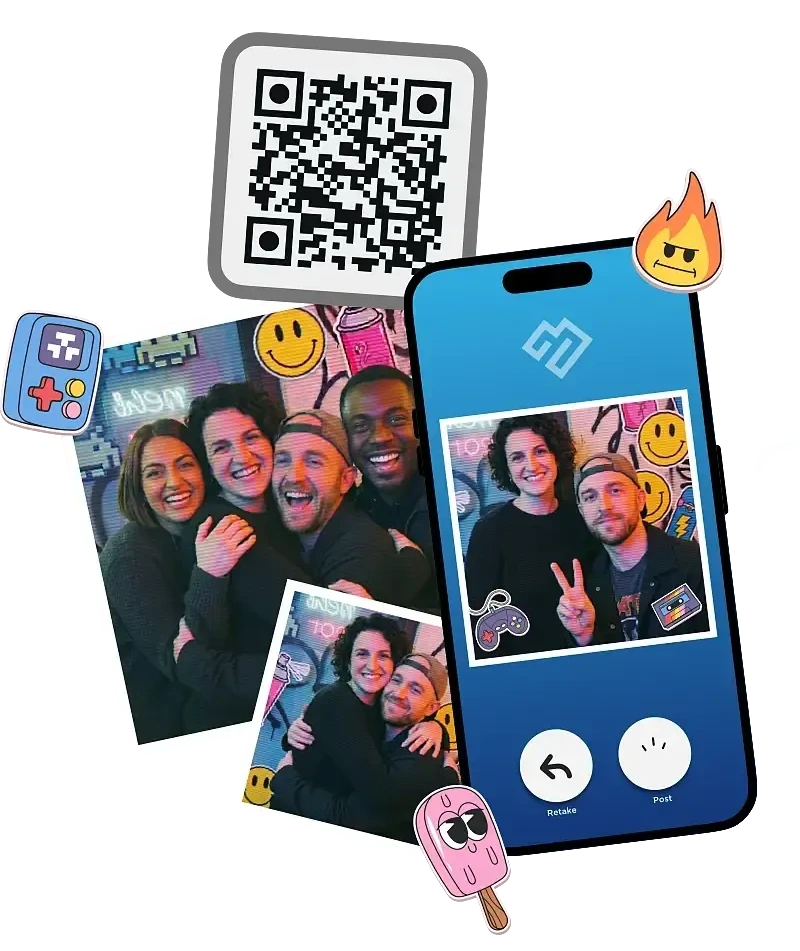
Simple Booth’s Virtual Booth runs in the browser with no app install required. Participants access via QR code or link, use their device camera or upload a photo, apply overlays, stickers, AI effects, or background replacement, and submit to a branded gallery. It automatically localizes into nine languages including English, Spanish, French, Dutch, and German.
Source: Simple Booth
Virtual Booth connects to the same analytics, Live Feed, and Gallery infrastructure as the HALO hardware, so brands running hybrid events can operate physical kiosks for in-room attendees and Virtual Booth for remote participants, with all submissions feeding a single combined gallery.
The link-based delivery also enables always-on campaigns embedded in email, on packaging, or on brand websites, not just event-day use.
Snapbar’s entire platform is browser-based by design, so every experience type (AI Photo Booth, AI Video, AI Stories, Persona Quiz, Trading Cards, Digital Photo Booth) works for virtual and hybrid events. This gives Snapbar a wider range of virtual formats. A remote attendee could take a Persona Quiz, generate an AI Story, or create a Trading Card, not just take a photo with overlays.
Source: Snapbar
Snapbar also integrates with seven event platform partners (6Connex, Bizzabo, Chati, Goldcast, RingCentral Events, Swapcard, and Xyvid) for embedding activations directly into virtual event environments, a capability Simple Booth does not offer.
Security and compliance
Neither platform holds formal third-party security certifications (SOC 2, ISO 27001) in their public documentation. Both take different approaches to enterprise compliance.
Simple Booth addresses compliance through its Select tier: data compliance tools for PII deletion on demand, in-app custom legal terms (embed client-specific privacy policy and ToS), moderation and age gate, and engagement with security questionnaires and IT assessments.
The privacy policy covers GDPR, CCPA, and Nevada requirements, and the company states it does not use facial recognition or biometric processing technology. In this model, the event operator is the data controller and Simple Booth acts as data processor.

Source: Simple Booth
Snapbar relies on negotiated enterprise terms rather than standardized certifications. Its privacy policy states that it does not use event content or participant data to train machine learning models, and that standard services do not create or permanently store biometric identifiers.
CCPA compliance is addressed in the privacy policy. Enterprise security terms are governed by the individually negotiated MSA rather than a published standard.
For organizations in regulated industries that need formal compliance documentation, both platforms would provide assurances through their enterprise engagement processes rather than pointing to pre-existing audit reports.
Simple Booth vs Snapbar: Which should you choose?
The choice depends on how you operate events, what you need from the platform, and how much control you want.
Choose Simple Booth if:
- You’re a photo booth rental company, DJ, photographer, or independent event operator
- You want to set up, run, and manage events on your own without vendor involvement
- Consistent photo quality from integrated hardware matters for your business
- You need published, predictable pricing that scales with your event volume
- Fast setup (under a minute) and tear-down for multiple events per week is essential
- You want to design custom layouts, overlays, and branding without external software
- Your events are primarily in-person with some virtual or hybrid needs
- You need lead capture with direct MailChimp sync or API delivery to your CRM
- You operate permanent venue installations that run unattended
Start with Simple Booth’s 7-day free trial to test the platform.
Choose Snapbar if:
- You’re an enterprise brand or agency running large-scale marketing events
- You want custom AI experiences with unique visual styles per event
- Your events need formats beyond photo booths: AI video, persona quizzes, trading cards, AI stories
- You have the budget for custom-quoted pricing and the timeline for 2 to 3 week event design
- Lead capture is a primary objective and you need qualitative data alongside contact details
- You run events at 500 to 50,000+ attendee scale and need platform reliability at that volume
- Real-time displays (social walls, mosaics, live slideshows) matter for your event floor
- You prefer a collaborative setup process with a dedicated Customer Success Manager
These platforms serve different parts of the event engagement market. Simple Booth gives operators independence: a complete hardware-software system with published pricing, fast setup, and control from a single dashboard. It works equally well for the photo booth rental company running three weddings a week and the venue operator who needs a permanent, unattended installation.
Snapbar gives enterprise brands depth: a managed platform with eight experience types, custom AI styles, and a measurement-focused dashboard built for justifying event marketing spend. It serves the brand manager running a 10,000-person conference and the agency managing events across a dozen clients per quarter.
The right choice depends on whether you need a system you control or a service you collaborate on. Both deliver branded photo experiences and lead data. They serve different operators, at different scales, with different levels of vendor involvement.
G7 Entertainment Marketing has used Simple Booth for over 10 years, logging 136,000+ fan interactions across their event marketing programs.
Simple Booth vs Snapbar FAQ
What is the main difference between Simple Booth and Snapbar?
Simple Booth is a self-operating photo booth system combining proprietary HALO ring-light hardware with an iPad app and cloud dashboard, designed for independent operators who set up and run events on their own.
Snapbar is a managed event marketing platform offering eight experience types with custom AI styles, designed for enterprise brands and agencies who work with Snapbar’s team to build each activation.
How do Simple Booth and Snapbar compare on pricing?
Simple Booth publishes pricing starting at $24/week for the Core plan, with monthly and annual options across five tiers. Snapbar publishes starting prices for its individual experiences but uses a custom-quote model for final pricing. Simple Booth offers a 7-day free trial; Snapbar has no documented free trial or freemium tier.
Which platform is easier to set up independently?
Simple Booth is designed for independent operation, with the HALO hardware setting up in under a minute using no tools, a visual preset editor, and an in-app Layout Designer for custom templates. Snapbar self-rates its DIY capability at 3/10 and typically requires a 2 to 3 week design-to-launch timeline with a Customer Success Manager facilitating the process.
Does Snapbar offer any experience types that Simple Booth does not?
Yes. Snapbar offers AI Video (animated video clips from photos), AI Stories (fill-in-the-blank narratives that shape AI portraits), Persona Quiz (Buzzfeed-style quizzes with persona matching), Trading Cards (collectible digital cards), and Event Headshots with five output methods. Simple Booth focuses on photos, GIFs, video, photo strips, and AI effects, plus a browser-based Virtual Booth for remote participation.
Which platform is better for lead capture and marketing data?
Both platforms capture lead data during the photo experience. Simple Booth reports 87 to 89% opt-in rates, supports up to 10 custom fields on its Select plan, and syncs natively with MailChimp or custom CRMs via API.
Snapbar captures richer qualitative data through quiz answers, story inputs, and survey fields, reports 95% email open rates on content delivery, and exports CRM-ready CSV files, though it lacks native real-time push connectors to Salesforce, HubSpot, or Marketo on its main event platform.
Can either platform run virtual or hybrid events?
Both platforms support virtual and hybrid events through browser-based experiences. Simple Booth’s Virtual Booth runs on any device with no app download, supports nine languages, and shares the same gallery and analytics infrastructure as its physical hardware.
Snapbar’s entire platform is browser-based, offering a wider range of virtual experience types and native integrations with seven event platforms including Bizzabo, Goldcast, and Swapcard.
Which platform is better for a photo booth rental business?
Simple Booth is the stronger choice for rental businesses. Its HALO hardware provides consistent lighting regardless of venue conditions. Weekly billing matches the variable income of rental operators. The 1-minute setup, offline mode for unreliable Wi-Fi, remote dashboard management, and multi-device licensing support the reality of running multiple events per week without vendor involvement.
Do either platform hold SOC 2 or ISO 27001 security certifications?
Neither platform publicly documents SOC 2, ISO 27001, or similar third-party security certifications. Simple Booth’s Select plan includes data compliance tools, PII deletion on demand, and security questionnaire support for enterprise IT review.
Snapbar addresses enterprise security requirements through individually negotiated Master Services Agreements. Both platforms document CCPA compliance in their privacy policies.
Keep reading
 Showdowns
Simple Booth vs Darkroom Booth: Which Photo Booth Software Fits Your Business in 2026?
iPad turnkey vs Windows DSLR veteran. Simple Booth or Darkroom Booth?
 Showdowns
Simple Booth vs Flassh: Which Photo Booth Platform Fits Your Events in 2026?
Integrated system vs speedy setup. Simple Booth or Flassh?
 Showdowns
Simple Booth vs LumaBooth: Which Photo Booth Software Fits Your Business in 2026?
Turnkey hardware vs budget cross-platform app. Simple Booth or LumaBooth?