Simple Booth vs TapSnap: Which Photo Booth Platform Fits Your Business in 2026?

If you’re comparing Simple Booth and TapSnap, you’re likely weighing these questions:
- Do you want to own and operate your own photo booth business, or rent a full-service booth for a single event?
- Is flexible, self-service software with remote management more important than having a trained attendant handle everything on-site?
- Do you need AI-powered photo effects and a built-in layout designer, or is DSLR photography with green screen and unlimited prints enough?
- Would you rather scale on your own terms with weekly-to-annual subscriptions, or work within a franchise network?
- How important are integrations, data capture, and CRM connectivity for your post-event marketing?
In short, here’s what we recommend:
TapSnap is a full-service franchise rental network with over 120 locations across North America, servicing more than 10,000 events per year.
Its three hardware formats (the flagship 42-inch touchscreen TapSnap 42, the compact Studio, and the roaming Mobile Photo Studio) cover a wide range of venue scenarios, and every rental includes a professional attendant who handles setup, guest facilitation, and teardown.
For corporate clients, TapSnap offers survey mode, a real-time analytics dashboard, and SnapCast live broadcasting. However, its rental rates of $300–$450 per hour and quote-only pricing make it expensive, and it lacks AI photo effects and a public API for CRM integration.
Simple Booth is a self-service photo booth platform pairing subscription-based iPad software with proprietary HALO ring-light hardware.
With 30,000+ customers, a 4.7-star App Store rating from 2,400+ ratings, and 40 million+ moments captured, it gives operators full control over their photo booth business through remote dashboard management, AI-powered effects, a built-in Layout Designer, and flexible pricing from $24/week to $249/month.
The platform captures first-party data with opt-in rates as high as 87%, includes a browser-based Virtual Booth for remote activations, and supports DSLR camera integration for studio-grade output.
Both platforms serve the photo booth market, but they run on different business models. Your choice depends on whether you want to build and run your own operation or hire a full-service vendor.
Simple Booth vs TapSnap at a glance
| TapSnap | Simple Booth | |
|---|---|---|
| Core Approach | Full-service franchise rental network | Self-service software + hardware platform |
| Hardware | Three proprietary formats (42”, 12”, roaming) | iPad-based HALO ring-light kits |
| Camera | Professional DSLR | iPad camera or external Canon/Sony DSLR/mirrorless |
| On-Site Attendant | Included with every rental | Operator-managed (unattended capable) |
| AI Photo Effects | Not available in rental line | Built-in AI transformation with three models |
| Virtual Booth | Browser-based ($199–$450 per event) | Browser-based (included with Core+ subscriptions) |
| Data Capture | Survey Mode (5 questions max) | Up to 10 custom fields with 87%+ opt-in rate |
| CRM Integration | Manual export only | MailChimp native sync, Open API (Pro+) |
| Offline Mode | Requires internet (LTE hotspot recommended) | Offline queue with automatic upload on reconnect |
| Setup Time | Managed by attendant | Under one minute (tool-less faceplate) |
| Pricing Model | Per-event rental quotes | Weekly, monthly, or annual subscriptions |
| Starting Price | ~$300–$450/hour (rental); Luna Go hardware at $2,495 | $24/week or $49/month (Core plan) |
| Best For | Event planners wanting full-service rentals | Operators building their own photo booth business |
The core difference: Full-service rental vs self-service platform
These two companies solve the same problem (delivering photo booth experiences at events) through opposite business models.
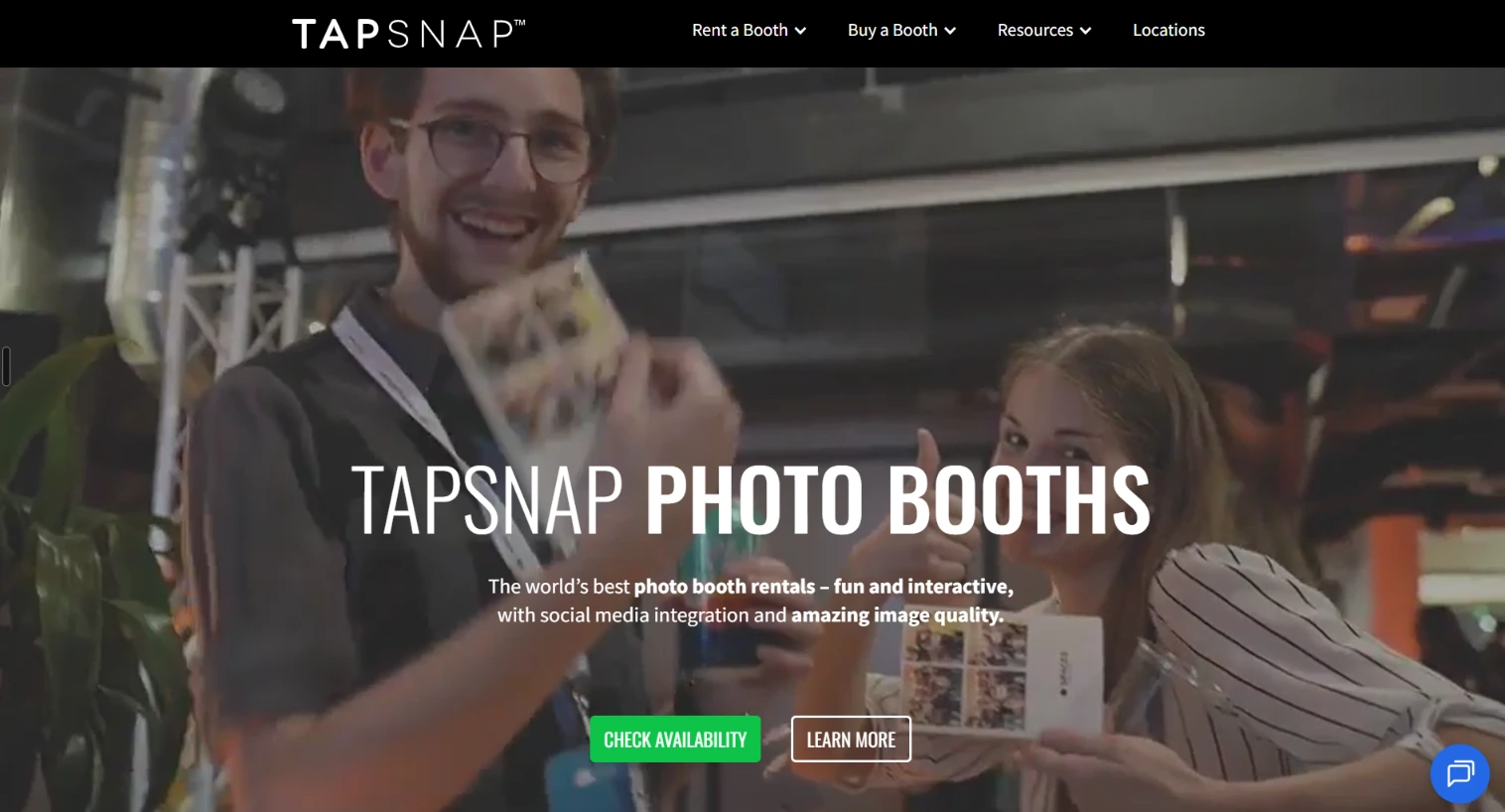
TapSnap operates as a franchise rental network. Founded in July 2012 by Scott McInnes, who drew on 12 years of experience in self-service kiosk technology, TapSnap built its business around attended service.
Source: TapSnap
When you book TapSnap, a professional attendant arrives with the equipment, manages setup and teardown, guides guests, and handles troubleshooting.
The client books, customizes, and shows up. This hands-off model works well for event planners, corporate marketing teams, and couples planning weddings who want reliable execution without learning new technology.
The franchise structure also gives TapSnap geographic reach. With 120+ locations across North America, corporate clients running multi-city activations can work with a single brand while relying on local operators. That consistency across markets is hard for independent operators to match.
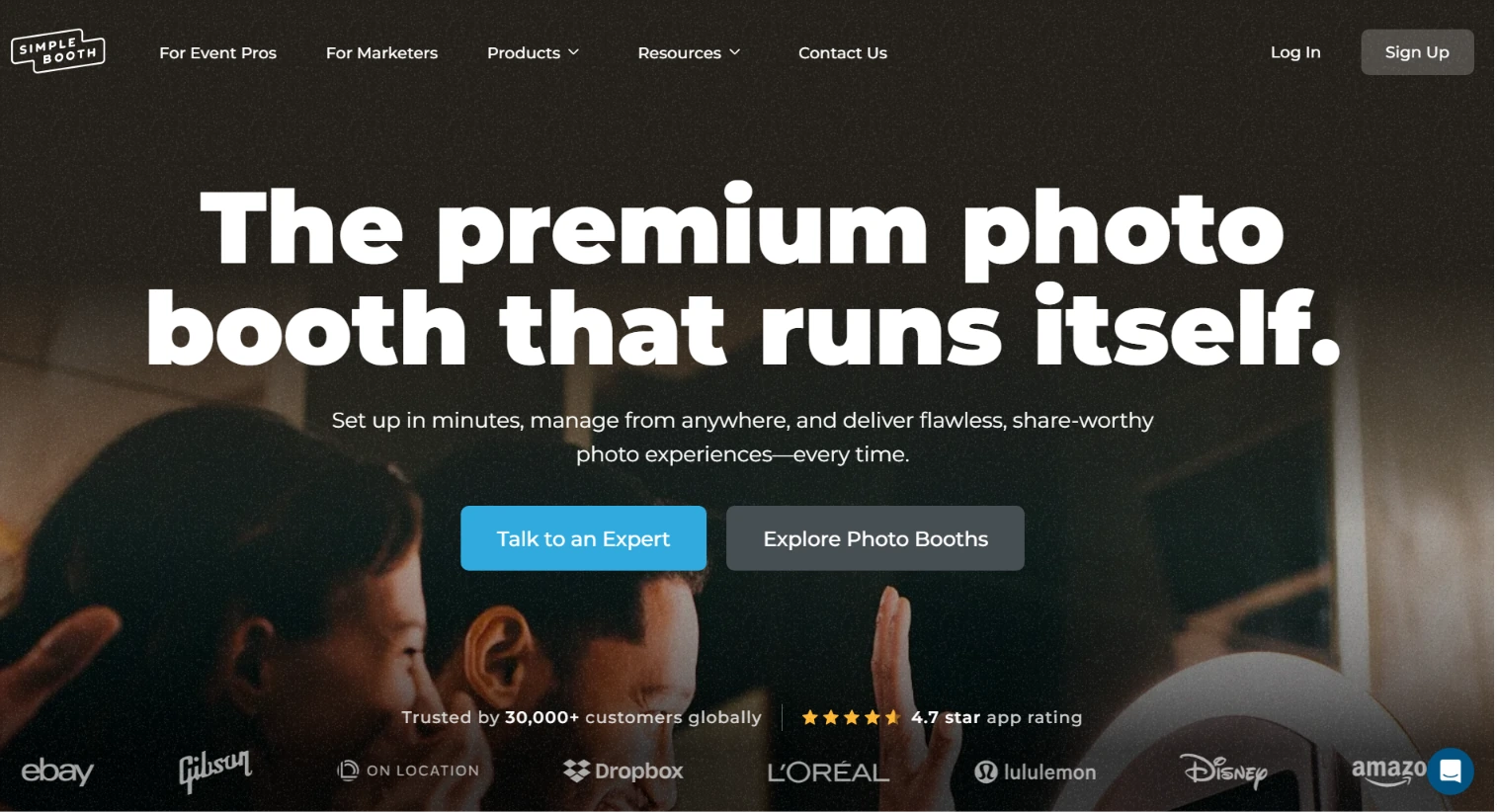
Simple Booth takes a software-first approach. Founded in 2013 by Mark Hennings, a wedding videographer who taught himself app development and built one of the first photo booth apps for live events, Simple Booth puts the operator in full control.
Source: Simple Booth
You buy or subscribe to the software, purchase the HALO hardware kit, and run the booth yourself. Settings sync from the online dashboard to the iPad, presets update remotely, and the app handles everything from capture to photo delivery without an attendant.
This self-service model favors photo booth rental companies, DJs, photographers, and venue operators who want to own their equipment and scale independently. No franchise fees, no per-event quotes, no dependency on someone else’s schedule. The trade-off: you manage the operation yourself.
The distinction shapes everything else: pricing, features, support, and who each platform serves best.
Hardware: Touchscreen booth vs iPad ring-light system
TapSnap offers three booth formats designed for different venue scenarios:
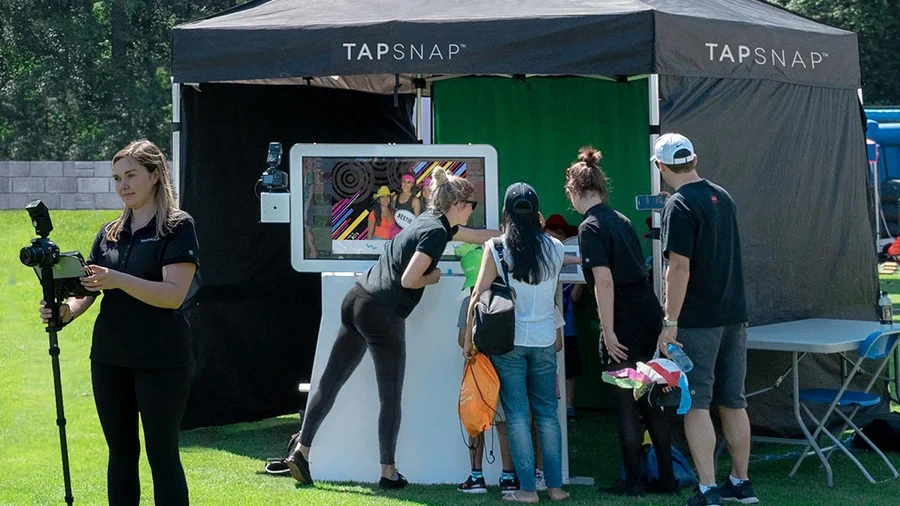
- TapSnap 42: The flagship unit with a 42-inch interactive touchscreen, professional DSLR camera, digital props with screenwriting (guests hand-write messages via an external keyboard), and on-site printing.
The assembled unit fits within a 24” x 20” footprint and stands approximately 70” tall, weighing around 50 lbs.
- The Studio: A compact version with a 12-inch touchscreen and the same DSLR camera, designed for space-restricted venues. It can run in self-service mode without an attendant.
- Mobile Photo Studio (MPS): A battery-powered, LTE-connected roaming unit with a 10-inch touchscreen. An attendant carries it through the event to capture candid shots on a golf course, festival, or convention floor, without needing Wi-Fi or a power outlet.
Source: TapSnap
The three-tier lineup lets TapSnap cover an entire event with both stationary and roaming capture. The MPS can pair with a stationary TS42 or Studio so guests captured while roaming can still pick up prints at the main booth.
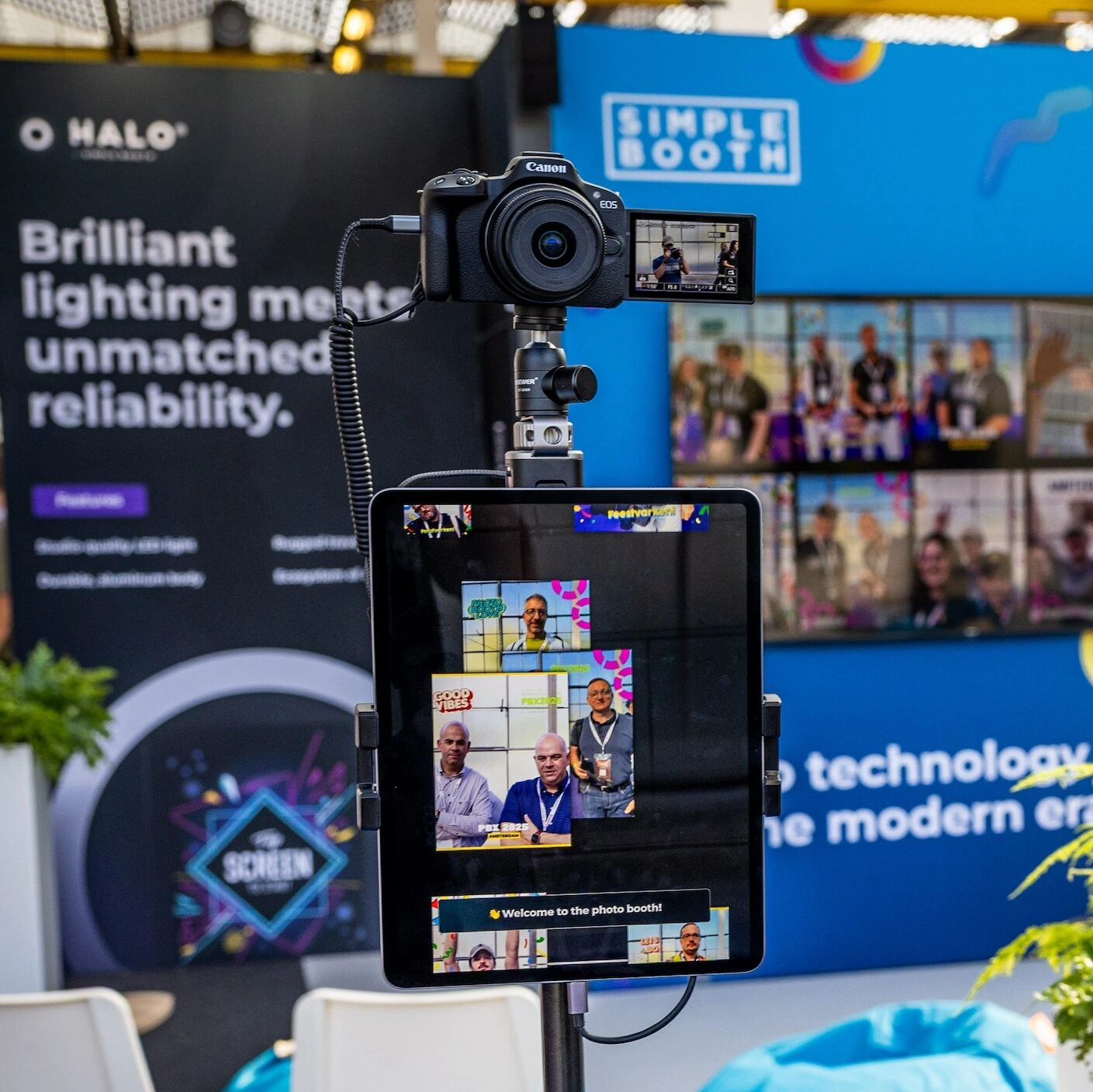
Simple Booth centers on the HALO hardware kit: a ring-light chassis machined from a single billet of anodized aluminum with a patented ring-light system.
The ring contains 112 LEDs producing up to 2,100 lumens, rated for 50,000 hours of operation, with a diffuser that illuminates groups 6 to 8 feet back from the camera.
HALO ships in two configurations: the Event Kit with an adjustable selfie stand and waterproof rolling travel case (49 lbs total), and the Install Kit with a steel wall mount for permanent venues.
The iPad snaps in via a tool-less faceplate and charges through a concealed built-in USB-C cable. Setup takes under one minute with no tools required.
For operators who want higher image quality, HALO 5.0 added Canon and Sony DSLR and mirrorless camera integration (Core plan and above), supporting both wired USB connections for long-event reliability and wireless WiFi connections for flexible setups. Professional-grade capture routes through the full HALO software pipeline.
Source: Simple Booth
The hardware philosophies differ. TapSnap builds around large proprietary touchscreens that double as crowd-drawing displays. Simple Booth builds around an iPad paired with studio-grade lighting in a portable, durable shell. TapSnap’s variety covers more venue scenarios out of the box; Simple Booth’s focus on the HALO means simpler, faster setup with a smaller footprint.
“It paid for itself pretty quickly. Now it’s just extra money coming in.” (Kurt Nielson Photography)
Software and creative features
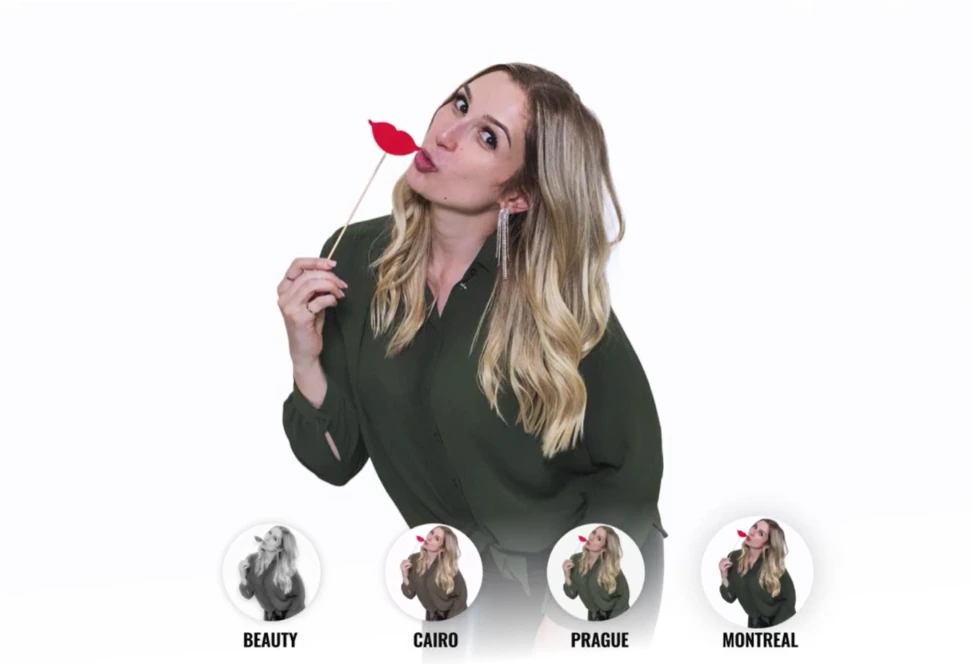
TapSnap’s creative toolkit is built around its touchscreen interface. Guests choose from green screen backgrounds (built-in library plus custom designs), drag-and-drop digital props, and creative filters including Prague, Cairo, and Montreal color treatments and the Beauty Mode black-and-white effect.
Source: TapSnap
Animation options include animated GIFs from 4-photo bursts, animated-background GIFs, and SnapBack (Boomerang-style) looping. Photo collages combine multiple captures into templated layouts.
On the TS42, guests can hand-write messages directly on the 42-inch touchscreen, a creative option unique to that model.
TapSnap’s in-house design team creates custom overlays, green screen backgrounds, and digital prop sets for each event, removing the design work from clients.
Where TapSnap’s creative suite shows its age is in the absence of AI features. The rental product line does not include AI photo transformation, AI background replacement without a green screen, or generative design tools.
Simple Booth’s software takes a different direction, emphasizing operator control and AI capabilities.
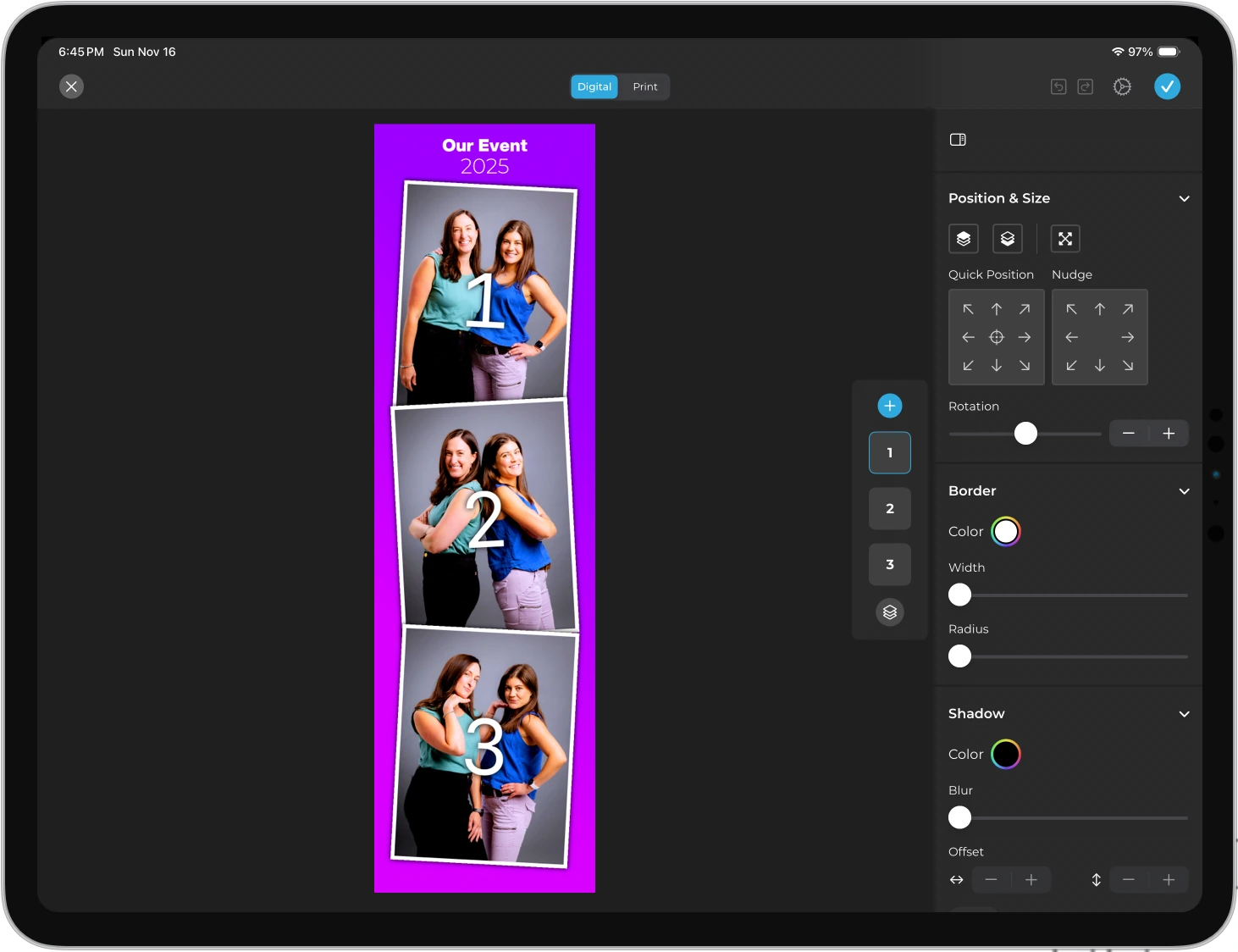
The Layout Designer, introduced in HALO 5.0, is a full in-app design tool with layers, fonts, gradients, logo placement, QR code embedding, and multi-layout support. Operators build their own templates without external graphic design software.
Source: Simple Booth
The AI Effects suite transforms captured photos using text prompts via three Nano Banana AI models, each balancing speed, quality, and group size.
The platform preserves guest identity automatically so guests remain recognizable regardless of how extreme the transformation is.
Operators can test prompts without consuming credits, and unique AI prompts can be assigned to each individual frame in a multi-frame layout for narrative strips.
Beyond AI effects, Simple Booth includes background replacement without a green screen, background blur and bokeh, Glam skin smoothing, 60+ themes and 100+ digital props, and guest-editable text layers (Plus+ and above) where participants type names or captions directly onto their photo before sharing.
Capture modes span still photos, classic photo strips, custom layouts, GIFs, looping Rebound clips, and full-length video (5 to 120 seconds on Core+).
The software gap is clear: TapSnap relies on proven creative tools (green screen, props, filters) delivered through attended service. Simple Booth pushes into AI transformation, self-service design tools, and operator-managed customization. If your events depend on green screen backgrounds with attendant support, TapSnap delivers that reliably. If you want AI effects, in-app design tools, and the flexibility to run unattended, Simple Booth is ahead.
Marketing tools and data capture
Both platforms turn photo booth engagement into marketing data, but the depth and automation differ.
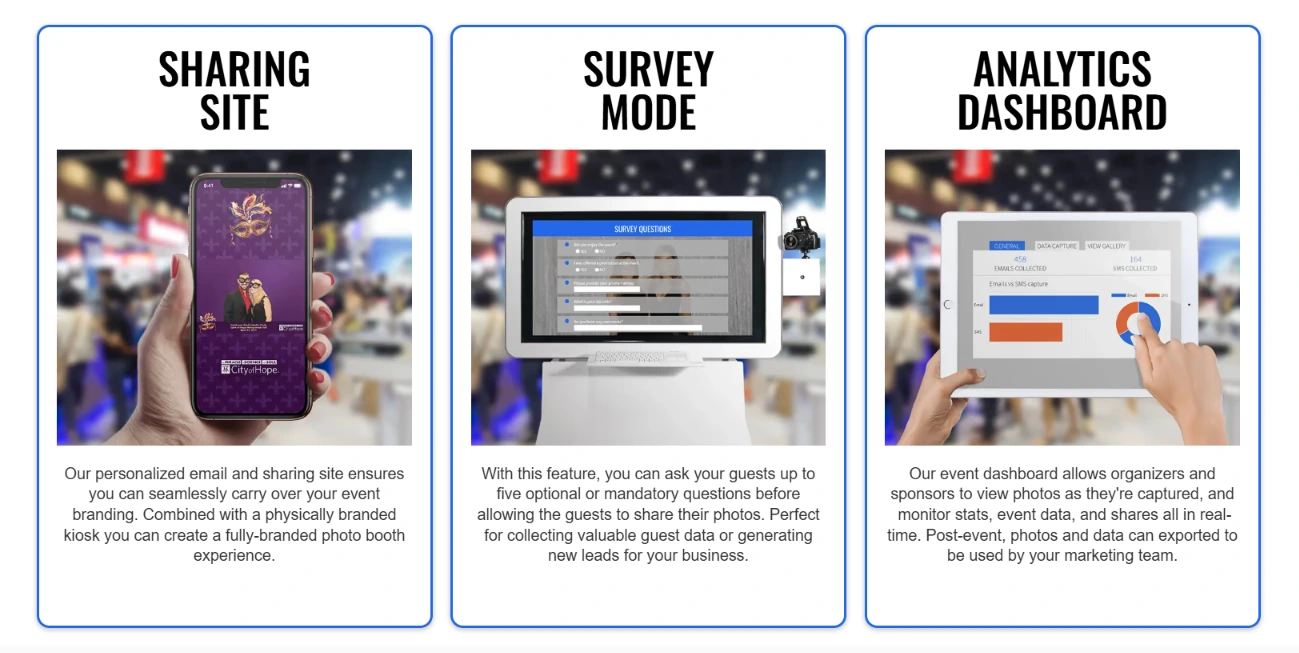
TapSnap provides a Survey Mode with up to five custom questions that gates the share flow, a data capture feature for lead generation, and a real-time analytics dashboard where organizers and sponsors can monitor photos captured and shares as they happen.
Source: TapSnap
Post-event, photos and data can be exported for the marketing team.
SnapCast broadcasts live booth photos to venue TVs and projection screens, creating a feedback loop: guests across the room see photos appearing and come to the booth.
The branded Sharing Site carries event graphics through the digital share experience, and guests share to Facebook, Instagram, Twitter, and email.
The limitations surface in automation and integration. TapSnap’s survey mode caps at five questions.
There are no documented CRM integrations (Salesforce, HubSpot, Marketo, or similar), and no public API or webhook system for routing lead data to external platforms automatically. Data leaves TapSnap through manual export.
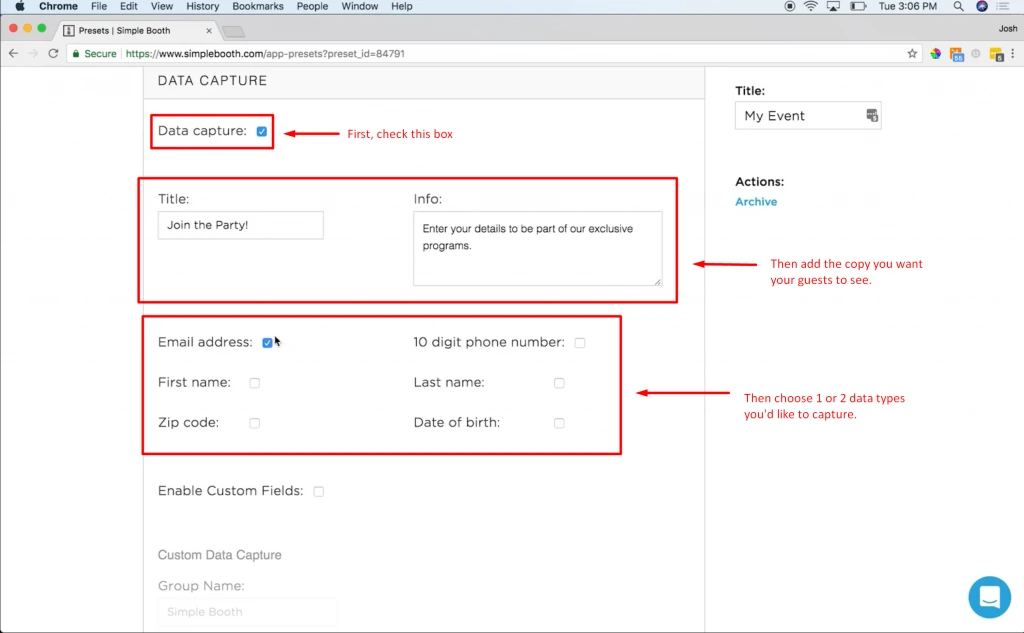
Simple Booth builds data capture into the photo experience. The lead capture form appears during the booth flow, collecting data as a natural part of receiving a photo rather than as a separate ask. The platform reports opt-in rates as high as 87 to 89% across deployments.
 *Source: [Simple Booth](https://www.simplebooth.com/blog/how-to-capture-customer-data-for-marketing/?srsltid=AfmBOooNTqAXh9Zpewue82B39L1gCCQw4CMM9WWeXTnOBmi1VJesAzIj)*
 The Pro plan supports 6 standard fields (email, first name, last name, phone, postal code, date of birth), and the Select plan extends to 10 custom fields including checkboxes and required legal terms.
Data syncs natively to MailChimp without developer involvement, and the Open API (Pro+) enables CRM delivery to any external system.
Simple Booth’s analytics dashboard tracks total participants, uploads, gallery views, social share clicks, and referred views across Facebook, X, LinkedIn, and Instagram.
The Select tier adds demographic insights via face detection (estimated age, gender breakdown, and average group size).
The Live Feed converts any public gallery into a real-time slideshow for TV or projector display, serving a similar function to TapSnap’s SnapCast.
Photo delivery options include QR code, email, SMS, AirDrop, and WhatsApp, with WhatsApp added in HALO 5.0 for international deployments.
Gallery privacy levels (Public, Unlisted, Private) give operators control over visibility, and brand moderation on Pro and Select lets operators approve photos before delivery or gallery display.
For marketing teams that need post-event data to flow into existing workflows automatically, Simple Booth’s API and MailChimp integration give it a clear advantage over TapSnap’s export-only approach.
“Treetop Golf built 150,000 unique email addresses across locations using Simple Booth’s lead capture.” (Simple Booth)
Virtual booth: Browser-based experiences compared
Both platforms offer virtual photo booths that run in a browser without hardware, but they differ in pricing, features, and how they fit into the broader platform.
TapSnap’s Virtual Booth is priced per event across three tiers: Starter ($199/4 hrs, $250/8 hrs), Pro ($299/4 hrs, $350/8 hrs), and Enterprise ($399/4 hrs, $450/8 hrs).
Guests access a branded URL, snap a photo using their device’s camera, apply frames and stickers, replace their background using AI-powered removal, and type a guest message of up to 50 characters in a handwritten font on a Polaroid-style frame. A 4-Pose GIF mode compiles four poses into an animated GIF.
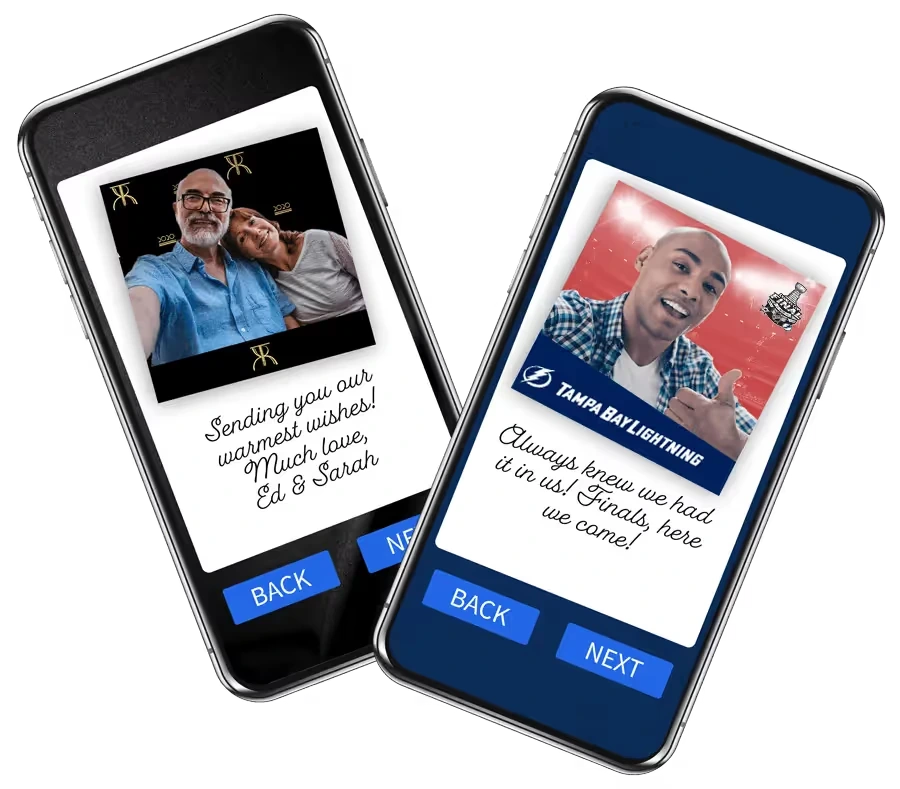
Source: TapSnap
The Enterprise tier includes a Sponsorship Page, a customizable endpoint linking to a sponsor’s website, donation page, or shop. TapSnap offers white-label capability that removes all TapSnap branding. Extended duration packages are also available (24 hours at $450, 1 week at $650, 1 month at $950).
Simple Booth’s Virtual Booth is included with Core subscriptions and above, not priced per event. Operators can run any number of concurrent events under one account.
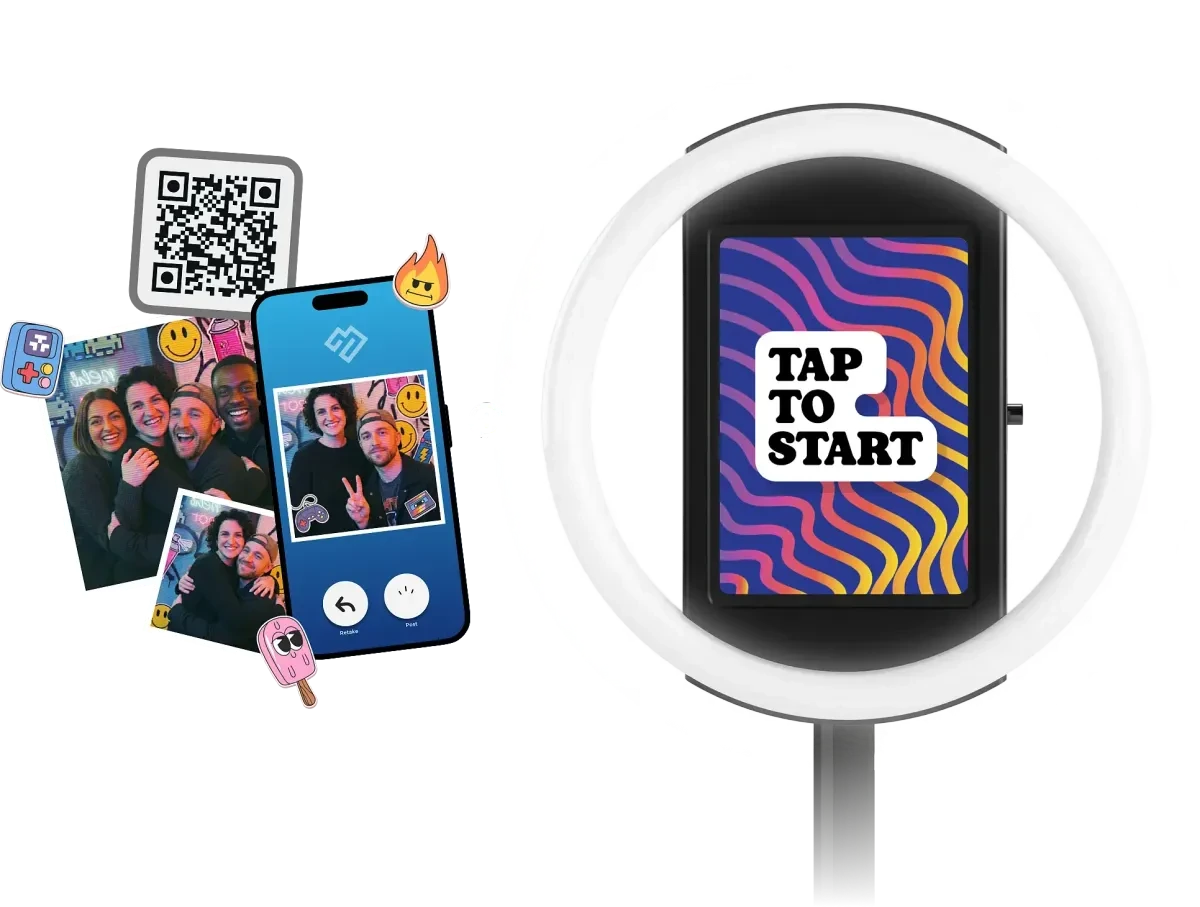
Source: Simple Booth
Features include Magic Background Replacement (no green screen required), overlays and drag-and-drop stickers, and the same AI Effects available in the HALO app.
The Guest Input system injects participant responses into AI prompts as template variables, producing personalized AI-generated photos per guest.
Virtual Booth automatically localizes into English, Hebrew, Spanish, Polish, Italian, German, French, Dutch, and Danish based on browser language.
Data capture fields are configurable, and all submissions flow into Simple Booth’s centralized analytics alongside HALO sessions. Brands running hybrid events can operate physical HALO kiosks and Virtual Booth at the same time, with all photos feeding a single gallery.
Simple Booth’s inclusion model (Virtual Booth comes with the subscription) costs less for operators who run frequent virtual or hybrid activations. TapSnap’s per-event pricing works for occasional use but adds up fast for recurring campaigns.
Pricing and business model
The pricing comparison reflects the core difference in how each company operates.
TapSnap uses a quote-based rental model. According to the franchise page, operators typically charge $300–$450 per hour for events. This includes the booth hardware, a professional attendant, unlimited prints, setup, and teardown.
The actual rate varies by location, event length, and customizations. No pricing page exists; every inquiry requires a quote.
For those who want to own a booth, TapSnap’s Luna hardware line ranges from $2,495 (Luna Go) to $8,750 (The Luna), with free lifetime software updates, lifetime 24/7 technical support, and free shipping. Luna software runs on a monthly subscription (price not publicly disclosed).
For franchise ownership, startup costs begin at well under $30,000 with in-house financing available.
Simple Booth uses a transparent subscription model. Plans scale by feature depth, not by event count or photo volume:
| Plan | Weekly | Monthly | Annual | Key Additions |
|---|---|---|---|---|
| Lite | $14.99 | $29.99 | $289.99 | Basic capture and delivery; ads shown (personal use) |
| Core | $24 | $49 | $490 | Ads removed, DSLR support, video, background tools, Virtual Booth, AI effects |
| Plus | $49 | $99 | $990 | Custom branding, analytics, guest-editable text, custom AI effects |
| Pro | — | $149 | $1,490 | Lead capture, API access, phone support, moderation, age gate |
| Select | — | $249 | $2,490 | Custom legal terms, security questionnaires, demographic analytics |
Each plan includes one device license. Additional devices require add-on licenses at a discount. AI effects consume credits at $0.10 per credit, with bonus credits on new subscriptions (50 to 200 depending on tier). Purchased credits do not expire.
HALO hardware kits start at approximately $2,090 for the Event Kit with iPad and Simple Care protection. 0% financing is available. A 7-day free trial lets operators test the software before committing.
The weekly billing option matters for rental operators with variable event volume. An operator who runs 10 events per month might subscribe weekly only during active periods, while a permanent venue installation benefits from the annual rate.
This flexibility doesn’t exist in TapSnap’s rental model, where costs are tied to event bookings.
For a photo booth business doing 4 to 8 events per month, Simple Booth’s Core plan at $49/month (plus the hardware investment) costs a fraction of what a single TapSnap rental event charges. The trade-off: Simple Booth operators handle setup and operation themselves.
Support and operational reliability
TapSnap includes a professional attendant with every rental, which eliminates most operational concerns for the end client.
Behind the scenes, TapSnap maintains business-hours tech support (Monday–Friday, 8am–5pm PST) and a separate after-hours emergency line at 866-990-2115 for live event issues.
Franchisees access a dedicated operator resource portal with setup videos, software training, printer guides, connectivity checklists, and graphics templates.
TapSnap’s connectivity guidance is practical: the company recommends purchasing a dedicated mobile cellular hotspot rather than relying on venue Wi-Fi, specifying minimum 2 Mbps / 2 GB per event data requirements. This specificity reflects a decade of franchise field experience.
Simple Booth tiers its support by plan: 7-day support (email/chat) on Lite, email and chat on Core/Plus, phone support on Pro, and a dedicated account manager on Select.
The platform compensates for the absence of an on-site attendant with reliability features: the Preflight Check screen catches configuration issues before each event, and Mission Control (triggered by a two-finger pinch) lets operators monitor device health and adjust settings without breaking the guest experience.
The offline upload queue stores sessions when connectivity drops and delivers automatically when the connection returns. For venues with unreliable Wi-Fi, this is a safeguard that TapSnap’s internet-dependent system does not offer.
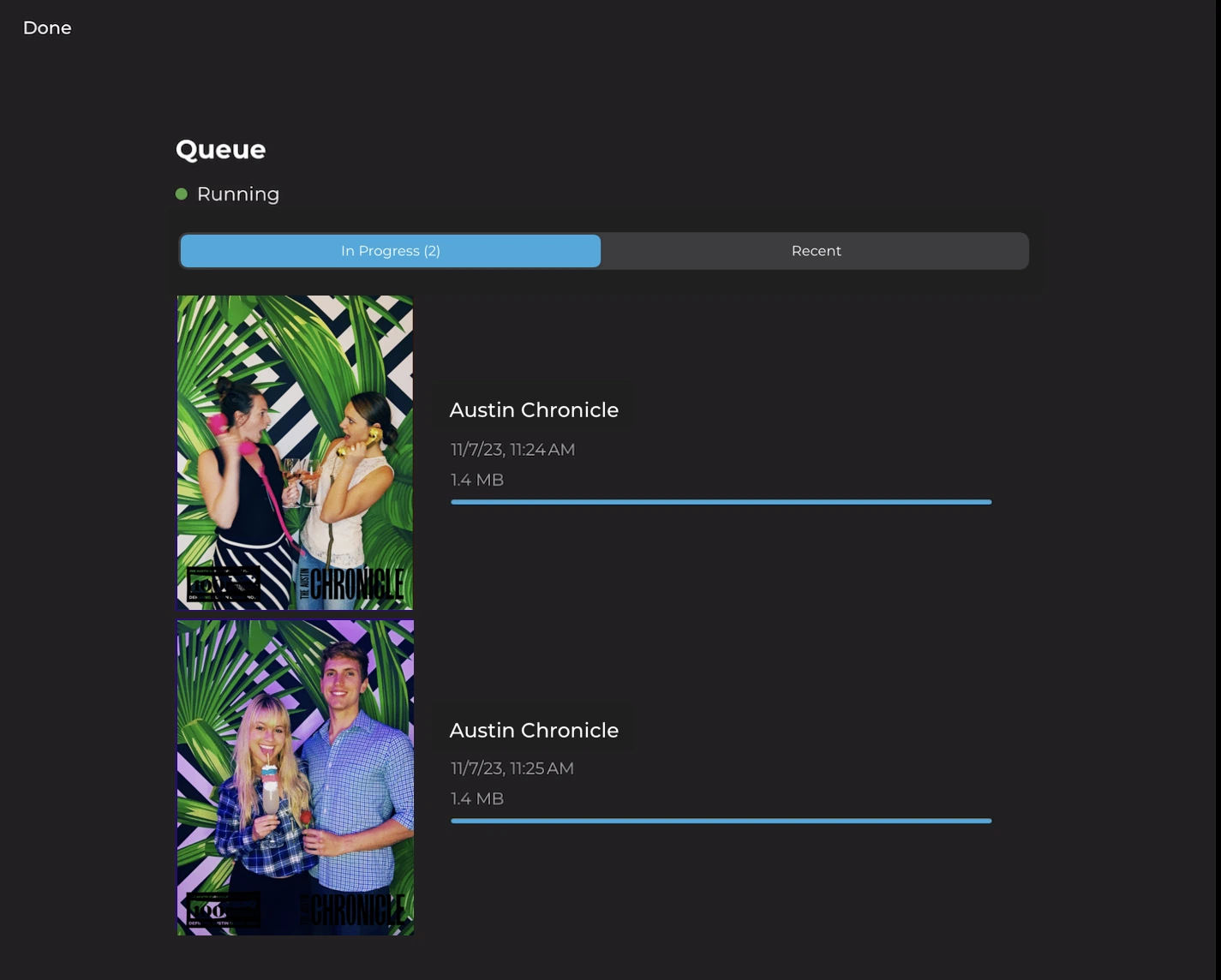
Source: Simple Booth
Documentation includes a 148+ article Help Center, a sequenced Start Guide, and a 5.0 Transition Guide with an AI assistant for natural language queries.
The HALO hardware comes with an optional $299 Simple Care protection plan covering 2 years of warranty and 2 accidental damage repairs.
One area where Simple Booth shows vulnerability: App Store reviews document occasional bugs after software updates, with one reviewer citing four events disrupted by post-update issues. Simple Booth advises disabling auto-updates as a precaution, which adds an operational step that shouldn’t be necessary.
“I knew nothing about photo booths when we started.” Amore Entertainment launched during COVID and scaled to multiple booths using Simple Booth. (Simple Booth)
Simple Booth vs TapSnap: Which should you choose?
The choice depends on what role you play in the photo booth market and how much control you want over the experience.
Choose TapSnap if:
- You’re an event planner or corporate marketing team that wants a managed photo booth rental with no equipment to learn or maintain
- You need multi-city event coverage with consistent quality through a single vendor’s franchise network
- Professional on-site attendant service is a requirement for your events
- Unlimited on-site printing is important for your guest experience
- You’re evaluating a franchise business opportunity in the photo booth industry
- Your events are concentrated in North American metro areas where TapSnap has franchise coverage
Choose Simple Booth if:
- You’re building or growing a photo booth rental business and want to own your equipment and software
- You want AI-powered photo effects, a built-in layout designer, and features that keep your offering current
- Flexible subscription pricing (weekly to annual) matters more than per-event rental costs
- You need data capture with high opt-in rates and automated CRM sync via MailChimp or API
- Your business model requires unattended operation or remote booth management across multiple locations
- You want a Virtual Booth included in your subscription for hybrid or always-on activations
- International photo delivery (WhatsApp, multi-language Virtual Booth) is relevant to your market
Start with Simple Booth’s 7-day free trial to test the platform before committing.
The photo booth market has room for both models. TapSnap serves buyers who want a vendor they can hand off to completely, backed by a nationwide franchise network and a decade of attended-service experience. Simple Booth serves operators who want to build their own business on a platform they control, with software advances (AI effects, Layout Designer, Virtual Booth) and pricing flexibility that a franchise model cannot match.
The question isn’t which platform is better overall. It’s whether your situation calls for a full-service rental vendor or a self-service platform you run yourself. For event planners booking a one-time corporate activation, TapSnap’s attended service removes risk. For photo booth operators building a repeatable business, Simple Booth delivers more control, more features, and a lower cost per event.
“10+ years, we’re big Simple Booth believers.” G7 Entertainment Marketing has captured 136,000+ fan interactions on the platform. (Simple Booth)
Simple Booth vs TapSnap FAQ
What is the main difference between Simple Booth and TapSnap?
Simple Booth is a self-service photo booth software platform paired with proprietary HALO hardware, designed for operators who want to own and run their own photo booth business.
TapSnap is a franchise-based rental network with over 120 locations across North America, providing full-service attended photo booth rentals. Simple Booth sells to operators; TapSnap sells to end clients through its franchise network.
How do Simple Booth and TapSnap compare on pricing?
Simple Booth uses a transparent subscription model starting at $49/month (Core plan) with no per-event fees and no caps on photos or events.
TapSnap charges rental rates of approximately $300–$450 per hour through its franchise network, with pricing available only through custom quotes.
For someone running their own photo booth business, Simple Booth’s subscription model costs far less per event.
Does TapSnap offer AI photo effects like Simple Booth?
TapSnap’s rental product line does not include AI-powered photo transformation. Its creative features focus on green screen backgrounds, digital props, creative filters, and animated GIFs.
Simple Booth offers built-in AI Effects with three models that transform captured photos using text prompts, plus AI background replacement without a green screen and AI-generated layout graphics.
Can I run a Simple Booth without an attendant?
Yes. Simple Booth is designed for unattended operation, with features like a Preflight Check screen, Mission Control for remote monitoring, iPad Guided Access to prevent guests from leaving the app, and an offline upload queue for venues with spotty connectivity.
TapSnap includes a professional attendant with every rental, which eliminates setup and troubleshooting concerns but adds to the service cost.
Which platform has better data capture for marketing?
Simple Booth offers stronger data capture, collecting up to 10 custom fields on its Select plan with opt-in rates as high as 87 to 89%. Data syncs natively to MailChimp and can route to any CRM via the Open API on Pro and Select plans.
TapSnap’s Survey Mode is limited to 5 questions and offers manual data export only, with no documented CRM integrations or API access.
Does TapSnap sell hardware for businesses that want to own a booth?
Yes. TapSnap’s Luna product line sells directly to businesses, with hardware starting at $2,495 for the Luna Go and going up to $8,750 for The Luna.
Purchases include free lifetime software updates, lifetime 24/7 technical support, and free shipping. The Luna iPad App runs on a monthly subscription priced separately from the hardware.
Which platform supports international events better?
Simple Booth has broader international support. HALO delivers photos via WhatsApp (added in the 5.0 update) alongside QR code, email, SMS, and AirDrop.
The HALO hardware supports dual voltage (110V–240V) for international power compatibility. Virtual Booth automatically localizes into nine languages.
TapSnap’s franchise network covers North America only, and its photo delivery relies on email, SMS, and social media without WhatsApp support.
Can I use either platform for virtual or hybrid events?
Both offer browser-based virtual booth products. Simple Booth’s Virtual Booth is included with Core subscriptions and above at no additional per-event cost, supports unlimited concurrent events, and shares analytics with the HALO app for hybrid deployments.
TapSnap’s Virtual Booth is priced per event starting at $199 for four hours, with add-ons like AI background removal sold separately as credits.
Keep reading
 Showdowns
Simple Booth vs Darkroom Booth: Which Photo Booth Software Fits Your Business in 2026?
iPad turnkey vs Windows DSLR veteran. Simple Booth or Darkroom Booth?
 Showdowns
Simple Booth vs Flassh: Which Photo Booth Platform Fits Your Events in 2026?
Integrated system vs speedy setup. Simple Booth or Flassh?
 Showdowns
Simple Booth vs LumaBooth: Which Photo Booth Software Fits Your Business in 2026?
Turnkey hardware vs budget cross-platform app. Simple Booth or LumaBooth?